


In the competitive global inflatable SUP wholesale and retail market spanning Spain, the broader EU, North America, Canada, and Australia, most B2B distributors, sports gear retailers, and new category developers struggle with one core problem: low net ROI stemming from unscientific bulk ordering and chaotic SUP inventory management, rather than fierce end-customer price competition. Many SUP wholesalers blindly chase low factory unit prices, overstock slow-moving SUP SKUs during peak seasons, ignore hidden logistics, compliance, and capital occupancy costs, and eventually face massive off-season inventory depreciation and profit erosion.
Working as a professional inflatable SUP manufacturer with years of B2B overseas service experience, RIDEWAVE has collaborated with hundreds of global SUP distributors to summarize a set of practical, market-verified procurement and inventory strategies tailored for cross-border SUP businesses. Unlike theoretical industry guides, this actionable framework combines 2026 international industry hotspots including EU sustainability regulations, fluctuating ocean freight costs, and regional seasonal consumption differences, helping B2B buyers lock in stable profit margins while eliminating inventory risks.
For brands planning private-label SUP expansion or customized SUP product upgrades, understanding the full production logic behind qualified retail-grade boards is the premise of low-risk bulk procurement - How Custom Paddle Boards Are Made: From Design To Production breaks down every critical production detail that determines your SUP product quality and market competitiveness.
This comprehensive guide will answer all core questions global SUP B2B buyers care about: how to avoid Spanish regional market risks, calculate real SUP wholesale ROI, select high-turnover inflatable SUP SKUs, build scientific seasonal inventory plans, and track core operational KPIs. Every strategy and data template shared in this article is derived from real RIDEWAVE B2B distributor cooperation cases and overseas market landing experience, ensuring 100% practicality for your SUP category expansion and profit improvement.
What market risks shape inflatable SUP ROI for Spanish retailers in 2026?
The biggest ROI risks for Spanish SUP retailers come from seasonal demand volatility, EU sustainability rules, port & freight cost swings, and consumer shift to durable inflatable SUP rather than cheap disposable models. Many wholesalers only focus on peak summer sales and overlook these layered risks, which quietly eat away profit margins before the selling season even ends.

Spain's coastal tourism and outdoor recreation market is heavily seasonal, and this pattern dictates every part of your SUP inventory planning. Mediterranean coastal towns see most water sports traffic between April and September, while inland cities have shorter, weaker demand windows. If you place large bulk orders without mapping regional demand, you will end up tying working capital in slow-moving stock that can only be liquidated at steep discounts once autumn arrives.
New EU packaging and plastic regulations also create hidden compliance risk for inflatable SUP importers. Non-compliant packaging, untested raw materials, or incomplete product documentation can trigger customs holds, extra inspection fees, or even rejected shipments at ports like Valencia and Algeciras. These unexpected delays push your goods past the start of peak season and directly hurt your planned ROI.
Freight instability remains another persistent threat for cross-border SUP bulk procurement. Sudden carrier rate hikes, container shortages, or vessel schedule changes can add thousands of euros to your landed cost. Budgeting only for quoted freight rates without building contingency funds is a common mistake among first-time SUP category buyers.
Consumer preference is also shifting in Spain and across EU, Canada, USA and Australia. Shoppers are moving away from ultra-low-cost thin PVC boards that fail after one or two seasons. Today's buyers want reinforced, multi-use iSUP models that support yoga, fishing, family recreation and touring. Stocking outdated, low-durability SKUs increases your return rate and damages your retail brand reputation.
When selecting your product lineup, you need to build your assortment around real end-user demand, not just factory price tags. Our earlier guide breaks down consumer-led product development for water sports gear, How To Design A Paddle Board That Sells, and helps buyers avoid investing in boards that will sit unsold on warehouse shelves.
At RIDEWAVE, our B2B team regularly shares updated regional market intelligence with distributors. We help our partners separate temporary hype from lasting market trends before they commit capital to large inflatable SUP orders. This does not guarantee zero risk, but it reduces blind purchasing decisions that destroy SUP retail ROI.
How should B2B buyers calculate true ROI for bulk inflatable SUP orders?
True SUP wholesale ROI counts not only gross profit margin, but warehouse holding cost, capital interest, obsolescence loss, defective rate, shipping and customs fees. Many distributors only calculate simple sales markup and underestimate hidden costs, leading them to overestimate profit when sourcing inflatable SUP inventory.
A lot of new SUP wholesalers fall into this trap: they compare only factory unit prices and projected retail selling price. This simplified math ignores dozens of ongoing expenses that chip away at returns. Cheap low-grade iSUP may look attractive on the quotation sheet, yet higher defect rates, customer complaints and warranty claims can erase most of your gross margin before the season closes.
Landed cost is the foundation of reliable ROI calculation for cross-border SUP bulk procurement. This number combines factory unit price, export packaging, sea freight, port handling charges, import customs duty, VAT, inspection fees and local last-mile delivery to your warehouse. If you skip any of these components, your entire profit forecast will be unreliable.
Once goods arrive, inventory holding costs start accruing month over month. These include warehouse rent, insurance, product handling, shrinkage and interest on the working capital you used to fund the purchase. Slow-moving inflatable SUP SKUs rack up these charges for months, which is why turnover matters just as much as per-unit profit.
You also need to build a line item for obsolescence and seasonal discount loss. SUP designs, colour trends and consumer preferences shift each year. Boards left unsold after summer will require heavy markdowns, and older stock may become impossible to sell at full price the following year. This write-down must be included in your ROI model.
Quality-related loss is another often-overlooked expense. Even with a trusted supplier, a small percentage of boards can have valve leaks, seam issues or packaging damage during transit. When you compare different inflatable SUP suppliers, always factor in expected defect rates rather than assuming zero product failure.

This ROI framework works for Spanish retailers, and it also applies to distributors operating in the US, Canada, Australia and broader EU markets. If you are preparing to send factory inquiries for your next order, our B2B checklist helps you ask the critical questions before committing funds, 10 Questions Every B2B Buyer Should Ask Before Placing An Inflatable SUP Factory Order.
At RIDEWAVE, our B2B sales team shares a simplified ROI calculator template with our distribution partners. We do not set your profit targets or guarantee margins, but we help buyers map out every cost bucket so they avoid nasty surprises after their inflatable SUP shipment lands.
What bulk procurement rules help Spanish distributors reduce factory & supply chain risk?
Smart bulk procurement does not mean ordering the largest container at once. It means segmented ordering, MOQ negotiation, staggered shipment, supplier quality validation and pre-production sampling to balance unit price and cash risk. Many new SUP wholesalers rush to fill full containers to chase a lower per-unit price, only to find capital locked and no flexibility if local demand shifts.
Segmented ordering is one of the most powerful risk-control tactics for inflatable SUP bulk buyers. Instead of committing your full annual inventory in a single shipment, split orders into pre-season mass stock plus smaller replenishment batches. This method lets you test market feedback with the first shipment before investing heavily in follow-up production, which works especially well for Spanish coastal retail markets with tight seasonal windows.
MOQ negotiation requires careful preparation before contacting any iSUP manufacturer. Factories often set standard minimum order quantities, but terms can shift based on order mix, repeat cooperation, and production scheduling. You should separate core SKUs from niche custom models: high-volume all-round inflatable SUP can meet standard MOQ easily, while low-volume custom printed boards can be negotiated for smaller minimum runs.
Pre-production sampling and formal inspection cannot be skipped, even with long-term factory partners. A signed sample confirms raw material thickness, welding quality, valve fit, printing accuracy and packaging specs. Without this step, you risk receiving goods that do not match your retail requirements, which creates costly delays when selling season is already underway. If private label and custom design are part of your expansion plan

Lead time buffer planning is another often-missed rule for SUP bulk procurement. Production delays, raw material shortages, vessel rollovers and customs inspection hold-ups all extend total lead time. For Spain-based buyers, we recommend building a 3–5 week safety buffer into your timeline, so cargo arrives before April when coastal SUP sales begin to climb.
Payment terms also shape supply chain risk. Avoid paying 100% deposit upfront whenever possible. Reasonable staged payments tie each payment milestone to production progress, sampling approval and loading inspection. This simple arrangement gives buyers leverage if quality or scheduling problems emerge.
At RIDEWAVE, our B2B team helps distributors structure staggered shipment schedules and sample approval workflows for inflatable SUP orders. We do not push customers into over-sized full container loads, and we openly discuss production bottlenecks and realistic lead times so buyers can plan their inventory with clear expectations.
Which inflatable SUP SKUs deliver the fastest inventory turnover for Spanish retail?
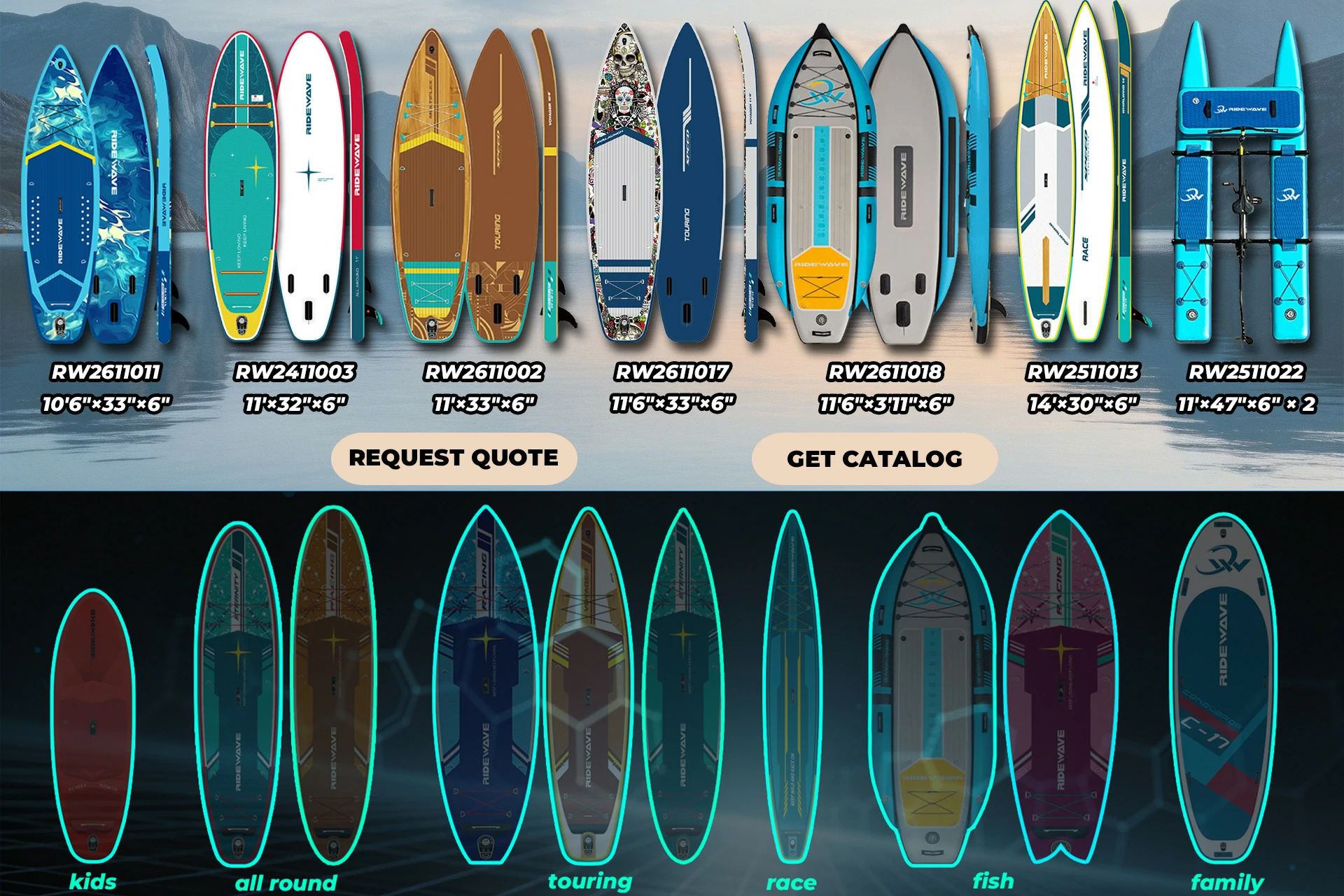
All-round inflatable SUPs remain the highest-turnover SKU for Spain's coastal retail, while niche boards (fishing, yoga, touring) deliver better margin but slower rotation. Successful distributors balance core high-volume SKUs and low-volume high-margin items. Too many niche SKUs tie up capital and increase warehouse complexity, while relying only on one basic board leaves you vulnerable to price competition.
For Spanish coastal shops catering to tourists and local families, all-round inflatable SUP is your foundational SKU. These boards suit beginners, lightweight enough for car transport, and fit lake, river and calm sea conditions. They have the broadest buyer pool across Spain, USA, Canada and Australia, so leftover stock can be redistributed across multiple regional markets if needed.

Fishing iSUP targets dedicated hobbyists. This segment enjoys stronger profit margins, but demand is smaller and more seasonal. Buyers look for extra D-rings, cargo platforms and stable wide decks. This SKU works best as a secondary add-on rather than your main bulk order, to avoid slow-moving inventory.

Yoga and fitness inflatable SUP appeal to wellness-focused consumers, mostly sold to inland fitness studios and beach wellness centres. Their thinner, extra-wide shape targets a narrow audience. While retail markups are attractive, turnover will lag far behind all-round models.

Kids and junior SUP boards serve family package sales. Pairing junior boards with adult all-round models creates bundle deals, lifting average order value for retailers. But children's sizes have size-limited customer groups and should only make up a small share of your bulk purchase.
When building your SKU portfolio, always consider local retail environment. Mediterranean coastal towns prioritize durable all-round boards for tourist rentals and retail sales. Inland Spanish cities sell more yoga and fitness boards. The same logic applies for distributors expanding into Canada, Australia and US inland markets. Your product lineup must match end-user habits, not just your personal preference.
To build a product range that sells consistently, you need to focus on real consumer behaviour rather than trendy gimmicks. Our earlier guide explains consumer-driven product strategy, How To Design A Paddle Board That Sells, helping buyers avoid investing in low-demand novelty SUP designs.
At RIDEWAVE, our B2B team helps distributors create balanced SKU mixes for their territory. We share sales benchmark data from similar EU retail partners, to help buyers decide the ratio between high-turnover core inflatable SUP and high-margin niche boards without overextending inventory risk.
How to build seasonal inventory planning to avoid summer overstock & stockouts?
Spanish SUP sales peak from April to September. Effective inventory planning splits inventory into pre-season stock, safety buffer and late-season small replenishment, to prevent both stockout in high season and heavy liquidation in autumn. Many wholesalers fall into one of two extremes: ordering too little and losing peak-season sales, or ordering too much and being forced to sell leftover inflatable SUP at steep discounts once summer ends.
Your pre-season stock should cover roughly 70% of your projected full-season sales volume. This stock needs to be manufactured and shipped between January and March, to clear customs and reach your warehouse before April. This timing aligns with rising beach tourism and outdoor activity bookings across Spain's Mediterranean coast. Pre-season orders lock in better factory scheduling and often more competitive ocean freight rates.
A safety buffer stock accounts for unexpected demand spikes, delayed replenishment shipments, or minor product damage during transit. This buffer should represent 10–15% of your forecast sales. Do not overinflate this reserve; excess safety stock quickly becomes slow-moving iSUP inventory once peak season fades.
Late-season replenishment is limited to small orders only. From June onward, production and shipping timelines shorten dramatically. Large orders placed after mid-June rarely arrive in time for peak summer sales. If demand exceeds your forecast, only place small top-up orders for your fastest-selling inflatable SUP SKUs.
At the end of each selling season, set clear rules for leftover inventory. Identify slow-moving units early and create bundled promotions, cross-region redistribution or wholesale discounts before autumn arrives. Waiting until October to handle surplus stock drastically reduces your ability to preserve margin, as consumers stop buying water sports gear.

Seasonal forecasting also benefits from multi-market alignment. Distributors selling across Spain, Portugal, Australia or North America can shift excess inflatable SUP inventory between hemispheres, because summer seasons are reversed. This cross-market balancing reduces write-off risk significantly and is a powerful strategy for larger B2B dealers.
Even with careful forecasting, demand will never match predictions perfectly. Market events, weather patterns and tourism volume all shift year over year. RIDEWAVE's B2B team helps partners schedule staggered delivery windows for SUP bulk procurement, giving distributors flexibility to adjust stock levels without committing all capital upfront.
What real results can a Spanish SUP distributor get by applying these procurement strategies?
A Spanish regional sports distributor partnered with RIDEWAVE adjusted bulk ordering and SKU portfolio, cut dead inventory by 32% and lifted annual SUP category ROI in 12 months, the following case details the full operation. This retailer operated physical shops along the Costa Blanca, serving holiday visitors and local outdoor enthusiasts, and they previously ran into the common trap of overbuying low-cost inflatable SUP to chase low per-unit pricing.
Before the partnership, this client purchased one full container of budget-grade iSUP every year. Their order contained too many niche colourways and non-core SKUs. The boards had higher seam failure rates, leading to more customer returns and warranty complaints. At the end of each summer, nearly half of their stock remained unsold, forcing steep autumn markdowns. Inventory turnover sat at only 2.1 per year, and large sums of working capital were locked in unsold inflatable SUP.
Working together with the RIDEWAVE B2B team, they rebuilt their entire procurement and inventory plan. First, they trimmed the SKU list down: 75% of the bulk order focused on durable all-round inflatable SUP, 20% reserved for fishing boards as a high-margin secondary line, and the remaining 5% for junior kid boards. They eliminated low-demand colour options and discontinued the thin budget models with high defect rates.
Instead of one single full-container shipment, they split the purchase into two staggered batches. The first shipment arrived in early March for the start of the tourist season. The second smaller shipment was scheduled for late May, acting as flexible replenishment stock only if retail sell-through hit pre-agreed targets. This approach removed the risk of paying for goods that they could not sell.
They also adopted the ROI calculation method and monthly inventory KPIs we covered earlier. Every month, the team tracked sell-through rate, holding cost and slow-moving SKU ratio. When one fishing board SKU sold slower than forecast, they quickly bundled those units with all-round boards for retail promotions before the end of August.
After 12 months, measurable business improvements appeared. Dead inventory decreased by 32%, inventory turnover rose from 2.1 to 2.9, and net ROI of the SUP category increased notably. Customer complaints dropped significantly because the upgraded inflatable SUP design reduced seam and valve failures. The distributor also saved thousands in warehouse holding costs, as less capital remained trapped in unsold stock.

This case is not a guarantee that every buyer will see identical results. Local tourism volumes, weather and retail competition will change outcomes year over year. Still, it demonstrates how the combination of smart SKU selection, staggered SUP bulk procurement and regular KPI tracking can turn a stagnant SUP category into a profitable part of a sports retailer's business.
What inventory KPIs should SUP wholesalers track month to month?
Three core KPIs decide your long-term SUP retail profitability: inventory turnover rate, holding cost percentage and sell-through rate. Tracking these metrics monthly lets you adjust procurement before slow stock piles up. Many SUP wholesalers only check total revenue and gross profit, ignoring these leading indicators until they face large piles of unsold inflatable SUP.

nventory turnover rate tells you how quickly your stock sells and refreshes within a full year. For inflatable SUP wholesale business, a healthy benchmark sits above 2.8 per year. A value under 1.8 signals serious trouble: capital is trapped, and you carry heavy risk of end-of-season write-downs. This metric is especially critical for seasonal water sports products, because iSUP demand is concentrated within a few summer months.
Sell-through rate measures how much available stock you actually sell within your selling window. For the main summer season, your target sell-through should stay higher than 65%. If it drops below 40% mid-season, you need to act quickly with bundle promotions or redistributing stock to other sales channels. Waiting until autumn will make rescue actions far less effective.
Holding cost ratio calculates how much you spend annually just to store and maintain your inventory. A healthy threshold is under 12% of the total inventory value. When this ratio climbs past 18%, warehousing fees, insurance and capital interest start eating most of your gross profit on inflatable SUP sales.
One supporting metric to monitor is slow SKU ratio. This tracks what percentage of your product lines remain unsold after 12 months. Aim to keep this number below 10%. Any SKU sitting unsold for a full year loses market freshness, colour appeal and resale value.
These KPIs work together rather than in isolation. High sell-through means nothing if turnover remains low. Strong turnover will not protect your margin if holding costs spiral upward. Wholesale buyers should build a simple monthly tracking sheet and review data at fixed meetings, instead of reviewing numbers only once at year-end.
At RIDEWAVE, we share this KPI framework with our B2B partners. We do not manage our customers' inventory for them, but we help buyers understand how these metrics connect to their inflatable SUP bulk order decisions. With consistent monthly tracking, you spot small negative trends before they turn into expensive inventory crises.
| KPI | Formula | Healthy Benchmark for iSUP | Warning Threshold |
|---|---|---|---|
| Inventory Turnover | Annual sold units / average stock units | ≥2.8 per year | <1.8 |
| Sell-through Rate | Sold units / beginning stock | >65% within selling season | <40% |
| Holding Cost Ratio | Annual inventory cost / inventory value | <12% | >18% |
| Slow SKU Ratio | SKUs unsold after 12 months / total SKUs | <10% | >20% |
What final checklist should B2B buyers use before locking a bulk SUP factory order?
Before confirming bulk inflatable SUP production, buyers need to verify compliance documents, sample quality, after-sales warranty, shipment terms and contingency plan for delays. Skipping any of these checks may lead to costly surprises once production begins. Even distributors with years of SUP wholesale experience should run through this checklist before signing off a large inflatable SUP order.
Start by validating all compliance documentation required for your target import market. For Spain and EU territories, this includes CE certification, REACH material test reports, product safety files and packaging declarations. For shipments heading to USA, Canada and Australia, separate safety and import documentation standards apply. Missing or outdated certificates can result in customs detention at port, which can make your iSUP shipment miss the summer selling window entirely.
Next, double-check pre-production samples against the final approved spec sheet. Confirm raw material thickness, drop stitch quality, air valve type, seam welding, printing graphics and packaging. Sign and archive the approved sample before mass production starts. If any changes are requested after sampling, update written specifications, do not rely only on verbal communication with the factory.
Review warranty and after-sales terms in writing. Clarify what defects qualify for factory support, defect replacement window, spare parts supply policy and who bears freight cost for replacement components. Cheap inflatable SUP suppliers often offer vague warranty clauses, leaving distributors covering all repair and return expenses by themselves.
Confirm shipment terms and contingency schedule. Lock down loading date, vessel cutoff, port of loading and destination port. Discuss backup plans for raw material shortage, production hold-ups or vessel rollover. Agree staggered shipment schedules in written contract if you are splitting your SUP bulk procurement into multiple batches.
Confirm payment milestones, and avoid full prepayment before goods are loaded. Match each payment step with completed deliverables: sample approval, production photo inspection, loading inspection. Negotiate terms to retain leverage if quality or schedule deviates from the contract.
You should also confirm spare accessory packing. Paddles, hand pumps, repair kits and shoulder straps are common bundled accessories for retail inflatable SUP. Confirm accessory quantity and quality standard in advance, because incomplete accessory kits create many post-delivery customer complaints.
At RIDEWAVE, our B2B team walks every new customer through this pre-order checklist before mass production begins. We share all compliance files upfront, document sample approvals clearly, and put warranty and shipment terms in written agreements. Our goal is not to push fast order confirmation, but to help buyers remove avoidable risks before committing capital to inflatable SUP bulk production.
To maximize ROI for your inflatable SUP retail business, low factory price should never be your only target. The highest profits come from balanced bulk procurement, carefully planned seasonal inventory, accurate ROI calculation, regular KPI tracking and strict pre-order quality and compliance checks.
Spanish, EU, Canadian, US and Australian B2B distributors all face similar challenges: short summer selling seasons, freight volatility, changing consumer preference and costly overstock risks. The strategies covered in this guide are built for these exact challenges. By splitting shipments, selecting the right mix of high-turnover and high-margin iSUP SKUs, and measuring inventory performance every month, you can reduce trapped capital and raise your SUP category profitability steadily.
RIDEWAVE works as a inflatable SUP manufacturer focused on long-term B2B partnerships rather than one-off large orders. Our B2B sales team supports distributors with sample validation, compliance documents, staggered shipment scheduling and market trend insights. We do not guarantee sales volume or profit, but we help you build a more resilient SUP supply chain.
If you want to review your current SUP procurement and inventory strategy with our team, reach out for a free B2B consultation.
Related Articles
How Spanish SUP Distributors Avoid Bulk Quality Inconsistency & Reputation Risks in 2026
SUP B2B Sourcing Guide: Cut Spain Import Logistics Costs & Shorten Lead Times
Why Premium Inflatable SUPs Boost Spanish Retailers' Off-Season Sales & Profit Margins
MSL Fusion Vs Single-Layer SUP: Which Construction Suits Spanish B2B Bulk Orders?
Solve Spanish SUP B2B Pain Points: Stable QC, On-Time Delivery & Local After-Sales Support