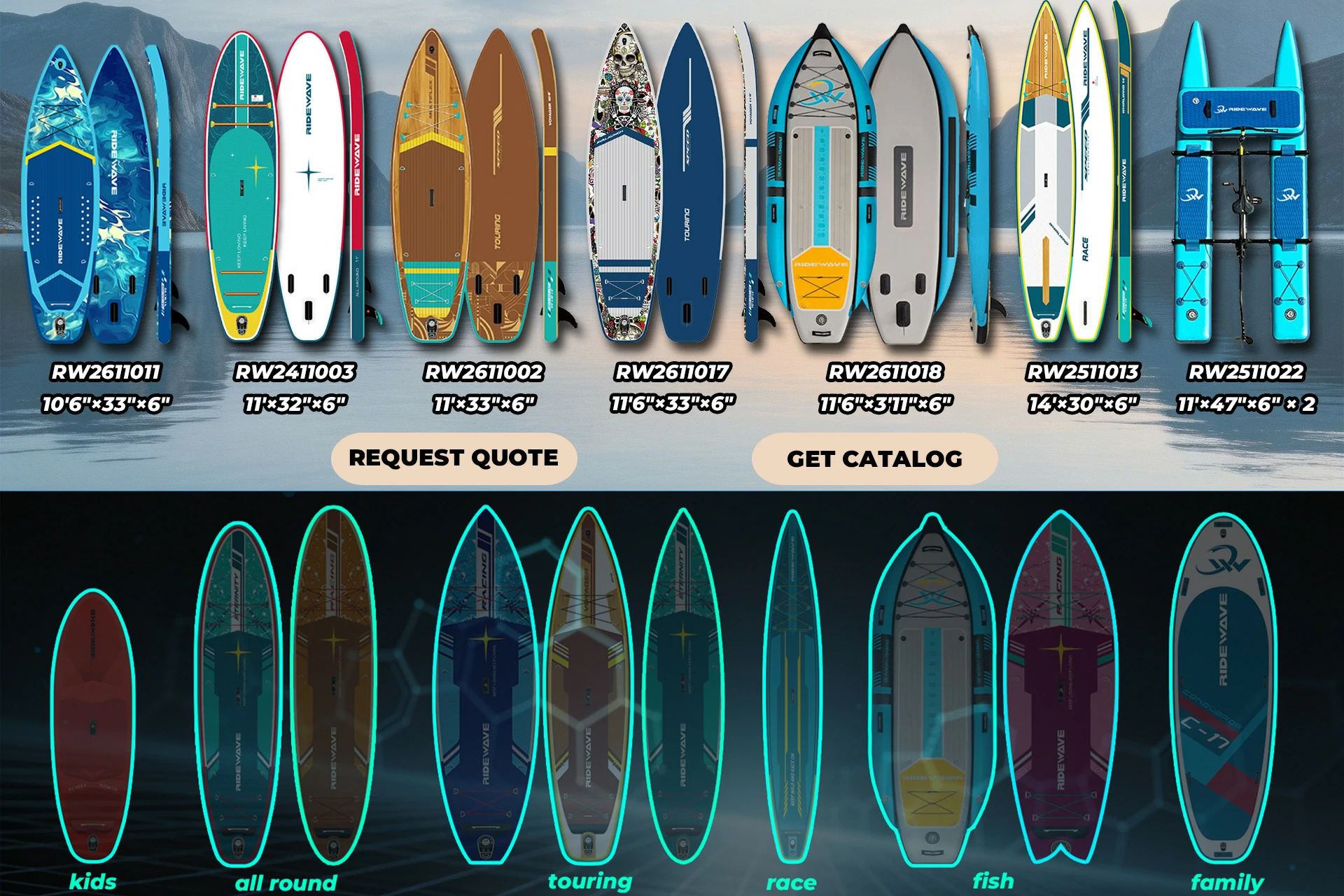



Spanish inflatable SUP distributors in 2026 are facing tighter local consumer protection rules, rising returns on defective water sports gear, and more competition from low-cost Asian imports. Bulk quality inconsistency is not just a factory production issue - it is a direct threat to distributor margins, local brand trust, and long-term market survival. Many wholesalers and watersport retailers have learned the hard way: one bad batch of inflatable SUPs can trigger negative social media reviews, Amazon marketplace complaints, and lost retail partnerships that take years to rebuild. This article breaks down practical, actionable strategies that Spanish SUP distributors use to control batch variation, limit after-sales claims, and protect their reputation when ordering large-volume SUP wholesale orders from overseas manufacturers. We will also share real-world factory checklists, procurement rules, and a RIDEWAVE field case study for B2B buyers expanding their watersport product line.

Why Do Spanish SUP Distributors Face Severe Bulk Quality Inconsistency Risks in 2026's Global Inflatable SUP Market?
2026's global inflatable SUP supply chain has created unique pressure points for Spanish SUP distributors that were less visible 3–5 years ago. The core source of batch inconsistency rarely comes from a single defective board; it comes from unstable raw material sourcing, shifting factory staffing, rushed production timelines, and cost-cutting choices made by contract manufacturers.
Many small overseas factories will swap PVC fabric suppliers between production runs without alerting the buyer. A slight change in fabric tensile strength, glue composition or drop-stitch density will not show up on sample boards. Samples are carefully hand-made, but mass production follows faster assembly lines. This creates the classic B2B SUP pain point: sample passes inspection, bulk shipment fails.

For Spanish distributors, this risk is amplified by EU product compliance obligations. Spain enforces strict EU REACH regulations for plastic and adhesive materials used in inflatable SUP products. If a bulk batch uses untested glue or non-compliant raw materials, distributors face customs hold, product recalls, fines, and permanent damage to their local dealer reputation.
Three major market shifts in 2026 raise these quality risks higher for SUP wholesalers:
• Raw material price volatility forces many low-tier factories to substitute cheaper drop-stitch or PVC layers without formal notification.
• European customers expect longer product warranties on leisure and touring SUP models, raising the cost of any quality defect.
• User-generated content on Instagram, TikTok and local Spanish outdoor forums turns isolated product failures into viral brand complaints quickly.
Spanish distributors often operate on thin profit margins. They cannot absorb hundreds of returned inflatable SUP boards or cover the logistics cost of a full product recall. This makes pre-production validation, in-line factory audits and pre-shipment sampling non-negotiable parts of modern SUP wholesale procurement.
How Does Batch Quality Flaw Damage Spanish SUP Distributors' Long-Term Brand Reputation & Local Market Share?
Many new SUP distributor buyers underestimate how a single poor bulk shipment ripples through their whole local business network. The damage does not end at returned inflatable SUP inventory. It cascades to retail partners, end customers, online review platforms, and even future negotiation power with retail chains across Spain and the wider EU.
Local Spanish outdoor shops, beach rental operators and regional resellers rely on consistent product quality to keep their own customers happy. When a distributor supplies SUPs with frequent air leaks, delamination, uneven board thickness or faulty valve fittings, those retail partners will simply switch suppliers. In the Spanish watersport market, retail partnerships take months or years to build and can be terminated after one bad season of defective SUP inventory.
Online reputation compounds this risk. Spanish consumers often post photos and videos of damaged inflatable SUP boards on Facebook groups, TikTok and trusted local outdoor review portals. Negative content does not disappear after the problem batch is replaced. It stays indexed by search engines, appearing when new retailers search for SUP wholesalers or inflatable paddle board brands. This creates long-term organic search damage for the distributor's own website and marketplace listings.
Financial risks also extend far beyond refund and return shipping costs. Common consequences of inconsistent bulk SUP quality for distributors include:
• Warranty claims for premature board degradation
• Lost deposit money if the factory refuses to rework defective bulk goods
• Increased insurance premiums for imported watersport goods
• Delayed retail launch dates and missed summer selling season window
• Legal claims when non-compliant inflatable paddle boards cause user injury
Even for established SUP distributor companies, repeated quality variation limits their ability to expand into new retail channels. Large sporting goods chains in Spain will conduct supplier background checks, and a history of bulk quality failures disqualifies wholesalers from tender opportunities.
Working with a manufacturer focused on batch consistency does not only cut after-sales work. It protects the distributor's biggest asset: trust with retail partners and end consumers. This is one reason more Spanish SUP wholesale buyers start prioritizing stable production records over the lowest unit price when sourcing inflatable paddle boards.

What 2026 Global Watersport Industry Trends Force Distributors to Upgrade SUP Quality Control Standards?
2026 has pushed inflatable SUP from a niche beach hobby into a mainstream outdoor category across Spain, Portugal, Italy and the wider European Union. That growth sounds positive for every SUP distributor, but it also raises the bar on product quality. More first-time buyers enter the market each year, and they are less forgiving of cheap, inconsistent gear than experienced paddlers. When a rental shop or outdoor retailer sells a board that delaminates after two months, the customer does not blame the factory - they blame the shop and the brand printed on the deck pad.

Three trends are reshaping what Spanish SUP wholesale buyers should demand from their suppliers in 2026:
• Regulatory tightening across the EU. The European Commission continues to update REACH and general product safety requirements for PVC-based outdoor goods. Distributors who imported cheap boards in 2023 or 2024 now face customs inspections, lab retests, and in some cases mandatory product withdrawal.
• Rising consumer warranty expectations. European paddlers increasingly expect a 2-year or 3-year warranty on recreational and touring SUP boards. A board that develops seam leaks or valve issues within the first season triggers not just a replacement, but a public review.
• Market saturation and price compression. More factories enter the inflatable paddle board space every quarter, which pushes unit prices down. Some manufacturers respond by reducing material thickness, cutting glue layers, or skipping pressure tests - exactly the choices that create batch inconsistency.
Distributors who keep sourcing on "lowest FOB price" logic will feel these trends hardest. The winning B2B buyers in 2026 are shifting toward total cost of ownership: board price plus after-sales cost, return logistics, warranty claims, and reputational damage.
For Spanish distributors specifically, the Mediterranean season is shorter than in Northern Europe. A defective batch that arrives in March or April does not just lose one sale - it misses the entire rental and retail peak from May through September. That window pressure makes pre-shipment quality control non-negotiable.
How Can Standardized Factory Production Processes Eliminate Inflatable SUP Batch Differences for Bulk Orders?
Batch inconsistency almost never happens because a factory is careless on a single day. It happens because production relies on human judgment rather than documented, repeatable processes. A well-run SUP factory treats every board in a bulk order the same way: same raw material rolls, same glue batches, same cut templates, same pressure-test threshold, same inspection checklist.
For SUP wholesale buyers, the question is not "is this factory good?" - it is "does this factory have a system that survives worker turnover, raw material price spikes, and rushed delivery schedules?"
For SUP wholesale buyers, the question is not "is this factory good?" - it is "does this factory have a system that survives worker turnover, raw material price spikes, and rushed delivery schedules?"
Standardized production that eliminates batch variation typically includes these layers:
• Raw material traceability. Every PVC roll and drop-stitch sheet used in a production run is logged with batch numbers. If a material defect appears later, the factory can trace exactly which boards used which roll.
• Fixed glue formulation and curing time. Glue is mixed in measured batches and cured under controlled temperature and humidity. "Seasonal glue adjustments" without buyer notification are a red flag for serious SUP distributor procurement teams.
• Automated or jig-guided cutting and laminating. Hand-cut boards vary by millimeters; jig-cut boards do not. Consistent lamination pressure and temperature also prevent uneven thickness that causes soft spots on the deck.
• Mandatory pressure testing at multiple stages. Not just a final air hold - pre-lamination pressure check, post-glue pressure check, and a 24-hour final hold before packaging.
• Documented final inspection checklist. Every board is checked for valve torque, weld seam integrity, deck pad adhesion, D-ring pull strength, and printed graphics alignment.

RIDEWAVE has built its production line around these standards specifically because Spanish and European SUP distributor partners told us their biggest frustration was receiving boards that looked identical to the sample but performed differently after three months of use. The sample was built by a senior technician; the bulk order was built by a rotating shift. Standardization removes that gap.
A practical tip for B2B buyers: when you audit a factory, ask to see not just the sample room but the active production floor on a random Tuesday. Watch whether the workers follow written checklists, whether raw material rolls are tagged, and whether pressure test logs are being filled out in real time. A clean sample room means nothing if the production floor runs on memory.
What Core Design Details Determine Inflatable SUP Bulk Consistency & End-User Satisfaction in 2026?
Many SUP distributor buyers treat board design as purely aesthetic. Graphics, deck pad patterns and colourways sell well in catalogues, but the hidden structural design choices are what control batch stability over mass production. Poorly engineered inflatable SUP designs force factory workers to make manual adjustments during production. Those manual tweaks create inconsistent performance from one batch to the next, which will eventually trigger customer complaints and returns for your SUP wholesale business.

When sourcing bulk SUP inventory for Spain and broader EU markets, there are five core design factors that directly impact batch repeatability:
• Drop-stitch grid layout. Uniform cell sizing across the entire board prevents weak zones and uneven rigidity. Custom irregular shapes require hand trimming, raising the risk of dimensional inconsistency between boards.
• Rail profile and glue contact area. Rounded rails with predictable bonding surfaces are far easier to replicate in mass production than sharp, complex contours. Small variations in glue coverage on complex rail shapes lead to hidden delamination risks.
• Valve placement and reinforced patch geometry. Reinforcement patches must have fixed size and shape. If the patch is hand-cut for every board, alignment and adhesive coverage will vary, creating slow air leaks that only appear after weeks of use.
• Deck pad bonding area and edge treatment. Thin, narrow deck pad edges peel easily when lamination pressure fluctuates in mass production. A wider bonded margin improves consistency and reduces warranty claims.
• Load point reinforcement for D-rings and carry handles. Pre-welded reinforced panels are more repeatable than manually glued reinforcement patches. Manual application creates pull-strength variation across a bulk shipment.
Design choices also tie into local end-user behaviour. Spanish coastal customers use inflatable SUP for beach rentals, family leisure and short touring trips. Boards designed for heavy repeated use with simple, repeatable construction will hold up better in bulk production and reduce your after-sales burden. Overly custom, complex shapes may look unique on product photos, but they amplify batch variation risk.
RIDEWAVE's design team works closely with European distributors early in the development phase to balance market appeal with manufacturing practicality. We avoid design features that look impressive in renderings but create unstable results on the production line. This collaborative design approach helps our partners avoid ordering eye-catching SUP models that become expensive liability once mass production begins.
Smart B2B buyers now involve manufacturers at the design stage, instead of finalising drawings and handing them over for production. This simple shift catches manufacturability issues before you commit to large deposits and bulk production schedules.
How Do Professional B2B SUP Procurement Screening Rules Avoid Reputation Risks for Distributors?
A distributor's biggest mistake when sourcing inflatable SUP is judging a factory only by sample quality and FOB price. Samples can be handcrafted, polished and tested exclusively for sales meetings. Without structured supplier screening rules, you may sign off on a supplier that cannot replicate that sample quality across hundreds or thousands of boards, putting your SUP wholesale brand and local reputation on the line.
Professional B2B procurement screening creates a checklist that evaluates factory capability, compliance and quality systems before deposit payment. This set of rules helps SUP distributor buyers filter out risky manufacturers before bulk production starts.
The core screening framework covers six evaluation categories:
• Documentation review. Verify valid REACH reports, product safety certificates, factory audit records and material test reports. Expired or incomplete certification creates customs seizure risk for EU imports.
• Production capability audit. Confirm production line size, shift staffing, equipment maintenance schedule and raw material storage conditions. Factories running temporary leased lines often struggle with batch consistency.
• Quality control workflow inspection. Confirm in-line inspection, pressure testing protocols and non-conforming product isolation process. Factories that mix defective boards back into finished inventory pose major risk.
• Batch traceability system check. Ask how the factory logs raw material batches, production shifts and test records. Without traceability, you cannot isolate bad stock if quality issues emerge.
• After-sales liability agreement. Clarify responsibility for rework, replacement and logistics costs when bulk non-conformity occurs. Verbal promises offer zero protection for cross-border SUP orders.
• Reference checks with existing European distributors. Speak to current EU clients of the manufacturer, specifically asking about batch variation, lead-time reliability and complaint resolution.

Many buyers skip these steps to save time. But cutting corners in supplier screening often leads to far larger losses: seized containers, returned inventory, cancelled retail contracts and damaged brand trust.
These pre-order checks are not just theory. They form the core questions every serious B2B buyer should ask before committing to large inflatable SUP orders.
How Does RIDEWAVE's Full-Link Quality Control System Solve Spanish Distributors' Bulk Quality Pain Points?
To understand what reliable batch consistency looks like in practice, it helps to look at a real distributor experience. In 2024, a family-owned SUP distributor based in Barcelona approached RIDEWAVE after two consecutive bad seasons with a lower-cost supplier. Their problem was not unusual. They had imported recreational and rental inflatable SUP boards for three years, and the first two seasons ran smoothly. By year three, warranty claims climbed sharply. Boards began showing slow air leaks at the valve base, uneven rail rigidity, and visible seam bubbling after two to three months of rental use. Their retail partners along the Costa Brava started switching to competing brands. Online reviews on Spanish outdoor forums began mentioning the brand name alongside "defection" and "air loss."
The root cause was exactly what we described earlier. The factory had quietly switched glue suppliers and reduced the drop-stitch fabric density to protect margins after raw material price increases. The sample boards the distributor originally approved used the older, thicker material. The bulk production used the cheaper substitute. No one told them.
RIDEWAVE worked with this Barcelona distributor through a structured onboarding process. We did not start with pricing. We started with a full-link quality review:
• Material traceability. We shared the exact PVC roll numbers and drop-stitch batch codes for their first order, so they could verify material consistency against their approved samples.
• Inline production reports. During their first bulk run, we sent weekly photo reports from the production floor, showing pressure test logs, lamination station records, and final inspection checklists.
• Third-party pre-shipment inspection. We encouraged them to book an independent QC inspection (SGS or Bureau Veritas) before container loading. The inspection report covered board thickness, valve torque, air hold time, and visual defects.
• Warranty terms written into the contract. Defect thresholds and replacement terms were explicitly stated in the sales agreement, not negotiated after problems appeared.
The result over the 2025 season: bulk defect rate stayed below 0.3% across two container shipments. The distributor reported that retail partner confidence recovered within one season, and their repeat order volume grew by roughly 40% year over year. They also expanded into a new touring SUP model line, something they had been hesitant to attempt after the previous supplier failure.

This case is not about RIDEWAVE being "perfect." It is about what happens when a manufacturer treats batch consistency as a shared responsibility with the distributor, rather than a hidden cost variable. Spanish SUP wholesale buyers do not need a supplier who makes the loudest claims. They need a supplier who documents every step and accepts accountability when something falls outside agreed thresholds.
What Key Quality Indicators Should SUP Distributors Verify Before Confirming Bulk Shipment?
Even with a good factory relationship, every SUP distributor should run an independent pre-shipment check on bulk orders. You do not need to fly to the factory yourself. A third-party QC inspector can measure the critical indicators below. The goal is not to catch every tiny cosmetic issue - it is to catch systemic problems that will trigger warranty claims and reputation damage later.
The table below summarizes the most important quality indicators, what a typical low-tier factory tends to deliver, what a reliable standard looks like, and what risk each gap creates for your SUP wholesale business. You can copy this table directly into your own procurement SOP or share it with your QC team.
| Quality Indicator | Typical Low-Tier Factory Output | Reliable Standard for Bulk SUP | Risk If Standard Is Skipped |
|---|---|---|---|
| Board thickness consistency | Varies ±1.5–2.0 mm across the deck | ±0.5 mm tolerance across the whole board | Soft spots, uneven rigidity, early delamination |
| Air hold test (24h) | Often skipped or held for only 2–4 hours | Full 24-hour hold at rated pressure, logged | Slow leaks appear only after customer use |
| Valve torque & seal | Hand-tightened, no torque record | Fixed torque spec, checked on every board | Valve loosening, slow air loss in storage/transport |
| Rail seam integrity | Visual check only, inconsistent glue coverage | Measured glue width + peel test sample | Bubbling, seam separation after 1–2 rental seasons |
| Drop-stitch density | Reduced without notice to hit price targets | Confirmed against approved sample, batch-coded | Board feels "soft," fails load expectations |
| Deck pad adhesion | Applied by hand, uneven edge pressure | Jig-guided lamination, standardized edge margin | Pad peels at edges, triggers warranty claims |
| D-ring pull strength | No pull test in production | Tested to fixed load threshold per batch | D-rings tear out under paddle leash / cargo load |
| Printed graphics alignment | Hand-aligned, visible variation board to board | Jig-guided, consistent registration across batch | Looks cheap in retail display, damages brand perception |
| REACH / material compliance docs | Expired or generic certificates | Current batch-specific test reports | Customs hold, product recall, EU fines |
A practical note: the biggest value of this table is not the numbers themselves. It is the conversation it creates with your supplier. When you share these thresholds in writing before production begins, you signal that you understand what batch consistency actually requires. Reputable inflatable SUP manufacturers will respond by documenting their processes. Less reliable suppliers will either avoid the conversation or quote prices that assume you will not inspect.
For new SUP distributor buyers, we recommend starting with third-party inspection on your first two or three orders. Once you have a stable track record with a factory, you can adjust inspection frequency - but keep the threshold table in your contract permanently. It becomes your reference point if quality drifts later.
RIDEWAVE includes a version of this indicator table in every wholesale order confirmation, so distributors know exactly what we are measuring before they approve the container.
How Can Distributors Cooperate With Reliable SUP Manufacturers to Reduce After-Sales & Reputation Risks?
Many SUP distributor partnerships fail not because of bad factory hardware, but because of misaligned expectations and poor communication throughout bulk production. When you treat your inflatable SUP supplier as a simple order filler, you will only discover quality problems once the container arrives at port. But when you build a collaborative manufacturing relationship, both sides share data, flag risks early, and lock in standards before material is cut. This collaborative model is the most effective long-term strategy for protecting your SUP wholesale brand in Spain and across EU territories.

There are five practical ground rules to build this low-risk cooperation:
• Lock material specifications in writing before production. Confirm PVC grade, drop-stitch density, glue type and batch traceability rules in your PI or technical datasheet. Verbal agreements about raw materials leave you with no recourse if substitutions happen.
• Schedule milestone check-ins instead of waiting for final photos. Request updates at material cutting, lamination, pressure testing and final packing stages. Small issues caught mid-production are cheap to fix; the same issues become expensive once boards are packed and loaded.
• Agree on a clear non-conformity handling process. Define what percentage of defective boards triggers rework, partial shipment hold, or full replacement. Clarify who pays for labour and freight when the factory fails to meet agreed specs.
• Keep one stable technical contact on both sides. Rotating sales representatives cause miscommunication on specs, colour codes and QC requirements. A dedicated point of contact reduces translation errors and prevents lost information between shifts.
• Run small trial orders before committing to full container volume. A 100–200 board trial run lets you test real batch consistency, logistics timing and after-sales response before investing in large FCL shipments. Even if samples look perfect, a small trial reveals hidden mass-production weaknesses.
For distributors expanding into rental-grade inflatable SUP, this collaborative approach is even more critical. Rental boards endure heavy abrasion, repeated inflation cycles and rough handling by untrained end users. Any hidden batch weakness will surface quickly and generate concentrated warranty claims in peak summer season.
RIDEWAVE applies this framework with all European wholesale partners. We encourage trial runs and written technical specs, not for extra paperwork, but to align expectations. We have seen many Spanish importers rush straight to full containers to save per-unit cost, only to spend far more resolving quality disputes. A small trial order is cheap insurance for your brand reputation.
How Do 2026 Eco-Friendly & Smart SUP Industry Standards Affect Bulk Quality Management for Distributors?
Sustainability is no longer a marketing gimmick for European SUP distributor buyers in 2026. Eco-focused standards are becoming embedded within material certification, customs clearance and retail buyer requirements. Many large Spanish outdoor retail chains now require suppliers to provide documentation on recycled raw materials, solvent-free adhesives and waste reduction programs. But adding eco-friendly features creates new batch consistency risks that wholesalers often overlook.
Sustainable inflatable SUP production introduces variables that impact quality control:
• Recycled PVC and composite materials have wider natural material variation than virgin resin. Without tighter incoming material inspection, recycled material batches can create inconsistent board rigidity and adhesive bonding.
• Low-VOC, solvent-free glue formulas behave differently with temperature and humidity shifts. Factory teams need updated curing protocols to avoid poor adhesion if switching to eco glue.
• Eco-printing and water-based inks require precise drying times. Improper curing causes graphics scratching and peeling during shipping or end-user use.
• Carbon footprint declarations require full supply chain traceability. Distributors need batch-level records for materials, manufacturing and shipping to back up environmental claims.
Beyond eco regulations, smart watersport gear trends are slowly touching the SUP market. Integrated waterproof sensors, built-in air pressure valves and custom embedded tracking tags are appearing on premium models. These add electronic components to inflatable boards, which expand your QC checklist and create new points of failure in bulk production.
The trap many SUP wholesale buyers fall into: they ask for eco-friendly materials without updating their quality acceptance criteria. A board marketed as sustainable can still suffer from seam leaks or weak D-rings. Green credentials do not automatically guarantee batch stability.

The practical recommendation for Spanish distributors: separate sustainability documentation from functional quality standards. Require your manufacturer to prove both. Ask for separate material performance test reports alongside environmental declarations.
RIDEWAVE's R&D team has spent two years testing low-VOC glue and recycled PVC blends for European bulk orders. We learned that eco materials demand stricter incoming QC and adjusted curing cycles. This means our B2B customers get compliant eco options without sacrificing the batch consistency they rely on for retail and rental sales.
What Hidden Supply Chain Risks Cause SUP Quality Instability in Transnational Bulk Trading?
Even when a factory runs a disciplined production line, transnational SUP wholesale shipments carry hidden risks that can turn a perfectly built inflatable SUP into a defective product by the time it reaches your Spanish warehouse. Most distributors focus only on factory-side quality, but supply chain logistics and storage conditions create their own set of quality problems that are often invisible until the customer opens the box.

The most commonly overlooked supply chain risks for bulk SUP shipments:
• Container heat exposure. Shipping containers sitting on open decks or in tropical ports can reach 60–70°C internal temperatures. Glue bonds weaken, deck pad adhesive softens, and PVC becomes more prone to deformation during long transit. Boards that pass QC at the factory can develop adhesion issues after 30 days on the water.
• Humidity and condensation inside sealed cartons. When containers cross climate zones, temperature swings cause condensation. Wet cartons lead to mould on fabric accessories, corrosion on metal D-rings, and mildew smells that customers notice immediately.
• Improper stacking and pallet weight. If boards are stacked too high or packed with heavy accessories underneath, the drop-stitch core develops permanent indentations. These flat spots are not visible at factory QC but become obvious when the board is inflated.
• Port delay and extended storage. Spanish ports and European inland hubs have seen delays grow since 2024. A two-month port delay means your boards sit inside hot containers far longer than planned. This accelerates material ageing and raises warranty risk.
• Mixed-pallet contamination. If your SUP boards are loaded alongside chemical cargo, wet goods, or food-grade products, fumes and moisture transfer can damage materials. This is rare but happens when factories book low-cost consolidations.
These risks explain why two distributors ordering from the same factory can end up with very different customer return rates. The difference is rarely the production line - it is how the shipment is handled between factory floor and your warehouse.
Practical mitigation steps for SUP distributor buyers:
• Ask the factory how boards are packed: individual cartons with desiccant, or bulk shrink wrap.
• Request that containers be loaded away from engine rooms and prefer upper-deck placement if available.
• Inspect the first opened carton at your warehouse within 48 hours of arrival. Look for moisture, odour, deformed rails, or loose accessories.
• Keep a small sample of boards from each batch in your own storage for 90 days, then inflate and inspect. This catches delayed material degradation before you sell through the full stock.
RIDEWAVE includes desiccant packs and humidity monitoring strips in every wholesale inflatable SUP shipment. It is a small detail, but it is one of the reasons our Spanish partners report fewer after-arrival quality issues compared to their previous suppliers.
How Can New SUP Resellers & Sports Gear Merchants Build A Low-Risk Bulk Procurement System in 2026?
Not every SUP distributor reading this article is an established watersport specialist. Many are sporting goods retailers, outdoor multi-brand stores, and e-commerce merchants adding inflatable SUP as a new product line in 2026. Expanding into paddle boards looks straightforward - the category is growing, margins look attractive, and suppliers are easy to find online. But without a structured procurement system, new entrants often become the most vulnerable to bulk quality inconsistency and reputation damage.
Building a low-risk SUP wholesale system does not require huge upfront investment. It requires discipline at every step:
• Start with a narrow product range. Do not launch 10 models in your first season. Pick 2–3 proven shapes (all-around, touring, yoga) that match your local customer profile. Fewer SKUs mean easier QC, simpler inventory management, and faster learning curves.
• Order a sample unit from at least 3 suppliers. Inflate the boards yourself, use them for 2–4 weeks, and compare seam feel, valve reliability, deck pad texture and packaging. Samples sold to buyers are different from production bulk.
• Verify compliance before negotiation. Confirm the supplier can provide current REACH test reports and product liability insurance details. If they hesitate or send expired documents, move on.
• Negotiate defect thresholds in writing. Ask for a clear agreed defect rate (typically 1–2%) and what remedy applies if it is exceeded. This is one of the most underused clauses in new-entrant orders.
• Book third-party QC on your first order. A $300–$500 inspection fee on a $20,000 container is cheap insurance. The inspector will catch 80% of obvious bulk problems before the container sails.
• Phase your order growth. Start with one 20ft container, not a full 40ft. Once you have sold through and checked after-sales feedback, scale up. New distributors who over-order on day one often get stuck with dead inventory if quality or market fit disappoints.
• Build your own after-sales process. Have a simple repair kit (patches, valve wrench, instructional video) ready for customers. This reduces warranty replacement costs and improves review scores, even if a few boards need minor fixes.
New SUP reseller businesses also tend to under-estimate how much educational content they need to provide. End customers who are new to paddle boards often blame the product for issues caused by incorrect inflation or poor storage. A good onboarding video and a quick-start guide reduce unnecessary returns and improve customer satisfaction.

RIDEWAVE regularly works with sporting goods brands that are adding inflatable SUP to their catalogue for the first time. We provide starter SKU recommendations, retail packaging options, and customer-facing user manuals in Spanish, French and German. This allows new entrants to launch confidently without building all the operational systems from scratch.
The key mindset shift: treat your first season as a learning year, not a volume year. The distributors who survive and grow are the ones who build stable supplier relationships and consistent quality records, not the ones who chase the lowest unit price.
Why Long-Term Manufacturer Partnerships Beat Spot Purchases for Spanish SUP Distributors' Reputation Protection?
Many SUP distributor buyers default to spot sourcing: compare quotes for every new container, rotate factories each season, and chase the lowest FOB price available on the market. This tactic seems smart on spreadsheets, but it quietly erodes product consistency, brand trust and long-term profit margins for inflatable SUP wholesale. Spot buying treats every order as a one-off transaction, so the factory has little incentive to invest in stable material batches, refine production settings or prioritise your QC requirements beyond that single shipment.

Long-term manufacturing partnerships, by contrast, build cumulative quality advantages that one-time spot purchases cannot match:
• Locked material formulation and raw material allocation. When a manufacturer reserves dedicated material rolls for your ongoing orders, they avoid substituting cheaper raw materials during price spikes. Your specs stay unchanged across seasons, not just for one batch.
• Continuous production process optimisation tailored to your SKUs. The factory's team becomes familiar with your board models, colour codes, reinforcement standards and recurring QC notes. They learn common defects specific to your designs and adjust tooling before problems reoccur.
• Priority scheduling during peak season. Watersport production has tight lead times before the European summer rush. Loyal wholesale partners get priority production slots. Spot buyers often face pushed-back lead times, rushed production and compromised quality when factory capacity fills up.
• Joint root-cause analysis when rare quality issues emerge. Even the most stable production lines will encounter occasional anomalies. With a long-term partner, both sides dig into material logs and production records to fix the source of the problem. Spot suppliers typically focus only on resolving the immediate complaint without fixing underlying process flaws.
• Shared product development roadmap. Trusted partners collaborate on upgrades: rental-grade reinforced rails, low-VOC glue upgrades, or custom accessories designed specifically for your Spanish retail audience. These improvements are rarely offered to occasional one-off buyers.
The biggest misconception among SUP wholesale buyers: long-term partnerships mean you must accept higher pricing. That is not true. Stable repeat orders help factories optimise raw material procurement and production setup cost. These savings can be partially passed to distributors, while maintaining consistent quality. Spot sourcing may win a lower unit price on one order, but hidden costs from returns, warranty claims and brand damage usually outweigh that small price advantage.
RIDEWAVE maintains multi-year agreements with many Spanish inflatable SUP distributors. Our partnership model includes annual spec reviews, early access to new material tests, and reserved production capacity for peak pre-summer orders. Our partners do not need to re-negotiate basic quality terms every time they place a container order. This frees their team to focus on retail marketing and local sales rather than re-auditing suppliers repeatedly.
For Spanish distributors, brand reputation is built season by season. A reliable long-term manufacturing relationship acts as the foundation to protect that reputation year after year.
What Future Quality Control Strategies Help Distributors Sustain Stable Profit & Market Credibility?
The global inflatable SUP market will keep evolving in 2026 and beyond. Tighter EU product safety rules, rising consumer expectations, and growing competition will make batch consistency no longer a competitive bonus, but a basic entry requirement for any serious SUP distributor operating in Spain and Europe. Distributors who survive and grow will not rely on occasional QC checks. They will build proactive, data-driven quality strategies to stay ahead of risks.
hree forward-looking QC strategies for European SUP wholesale buyers:
• Build a centralized batch database. Log every shipment's raw material batch codes, pressure test results, third-party inspection reports and end-user complaint rates. Over time, this dataset reveals patterns: which materials or production periods correlate with higher warranty claims. You can adjust sourcing specs before issues scale up.
• Adopt continuous sample ageing testing. Keep representative boards from every batch in storage for accelerated ageing tests. Simulate high heat, repeated inflation and UV exposure, to forecast long-term durability. This helps catch slow-failure defects months before they appear on the market.
• Integrate quality KPIs into supplier performance reviews. Evaluate your factory quarterly using measurable metrics: batch defect ratio, on-time delivery rate, non-conformity resolution speed, and documentation completeness. Tie future order volume to these KPIs, rather than only negotiating price.
These practices shift quality control from "problem fixing after delivery" to "risk prevention before production". This transformation protects profit margins, because warranty work, return logistics and brand recovery cost far more than upfront quality investment.

For Spanish distributors specifically, the Mediterranean selling window remains short and intense. One bad batch can damage retail relationships for multiple seasons. Investing in predictive quality management safeguards your peak sales period, retail partnerships and brand reputation.
RIDEWAVE continues to upgrade our internal QC system with digital batch logging and accelerated ageing chambers for all inflatable SUP models. We share aggregated performance data with our wholesale partners, so they can make data-backed inventory and marketing decisions.
Batch inconsistency is not an unavoidable curse in the inflatable SUP wholesale industry. It comes from weak design, undocumented production workflows, unvetted suppliers, hidden supply chain stress and short-term purchasing mindsets. For SUP distributor buyers in Spain and EU markets, stable quality is not something you hope your factory delivers. It is something you define in writing, verify at every production milestone, enforce via contracts, and protect through thoughtful logistics planning. Whether you are an established watersport wholesaler or a brand-new retailer adding paddle boards to your lineup, quality consistency is the foundation of sustainable profit. When your boards perform reliably season after season, your retail partners trust you, end customers leave positive reviews, and your brand stands out in an increasingly crowded European watersport market.
Related Articles
When Should Italian Importers Place Their Bulk Inflatable SUP Orders?
Which Custom Solution Works Best For Italian Retailers: OEM Or ODM Inflatable SUP?
Which Drop‑Stitch Inflatable SUP Specifications Are Unignorable For Italian B2B Wholesale Buyers?
What Should Italian Watersport Wholesalers Know Before Sourcing Inflatable SUP Boards From China?
A B2B Guide: How Australian Wholesalers Source High-quality Inflatable SUPs?