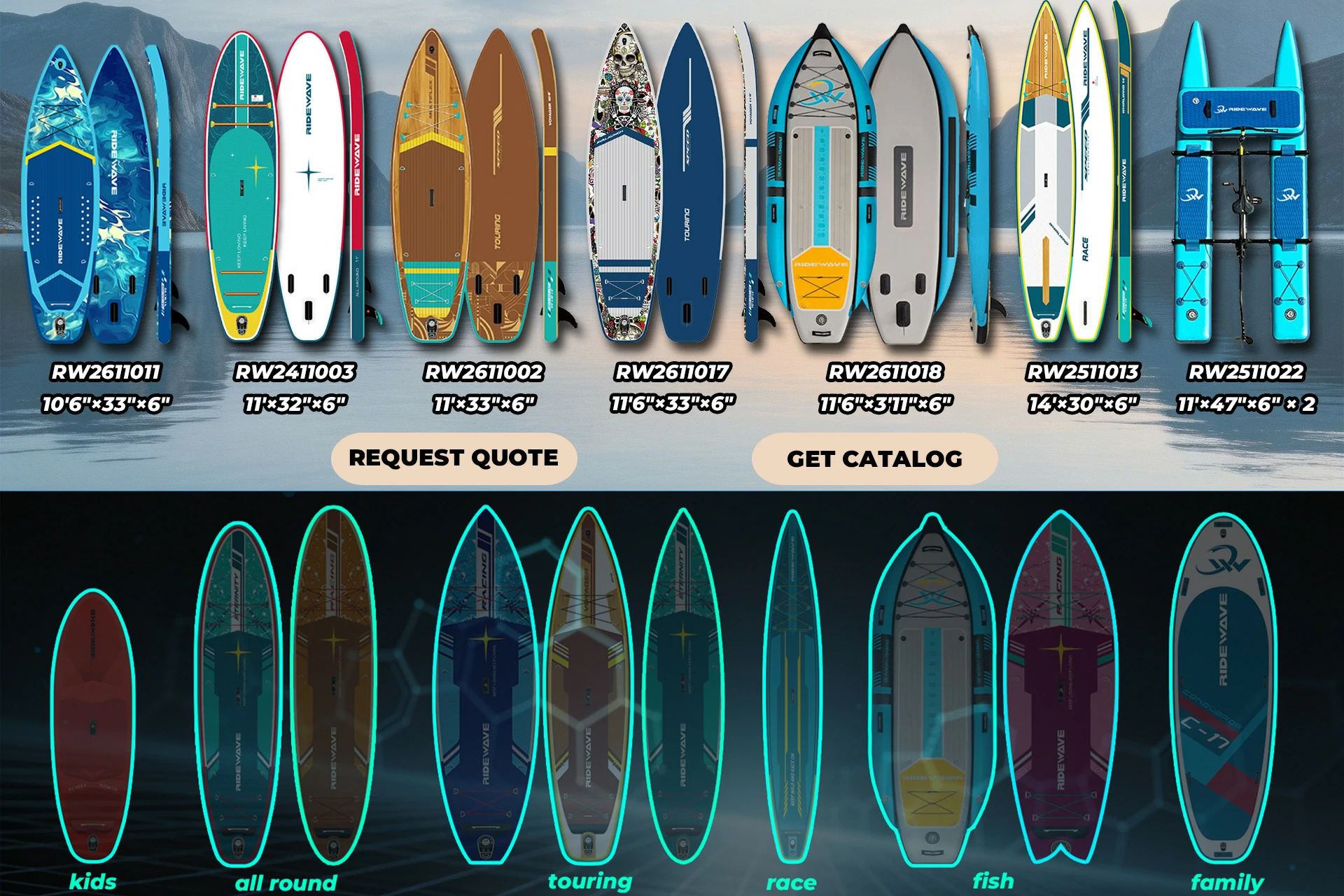



If you are a SUP wholesaler, distributor, sports goods retailer or brand owner looking to expand your water sports catalog into Argentina, Uruguay, Chile and nearby South American territories, picking the right inflatable SUP lineup is not just about grabbing low unit prices. The Southern Hemisphere summer window, local saltwater and inland lake conditions, import documentation rules, and consumer spending habits all shift which iSUP models turn inventory into steady profit. Many new buyers overstock generic recreational boards and run into high return rates, slow sell-through, or customs delays, because they source without region-specific field feedback.

As an inflatable paddle board manufacturer that ships mixed containers to South America year after year, RIDEWAVE has watched which designs move reliably and which sit in warehouses for months. Every successful regional portfolio balances ready standard stock and controlled custom runs, and you can learn more about how custom designs move from factory sketch to finished goods in How Custom Paddle Boards Are Made: From Design To Production. This guide walks you through market drivers, high-margin categories, must-have material specs, container packing ratios, compliance checklists, real dealer results, and common sourcing mistakes that eat into your wholesale margins. It is written for B2B buyers who want actionable data to build a scalable SUP paddle board assortment that works for South America, while also fitting cross-border sales into North America, Europe and Australia.
What South American market factors decide which inflatable SUP models sell best in Argentina?

Southern Hemisphere seasonality, local water chemistry, import restrictions, price sensitivity and the split between casual beach users and dedicated water sports fans together decide which inflatable SUP SKUs perform reliably for Argentina and neighboring markets. Unlike Northern Hemisphere markets, the peak selling window for iSUP lands from November through February, aligning with local summer holidays, coastal tourism and inland lake getaways. Distributors who time their container arrivals 4–6 weeks before demand spikes capture far better sell-through, while late shipments often land right as consumer interest fades. Saltwater exposure along the Atlantic coast creates a non-negotiable material requirement: boards built for coastal use cannot cut corners on UV and salt-resistant lamination, even if that pushes landed cost slightly higher. Inland markets around rivers and freshwater lakes tolerate more budget-friendly builds, but these buyers still reject boards that warp or delaminate after a handful of outings. Currency volatility, complex customs paperwork and inconsistent lead times from overseas suppliers also shape buying behavior. Many Argentina wholesalers now favor mixed container assortments instead of single-model bulk orders, because one slow-selling SKU can lock up capital for months. RIDEWAVE's shipment logs from the past three years show that balanced mixes, centered on versatile all-around inflatable paddle board designs, outperform single-SKU bulk orders in nearly every South American territory we serve.
• Atlantic coastal zones: high salt, strong UV, rental businesses and casual tourist traffic
• Freshwater river and lake zones: family recreation, beginner buyers, lower tolerance for premium pricing
• Mountain lake zones in Chile: cooler water, serious touring users, willingness to pay for reinforced construction
• Small island and resort markets: low order volume, high logistics cost, demand for compact, easy-to-store blow up SUP
| Market | Main Water Environment | Hot Selling SUP Type | Local Consumer Price Tendency | Main Risk |
|---|---|---|---|---|
| Argentina | Coastal saltwater + inland lakes/rivers | All-around touring, entry recreational | Mid-price preferred, sensitive to big price jumps | Currency fluctuation, strict customs document check |
| Brazil | Beaches, rivers, lagoons | All-around, fishing SUP | Large volume at entry price | High import tax, complex customs |
| Chile | Pacific coast, mountain lakes | Salt-resistant premium all-around | Willing to pay for durable quality | PFAS compliance request from big retailers |
| Uruguay | Coastal calm water | Family recreational, yoga SUP | Balanced mid-range | Small order volume, high per-unit logistics cost |
If you are sorting out whether to prioritize custom graphics or standard ready stock for your next South America order, you can revisit how factory workflows change for custom runs in How Custom Paddle Boards Are Made: From Design To Production.
Which inflatable SUP categories bring the highest gross margin for South American B2B distributors?
Mid-range all-around inflatable SUP boards deliver the most stable gross margin for South American wholesalers, while entry-level recreational SKUs drive volume and niche options such as fishing and yoga SUP create differentiation that helps you avoid brutal price competition. Margin is not the only metric to weigh, though. A high-margin category with slow turnover ties up cash and raises warehouse holding costs, which hurts profitability just as much as thin margins on fast-moving stock. Entry-level blow up paddle board models pull first-time buyers into your catalog and support bundle sales with pumps, paddles and carry bags, but these lines attract fierce price competition and often carry higher after-sales claim rates when factories cut fabric thickness. Fishing SUP and yoga SUP command stronger per-unit profits, yet they serve smaller audience segments and require targeted marketing for local fishing communities or wellness studios. Premium touring and race stand up paddle board models deliver excellent margin for specialist retailers, but they are not suitable for broad, mass-market distribution across Argentina's mixed customer base. RIDEWAVE's dealer data shows that the strongest wholesale portfolios do not chase the highest single margin; they stack fast-turn volume SKUs with reliable mid-range core lines and a small percentage of niche boards to lift average order value.

• Entry recreational iSUP: high velocity, low barrier to entry, ideal for sports shops and supermarket-style retail
• Mid-range all-around touring iSUP: balanced durability, broad use case, core profit driver for most South America distributors
• SUP fishing boards: high perceived value, loyal buyer group, slower inventory rotation
• SUP yoga boards: wide, stable platform, appeals to wellness brands and yoga studio partnerships
• Kids inflatable SUP: low per-unit profit, works best bundled with adult boards for family retail sets
• Premium race & long touring iSUP: best for specialist water sports retailers, limited mass appeal
What core specs should a saltwater-ready inflatable paddle board have for Argentina's coastal trade?
Saltwater-ready inflatable SUP built for Argentina's coastal trade needs reinforced drop stitch fabric, anti-UV and anti-salt coating, corrosion-resistant metal valves and thick rail protection, rather than only a low unit price. Many new buyers focus only on board thickness and quoted DWF fabric weight, but coastal failure usually comes from overlooked weak points: cheap plastic valves that seize up after salt exposure, thin rail tape that abrades on sand, and standard lamination that breaks down under intense UV. The drop stitch core is the backbone of every iSUP, but fabric treatment separates boards that survive repeated coastal use from boards that develop bubbles and delaminate within a few months. For Argentina beach rental operators, this specification gap is especially critical: rental fleets cycle daily, and a high failure rate will erase all rental revenue quickly. Freshwater boards can skip some of these upgraded treatments, but any board marketed for coastal or multi-use sale should carry verified salt spray and UV aging test reports. RIDEWAVE marks out its saltwater series separately, so B2B buyers can avoid mixing freshwater stock into coastal orders by mistake.

• 1000D or higher reinforced DWF drop stitch fabric for main body
• Double-layer rail reinforcement with anti-abrasion tape
• Metal screw valves instead of plastic valves for salt resistance
• UV-stabilized, salt-resistant outer lamination
• Non-slip diamond EVA deck that holds up to frequent wet cleaning
• Certified salt spray aging test report for coastal listings
How can B2B buyers match SUP model selection with container planning for South America shipments?

A balanced container mix with 40–45% all-around boards, 35–40% entry recreational boards and 10–15% niche SKUs is the most proven formula for Argentina and nearby markets. Container planning is where many distributors leave money on the table. Overloading one model locks inventory, while too many tiny niche SKUs raise picking, packing and sorting complexity without enough sales volume to justify it. You also need to account for packaging size, weight, accessory bundles and how many full sets fit into a 40HQ container. Some inflatable SUP designs look attractive on a spec sheet but ship poorly because bulky backpack packaging cuts down total loading quantity. Your accessory pack is another lever: matching pump quality, paddle grade and repair kits to your target price tier prevents customer complaints and keeps your return rate low. This planning work ties directly into product design, because shapes, sizing and packaging are all built around how you plan to sell and ship the board. If you want to refine your lineup so your selected iSUP models sell faster in your target channels, you can learn design principles in How To Design A Paddle Board That Sells.
• Prioritize mid-range all-around models as your container foundation
• Limit niche SKUs to 15% of total volume to reduce inventory risk
• Confirm packaged dimensions before finalizing your order, not just bare board size
• Standardize accessory bundles per price tier to simplify warehouse handling
• Reserve a small portion of container space for sample stock and new test SKUs
What compliance and certification documents are mandatory for inflatable SUP imports into Argentina and nearby South American countries?
While South America does not fully copy EU regulatory frameworks, every importer must prepare material test reports, factory declarations and properly formatted product safety labels; premium lines sourced for larger retailers often need additional REACH and PFAS compliance documentation for inflatable SUP shipments. A frequent and costly mistake for first-time South America buyers is assuming the same certification package used for Europe or the USA will clear customs automatically. Argentina, Brazil, Chile and Uruguay each maintain separate customs requirements, and inspectors frequently ask for batch-specific test records instead of generic, multi-year old reports that cover no specific production run. HS classification is another easy pitfall. Misclassifying iSUP under the wrong HS code can trigger extra duties, inspection holds or even cargo seizure. Labels must include clear Spanish product information, material composition and safety warnings, not only English text. RIDEWAVE organizes test reports by production batch and supplies editable label templates for Spanish-language markets, so distributors can align their paperwork ahead of vessel arrival rather than scrambling once goods reach port.

• Batch-wise material test reports for DWF fabric, EVA deck and plastic/metal valve components
• Factory self-declaration for safety and non-toxic raw materials
• Correct HS code classification for inflatable stand up paddle board cargo
• Spanish safety warning labels with weight limit and adult supervision notices
• PFAS, REACH supporting documents if your buyers sell to large retail chains
• Commercial invoice and packing list formatted to local customs standards
What real-world results can a manufacturer's SUP portfolio bring to Argentina-based distributors?

A well-tuned regional inflatable SUP portfolio reduces inventory waste, shortens sell-through cycles and lowers after-sales claims, which is demonstrated by one of RIDEWAVE's long-term Argentina dealer partnerships. This family-owned outdoor retailer previously sourced only low-cost generic blow up paddle board units from multiple suppliers, targeting beach tourists and local lake users. Their core pain points were consistent: high leak and delamination claims, unpredictable lead times, and heavy cash lock-up because 60% of each container was tied to one single entry-level SKU. The dealer worked with our team to rebuild their assortment using the mixed container formula we covered earlier: 45% salt-resistant mid-range all-around iSUP, 40% beginner recreational boards, and 15% fishing and kids SUP for add-on sales. They also switched from plastic valves to metal corrosion-resistant valves on all coastal stock, and rolled out pre-sales marketing before the November summer rush. Over the first Southern Hemisphere selling season, their overall after-sales failure rate dropped sharply, inventory turnover improved, and the fishing SUP niche brought higher average order value without overwhelming their warehouse capacity. The project was not without challenges: local currency fluctuations forced them to adjust retail pricing twice, and one vessel faced a short port delay. RIDEWAVE supported them with flexible partial shipment scheduling and Spanish marketing assets to keep their pre-sale promotions on track. This case does not mean every Argentina dealer will see identical results, but it shows how intentional model selection and material upgrades move the needle far more than simply chasing the lowest unit price.
• Original sourcing model: single-SKU heavy orders, low-cost generic boards, high after-sales risk
• Revised portfolio: balanced mix with salt-resistant core all-around inflatable SUP
• Operational changes: pre-sales launch before summer peak, metal valve upgrade for coastal stock
• Factory support: batch test paperwork, Spanish marketing files, flexible split shipment options
• Key takeaway: material quality and balanced SKU mix stabilize profit better than rock-bottom pricing
Should South American wholesalers prioritize custom SUP or ready-stock standard models for 2026–2027 summer season?
Most new entrants and cash-limited distributors should start with ready standard inflatable SUP models; established brands with stable retail channels can add low-MOQ custom boards to build exclusive advantages for the 2026–2027 Southern Hemisphere summer. Ready stock iSUP cuts lead time risk, lowers sample and trial order complexity, and lets you test local demand without committing to large minimum runs. Standard models also come with pre-built test reports, existing product photos and ready marketing copy you can adapt for Spanish listings. Custom printed paddle boards, on the other hand, protect you from direct price competition, help you build your own brand identity, and can command stronger retail margins. The tradeoff is clear: custom orders carry longer lead times, higher per-unit setup costs and MOQ requirements that lock more inventory. Even experienced buyers often split their order: majority ready stock for fast turnover, a smaller custom run for exclusive store branding. Before you lock in a factory order, you need to vet your supplier carefully on production capacity, quality control and documentation reliability, and you can work through the key checkpoints in 10 Questions Every B2B Buyer Should Ask Before Placing An Inflatable SUP Factory Order.

• Ready standard inflatable SUP: short lead time, lower trial risk, pre-approved test documents
• Custom graphic / branded SUP: exclusive differentiation, higher retail margin, longer lead time
• Low-MOQ custom options: fit for established brands that want limited exclusive stock
• Split order strategy: mix standard stock and small custom runs to balance speed and differentiation
• Avoid large custom runs if you do not have proven local sales history for SUP
What common sourcing mistakes make South American SUP distributors lose profit?
The biggest profit killers for South American inflatable SUP distributors are overbuying untested niche models, ignoring saltwater material limits, skipping compliance documents and locking all capital into one single container SKU. Many buyers fall into the trap of chasing a trending SUP style seen on social media, without first testing how that board performs in local water, or checking whether local consumers are willing to pay for it. Cutting corners on fabric and valve quality to hit a lower landed cost is another widespread error. Savings on the unit price disappear quickly once leak claims, returns and bad customer reviews pile up. Some distributors also underestimate customs risk. Skipping batch-specific test reports or using incorrect labels can lead to cargo being held, which creates missed summer sales windows and expensive detention fees. A final common mistake is treating all South American markets as identical. A board that sells well in Brazil may underperform in Chile or Argentina, due to different water conditions, tax rules and consumer preferences. RIDEWAVE shares field feedback from our regional shipments to help buyers avoid repeating these well-documented sourcing missteps, but final inventory and purchasing decisions still rest with each individual distributor.

• Overinvesting in niche or viral SUP styles without local market testing
• Selecting cheap, non-salt-resistant materials for coastal selling lines
• Using outdated, non-batch-linked certification documents for customs clearance
• Single-SKU heavy orders that create severe inventory risk
• Applying the same SUP assortment across Argentina, Brazil, Chile and Uruguay without adjustment
• Ignoring detention and demurrage risk when planning vessel arrival timing
How to build a scalable SUP wholesale business that covers South America, North America, Europe and Australia?

You can build a scalable inflatable SUP wholesale business that spans South America, North America, Europe and Australia by selecting a core base model that meets cross-region compliance, then adjusting accessories, graphics and labeling for each target market. The goal is not to design a completely separate board for every country, which fragments your inventory and raises factory costs. Instead, you lock in a core all-around iSUP platform with robust fabric, reliable valves and test reports that satisfy REACH, PFAS and saltwater requirements. You then modify only the variable parts: print artwork, warning labels, accessory packs and packaging. This one-base-model strategy simplifies container planning, reduces SKU chaos and lets you shift inventory between regions when demand shifts. For example, stock built for Argentina's summer can be redirected to Northern Hemisphere clients once their warm season arrives, as long as labels and marketing assets are swapped. It still pays to keep region-specific tweaks: saltwater upgrades for coastal markets, family-focused bundles for recreational retail, and premium specs for specialist retailers. RIDEWAVE supports this multi-market approach by offering core base models that support both standard stock and custom graphic changes, with modular accessory packaging for different global regions.
• Lock one durable core all-around inflatable SUP platform for cross-market sourcing
• Keep fabric, valve and base specs consistent; change only print, labels and accessories
• Prepare multi-language safety labels and regional compliance documentation
• Build flexible container plans that allow inventory reallocation between hemispheres
• Tier accessory bundles to match price expectations in each target country
• Keep a small test stock for new regions before committing large orders
Every South America inflatable SUP distributor balances risk, cash flow and sell-through. The strongest assortments are built around durable mid-range all-around iSUP, supported by steady entry-level volume SKUs and a small selection of niche boards for differentiation. Compliance paperwork, saltwater material choices and smart container mixing will make or break your season, especially within Argentina's volatile import environment. There is no universal perfect SUP lineup, but the market data and dealer case shared here give you a tested framework to test, adjust and scale your water sports catalog. Reach out to our wholesale team if you would like to review sample specs, batch test documents or custom graphic options for your next South America order.
Related Articles
Drop Stitch Inflatable SUPs: What Quality Specs Matter For South America Market
OEM & Private Label Inflatable SUPs: A Complete Sourcing Guide For Argentina Dealers
Fishing Inflatable SUPs: The High-Margin Niche For Argentine Water Sports Wholesalers
Argentina Import Guide: Customs Rules & Documentation For Bulk Inflatable Paddle Boards
Inflatable SUP Wholesale For Argentina: How South American Distributors Boost Profit Margins