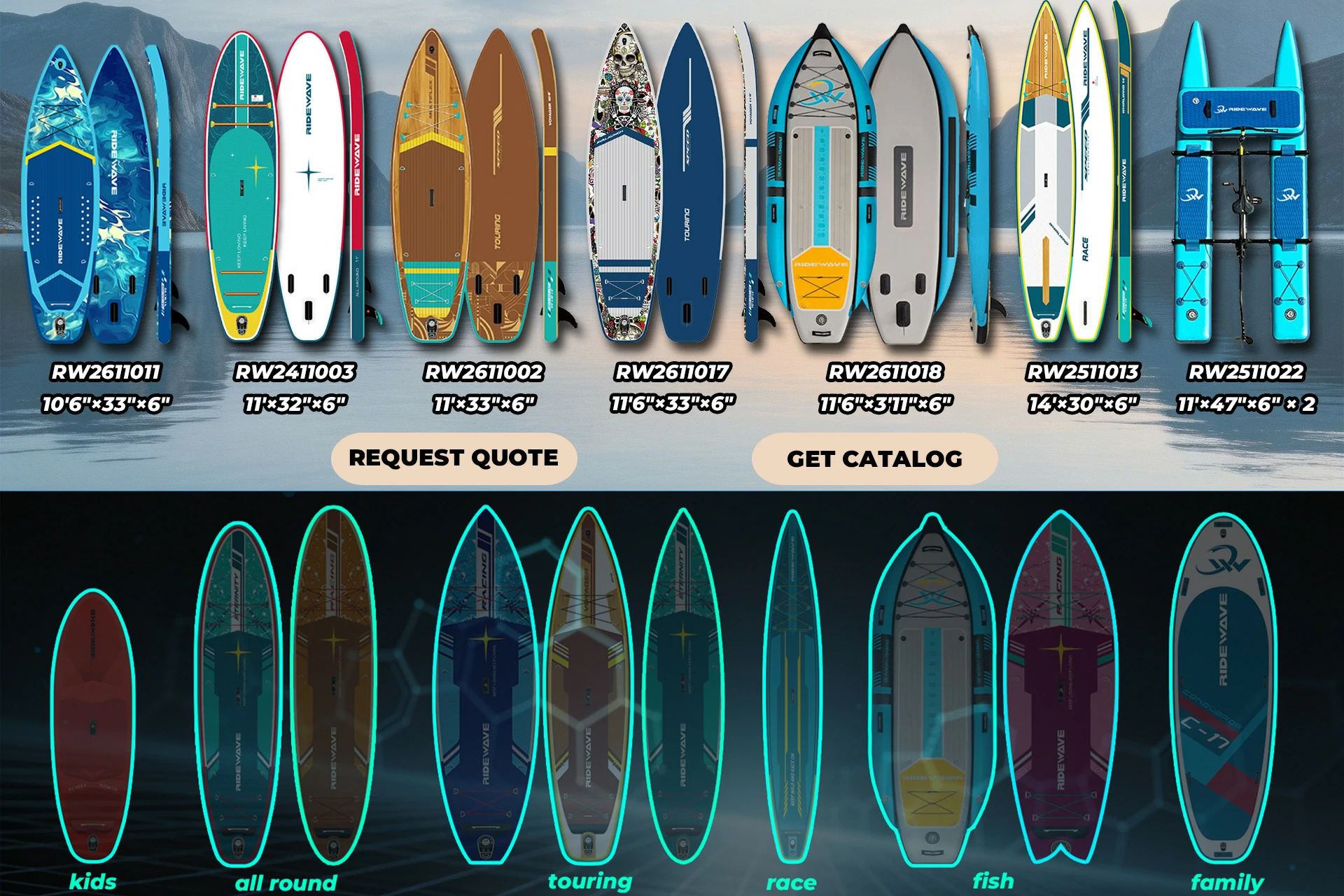


Dutch and pan-European B2B distributors, wholesalers, and private-label sporting goods brands sourcing inflatable SUP often focus too heavily on unit price and overlook flexible MOQ negotiation, clear warranty boundaries, spare parts allocation, and liability rules - these four elements actually determine your true profit margin and reduce retail complaint risks when importing iSUP paddle boards. Many importers rush into factory contracts only to discover rigid minimum order requirements, vague after-sales clauses, or unexpected cost increases triggered by EU CBAM and Rotterdam port logistics delays, erasing their planned ROI before boards even reach European warehouses. When you negotiate with a professional inflatable stand up paddle board manufacturer such as RIDEWAVE, your negotiation strategy should separate standard stock SUP boards from OEM custom orders, and build enforceable after-sales terms into your purchase agreement from the first trial order. To fully grasp production constraints before opening talks, read How Custom Paddle Boards Are Made: From Design To Production, which breaks down material selection, drop-stitch lamination and quality control workflows that shape factory MOQ limits.
The Netherlands remains a critical European hub for wholesale inflatable SUP distribution, thanks to Rotterdam's deep-water port, mature B2B outdoor retail networks, and strong consumer demand for all-round, fishing, yoga and touring inflatable paddle boards. Yet many Dutch buyers face identical pain points: they want to test multiple SUP models without committing to full container loads, protect their business from defective board claims, and avoid being trapped by one-sided factory warranty language. This guide is built for importers, resellers and emerging water-sports brand owners, explaining practical negotiation tactics, contract wording tips, true landed cost calculation, and real-world case studies from RIDEWAVE's B2B wholesale partnerships. We will show you how to negotiate realistic MOQ tiers, lock in spare parts provisions, define defect acceptance thresholds, and structure multi-year distribution agreements for bulk inflatable SUP imports across the EU, UK, USA, Canada and Australia.
Why Do Dutch B2B Buyers Care More About MOQ Flexibility Than Unit Price?

Many new wholesale inflatable SUP buyers from the Netherlands immediately start negotiations by pushing for a lower per-board price, yet seasoned importers know that rigid minimum order quantity rules often create far bigger risks than a slightly higher unit cost. When you source inflatable stand up paddle boards, a non-negotiable high MOQ locks your capital into large inventory batches, limits your ability to test multiple SUP models, and slows your response to fast-shifting European water sports consumer trends. For Dutch distributors selling across Benelux, stock turnover is everything; slow-moving iSUP paddle boards sitting in Rotterdam or local warehouse racks tie up cash and increase storage, insurance and depreciation costs over time.
MOQ flexibility is especially valuable for private-label brands and new entrants expanding into the bulk inflatable SUP market. A factory that refuses to adjust order minimums forces buyers to place oversized orders before validating local market demand. RIDEWAVE works with dozens of Benelux wholesalers on tiered MOQ frameworks built around production line constraints, rather than enforcing one universal hard minimum for all drop stitch SUP orders. These tiered structures separate ready-stock paddle board SKUs from fully custom OEM boards, giving buyers clear choices when planning trial imports.
Before diving into negotiation tactics, it helps to quantify the financial gap between small trial orders and full-container shipments. The table below compares capital outlay, inventory risk and turnover expectations for common inflatable SUP order sizes.
| Order Type | Estimated MOQ | Approx. Total Goods Value | Inventory Risk Level | Typical Stock Turnover | Best For |
|---|---|---|---|---|---|
| Small trial mixed SKU | 50 pcs | Low | Low | Fast | New distributors, brand testing new SUP models |
| Half container (20GP) | 150–250 pcs | Medium | Medium | Moderate | Established wholesalers testing 2–3 board styles |
| Full 40HQ container | 450–650 pcs | High | High | Slow | Mature distributors with proven retail demand |
How Do You Actually Negotiate Inflatable SUP MOQ With an Overseas Factory?
Many B2B inflatable SUP buyers approach MOQ talks as a simple haggling exercise, but successful negotiation with an overseas inflatable stand up paddle board manufacturer relies on understanding what drives factory minimums, rather than only demanding a lower number. Every iSUP paddle board production run carries fixed overhead costs: raw material batch preparation, drop‑stitch sheet cutting, mould setup, machine calibration, and first‑article quality inspection. These fixed expenses are the core reason factories enforce minimum order quantities for custom bulk inflatable SUP orders.
When negotiating MOQ for wholesale inflatable paddle boards, separate your request into two categories: ready‑made stock SUPs and fully custom OEM paddle boards. Stock SUP models that the factory already produces regularly have far lower barriers, because materials, cutting templates and production workflows are already in place. Custom orders, which require unique graphics, custom board dimensions or modified D‑ring layouts, need dedicated line setup, which will naturally raise baseline MOQ requirements.
RIDEWAVE's B2B sales team often shares four practical negotiation frameworks with European importers to unlock flexible order limits, without forcing the factory to absorb unsustainable production losses: • Combine existing stock inflatable SUP SKUs for mixed trial orders • Pair a smaller custom batch with a larger volume of standard ready‑to‑ship paddle boards • Sign a 12‑month volume forecast agreement to reduce the per‑shipment MOQ requirement • Schedule production within existing production windows, rather than requesting urgent priority manufacturing slots
Buyers also need to avoid one common negotiation mistake: asking for an extremely low MOQ while demanding multiple custom changes at the same time. Custom printing, reinforced handles, upgraded valve systems and custom packaging all add separate setup work. Stacking too many custom modifications on a tiny order will nearly always result in rejected MOQ requests or inflated unit pricing.

It helps to frame your negotiation around mutual benefit. Instead of saying "reduce your MOQ for me", explain your market validation plan. Tell the factory you plan to place repeat full container orders if the trial batch sells well locally. Factories such as RIDEWAVE are far more willing to adjust terms when buyers share realistic sales projections and commit to future cooperation, rather than treating the negotiation as a one‑time transaction.
Can You Mix Different Board Models in One Container to Lower Effective MOQ?
Many B2B wholesale inflatable SUP buyers assume mixed SKU container shipments are universally available, but mixed loading rules vary widely between factories. Mixing multiple inflatable stand up paddle board models in a single container is one of the most powerful ways to reduce your effective MOQ, allowing you to test diverse SUP models without committing a full container of only one single iSUP design. However, mixed orders still have practical limits based on packaging dimensions, pallet rules, raw material batches and factory production scheduling.
For European distributors targeting Benelux, Germany and France, mixed container loads are extremely valuable. A wholesaler can combine all-round inflatable SUP, fishing paddle boards, yoga SUP and touring inflatable paddle boards in one shipment. This strategy lets retailers stock a full product portfolio, cater to varied customer groups, and avoid overstocking a single slow-selling board style. RIDEWAVE regularly handles mixed-container orders for EU importers, with clear internal rules to balance buyer flexibility and factory operational efficiency.
It is critical to understand the difference between "theoretical mixing" and "factory-approved mixed loading". Not every combination of iSUP paddle boards can be packed together seamlessly. Larger boards occupy more carton space, which changes the total quantity you can fit inside a 40HQ or 20GP container. The table below shows common inflatable SUP styles, carton measurements, estimated quantity per 40HQ, and recommended mixed loading combinations for B2B wholesale buyers.

| Inflatable SUP Model | Typical Board Size | Carton Size (L×W×H cm) | Estimated Qty per 40HQ | Best Mixing Partners |
|---|---|---|---|---|
| All-round SUP | 10'6" | 92 × 42 × 28 | 520 pcs | Yoga SUP, beginner paddle board |
| Fishing inflatable paddle board | 11' | 105 × 45 × 30 | 420 pcs | All-round SUP |
| Yoga SUP | 10' | 88 × 40 × 26 | 560 pcs | All-round SUP |
| Touring inflatable stand up paddle board | 14' | 122 × 48 × 32 | 360 pcs | Fishing SUP (limited ratio) |
When planning your mix, always set a minimum percentage for each selected SKU. Most manufacturers, including RIDEWAVE, require each mixed model to account for 15% or more of the total container volume. This avoids excessive line changeovers that slow down mass production. Buyers also need to confirm carton labeling requirements in advance. Clear individual SKU markings simplify customs clearance in Rotterdam and local warehouse sorting once the bulk inflatable SUP shipment arrives.
One extra detail many importers overlook: mixed orders may have a small packing and sorting surcharge. This fee covers extra labour for separate packing, labeling and pallet grouping. You should negotiate this fee upfront and include it inside your formal quotation, so no unexpected charges appear before shipment.
What After-Sales Clauses Should Every Wholesale iSUP Contract Spell Out?

Many B2B inflatable SUP buyers focus all negotiation energy on pricing and MOQ, only to leave after-sales and warranty obligations loosely defined in their purchase contract. Vague warranty wording is one of the biggest profit killers for wholesale inflatable paddle board importers operating in the EU, especially the Netherlands. European consumer protection rules impose strict liability on distributors, so defects from inflatable stand up paddle boards will often land on your business before you can escalate issues back to your factory partner.
When drafting terms for bulk inflatable SUP orders, your written agreement must clearly separate manufacturing defects from damage caused by end-user misuse. Factory liability should cover drop‑stitch seam separation, defective air valves, faulty D‑ring welding, and poor heat sealing on the rail. Wear and tear, improper inflation, sharp object punctures, and UV damage after normal use are not factory-covered defects. This distinction protects both you and your supplier from endless warranty disputes after iSUP paddle boards reach retail customers.
RIDEWAVE recommends seven core after-sales clauses every B2B buyer should negotiate and add to the sales contract. These clauses set clear boundaries for defect rates, spare parts support, inspection windows, claim timelines, shipping responsibility for replacements, packaging quality standards and product compliance documentation.
Do not rely on verbal promises from factory sales representatives. All warranty, spare parts and defect resolution rules must be captured in your formal proforma invoice or sales contract before deposit payment. Even trusted suppliers can change internal teams, and written clauses prevent miscommunication months later when a claim arises.
How Do Dutch Importers Handle Warranty Claims Without Alienating Their Own Retailers?
Dutch inflatable SUP importers operate within strict EU consumer protection laws, which place much of the warranty burden on local distributors, not overseas factories. When retailers contact you with complaints about defective inflatable stand up paddle boards, slow responses or complicated claim processes will quickly damage your B2B relationships and reduce repeat orders from your retail partners. The core challenge for every wholesale inflatable paddle board distributor is to separate factory-side manufacturing faults from end-user damage, while delivering fast support to retailers without absorbing unnecessary costs.

Many new B2B buyers make one costly mistake: waiting for the factory to validate every claim before responding to retailers. Retailers in the Netherlands, Belgium and Germany serve local customers who expect quick resolutions. Delayed replies can lead to chargebacks, negative online reviews, and permanent loss of retail accounts, even when the root issue is not your fault. A well-planned spare parts inventory is your most effective buffer for bulk inflatable SUP warranty cases.
RIDEWAVE advises European wholesale partners to build a small local stock of critical spare parts alongside each incoming container shipment. Essential items include replacement air valves, D-rings, repair patches, hand pumps and ankle leashes. Having these parts stored in your Dutch warehouse lets your team resolve most minor iSUP paddle board defects within days, instead of waiting weeks for factory shipments from Asia. This approach keeps retailers satisfied and protects your brand reputation across Benelux water sports retail channels.
You should also create a simple, standardized claim workflow to share with all retail clients. The workflow should clearly list what evidence retailers need to submit: high-resolution photos, short video clips showing the defect, purchase batch numbers and board serial numbers. This standardized evidence collection helps you quickly filter accidental damage from genuine manufacturing defects, and simplifies the process when you escalate valid claims back to your inflatable SUP manufacturer.
A practical rule of thumb: reserve roughly 1% of your total order budget as a warranty contingency fund. This reserve covers unexpected small claims and local shipping fees for spare parts sent to retailers. This small financial buffer prevents isolated warranty incidents from eating into your overall profit margin on wholesale inflatable SUP sales.
What Does a Real RIDEWAVE Wholesale Order Actually Look Like?
Case studies turn abstract negotiation rules for inflatable SUP into tangible, real-world results. This story follows a North American outdoor sports wholesaler that wanted to expand its product line with private-label inflatable stand up paddle boards, without committing to large upfront inventory risks. The distributor had existing retail partners selling kayaks and outdoor gear across Canada, but had never imported bulk inflatable SUP before and worried about rigid MOQ rules and unclear after-sales support.
When they first reached RIDEWAVE, their original request was a fully custom printed graphic series of all-round inflatable SUP boards. Their target was 200 pieces, but the pure OEM custom artwork requirement carried a baseline MOQ of 500 units. The buyer could not justify ordering 500 custom boards in one shipment, as they lacked market data to confirm local Canadian consumer demand.
The RIDEWAVE B2B team proposed a compromise plan: • Mix 120 units of ready-stock standard inflatable paddle boards with 80 units of custom graphic private-label SUPs. • Lock the combined total at 200 pcs, which qualified for a reduced trial MOQ under our annual forecast framework. • Include complimentary spare parts and repair kits proportional to the full 200-piece shipment. • Write a 1.0% manufacturing defect threshold and 2-year limited drop-stitch warranty directly into the sales contract. • Schedule production inside our existing production window, avoiding urgent rush surcharges.
The buyer accepted the terms and placed the deposit. Production, QC inspection, container loading and ocean shipment to Vancouver port proceeded smoothly. After the shipment arrived, only one board had a minor valve defect, which was quickly resolved using the pre-shipped spare parts kit. The distributor's retail network sold through nearly the entire trial batch within 7 months.
Based on strong retail feedback, the client signed a 12-month volume forecast agreement for the next year. Their second order jumped to a full 40HQ mixed container of SUP models, including fishing and touring iSUP paddle boards. They also added new custom graphic SKUs, now confident in market traction.

This example highlights one critical lesson for every wholesale inflatable SUP buyer: flexible MOQ and well-defined after-sales terms are not free concessions. Suppliers like RIDEWAVE will adjust order requirements when buyers share realistic sales forecasts and demonstrate a clear long-term growth plan, instead of only seeking a one-off cheap trial shipment. Before designing artwork for your own private label project, read How To Design A Paddle Board That Sells to understand what visual features resonate most with North American and European outdoor shoppers.
How Do You Calculate True Landed Cost Before You Even Open a Negotiation?
Many B2B inflatable SUP buyers only compare FOB prices when evaluating suppliers, yet the FOB unit price represents just one piece of your total expenditure for wholesale inflatable paddle board imports. Your true landed cost is the full amount spent to get one inflatable stand up paddle board delivered into your European warehouse. If you skip this calculation before negotiating MOQ and contract terms, you risk locking in a deal that appears cheap on paper but erodes your profit margin once the goods arrive at Rotterdam or other EU ports.
True landed cost calculation covers far more than factory pricing. It includes ocean freight, port handling fees, customs duties, EU VAT, inland trucking, insurance, inspection charges, currency exchange fees, warehousing costs and a small provision for warranty spare parts and unexpected losses. For bulk inflatable SUP, larger containers reduce per-unit shipping costs, but higher MOQ increases your upfront capital commitment and inventory holding risk. This trade-off is the core reason landed cost analysis must be completed before you start negotiating order quantities.
Below is a complete cost breakdown example for a single all-round inflatable SUP, based on FOB pricing and delivery to a warehouse in the Netherlands. All figures are illustrative for B2B planning and can be adjusted based on current freight rates and order scale.
You also need to factor in inventory holding cost month over month. Slow-selling iSUP paddle boards sitting in storage create ongoing costs for rent, insurance and capital lockup. This reinforces why flexible low trial MOQ is valuable: it lets you test market demand without paying high carrying costs on thousands of unsold inflatable paddle boards.
What Do 2026 Tariff Shifts and Rotterdam Shipping Headwinds Mean for iSUP Buyers?
European wholesale inflatable SUP importers cannot ignore evolving global logistics and trade rules when planning bulk inflatable SUP purchases. 2026 has brought subtle but impactful changes to port operations, carrier pricing and EU environmental regulations that directly affect anyone importing inflatable stand up paddle boards through Rotterdam. Many B2B inflatable SUP buyers build their budgets using last year's freight and tariff data, only to face unexpected cost increases and shipment delays once production is underway.
Rotterdam remains Europe's primary entry port for Asian water sports goods, but ongoing congestion, terminal labour scheduling adjustments and peak-season carrier surcharges continue to create uncertainty for iSUP paddle board shipments. Vessel space can tighten rapidly in spring, ahead of Europe's summer paddle sports season. If you lock production without reserving container space early, your inflatable paddle boards may sit at the factory warehouse for weeks, missing your retail sales window and hurting seasonal revenue.
The most important regulatory update for inflatable SUP buyers in 2026 relates to EU CBAM, the Carbon Border Adjustment Mechanism. Importers must now verify carbon reporting documentation from suppliers for carbon-intensive materials such as the PVC and drop-stitch fabric used in SUP construction. Non-compliance can trigger additional administrative fees or hold-ups during customs clearance. Working with a manufacturer like RIDEWAVE simplifies this process, as our team prepares the required material and carbon related paperwork for B2B wholesale shipments bound for the EU.
Tariff classification also deserves careful review. Inflatable stand up paddle boards fall under HS code 950691, but misclassification is still common. Incorrect HS coding can lead to customs inspections, duty re-assessment and costly delays at Rotterdam. Always confirm the HS classification with your freight forwarder and factory before shipment.

These shipping and regulatory pressures reinforce two core negotiation priorities for SUP importers: • Build contingency time into your production and delivery schedule, especially for orders shipping before the European summer water sports peak. • Negotiate flexible shipment scheduling terms with your supplier, to avoid penalty fees if port delays force minor timeline adjustments.
Logistics volatility makes the landed-cost calculations we covered in the previous section even more critical. Small shifts in freight or regulatory charges can erase your projected profit margin on wholesale inflatable paddle board orders.
How Can You Build Long-Term B2B Partnerships for Stable Inflatable SUP Supply?
Many B2B inflatable SUP buyers treat supplier relationships as one-off transactions focused only on the lowest wholesale inflatable paddle board price. However, long-term partnerships with a reliable inflatable stand up paddle board manufacturer deliver greater value than squeezing marginal per-unit discounts. Stable supply chains become increasingly important when sourcing bulk inflatable SUP, especially amid volatile freight rates, port congestion and changing EU compliance requirements for iSUP paddle boards.
A strong B2B partnership for inflatable SUP relies on transparent two-way communication. Instead of hiding your sales forecasts or retail feedback from your manufacturer, share honest market performance data, seasonal demand peaks and retailer feedback. Factories such as RIDEWAVE use this information to reserve production capacity, schedule raw material stock, and prioritise your orders during busy spring manufacturing windows for the European summer water sports season. This level of collaboration reduces production delays and lowers the risk of material shortages impacting your SUP models.
There are several actionable steps you can take to nurture a sustainable supplier relationship: • Share quarterly sales projections, not just last-minute order requests. • Provide honest feedback on product quality, packaging and retailer complaints. • Plan orders 3–4 months ahead of peak selling seasons to avoid rush production surcharges. • Negotiate a framework agreement that locks in tiered MOQ, spare parts terms and warranty rules for 12 months. • Work together to iterate product improvements, such as reinforced handles or upgraded valve systems for your target market.
Long-term agreements also create mutual risk reduction. When a manufacturer sees consistent annual volume from a buyer, they are far more willing to approve flexible mixed SKU loads, offer priority QC checks, and assist quickly when customs or compliance issues appear. For private-label OEM inflatable SUP buyers, ongoing collaboration also speeds up new product development cycles, helping you launch fresh SUP models ahead of competitors in Benelux, UK, USA and Australian water sports markets.

Even in a stable partnership, you should keep periodic quality audits and annual contract reviews. Market conditions change every year, so revisit landed cost estimates, defect thresholds and spare parts allocations before renewing your framework deal. Building trust does not mean removing all safeguards; it means creating predictable terms that benefit both your wholesale business and your inflatable paddle board supplier.
Negotiating successful terms for wholesale inflatable SUP is not about pushing suppliers into one-sided, unsustainable concessions. For Dutch and pan-European B2B inflatable SUP distributors, the best strategy balances flexible MOQ, clear after-sales warranty rules, realistic landed cost planning, and careful logistics scheduling for inflatable stand up paddle boards.
Your biggest profit risks rarely come from a small increase in unit price. The real threats are rigid minimum order limits, ambiguous warranty contracts, underestimated import fees, port delays and poor inventory turnover for your iSUP paddle boards. By mixing SUP models in containers, reserving local spare parts stock, calculating full landed costs, and building transparent long-term supplier relationships, you can reduce risk while expanding your bulk inflatable SUP product portfolio.
Working with a professional manufacturer such as RIDEWAVE gives you access to tiered trial order options, clear written warranty terms, EU compliance documentation and support navigating Rotterdam logistics and CBAM requirements. Whether you are testing your first small trial shipment or scaling up to full-container private label orders, focus negotiation on the full business package instead of only chasing the lowest per-board price.
With the tactics and contract guidance in this guide, you can enter supplier negotiations fully prepared, protect your profit margins, and build a resilient inflatable paddle board wholesale business across Europe, North America and Australia.
Related Articles
What Types Of Inflatable SUP Deliver The Best Profit Margins For Dutch Dealers?
How To Cut Lead Times When Shipping Bulk Inflatable SUP To Rotterdam Port?
How Do Dutch Wholesalers Optimize Inventory For Seasonal Inflatable SUP Demand?
Is Private Label OEM Inflatable SUP A Good Investment For Dutch Water Sport Brands?
| What Hidden Sourcing Risks Should Dutch Inflatable Paddle Board Importers Watch Out For? |