

Introduction: Closing the Performance Gap in the Kayak Market
For decades, the global inflatable kayak industry has struggled with a persistent stigma: that a portable boat is, by definition, a "leisure-only" toy. Retailers and distributors often find themselves caught in a challenging position, balancing the undeniable consumer demand for storage-friendly gear with the risk of selling products that lack the structural integrity of traditional hard-shell vessels.
However, the market is undergoing a structural shift. Today's outdoor enthusiasts-whether they are professional anglers, expedition paddlers, or high-end rental operators-are no longer willing to sacrifice tracking performance and hull rigidity for the sake of portability. They expect the convenience of an inflatable watercraft but demand the response time and efficiency of a composite boat.
For B2B wholesalers and retail brand owners, this "Performance Gap" is your greatest opportunity and your most significant risk. Stocking kayaks that flex under load or lose shape in choppy water is a recipe for high return rates and eroded brand trust. Conversely, partnering with a manufacturer that prioritizes high-pressure structural integrity allows you to capture the high-end segment of the market, command premium pricing, and solidify your reputation as a provider of serious, pro-grade equipment. At RIDEWAVE, we believe that rigidity is not just a technical specification; it is the fundamental metric of quality that guarantees your inventory stays on the water and out of the return pile.
The Physics of "Flex": Why Rigid Kayak Performance Drives Retail Success
When a paddler steps into a kayak, they aren't just looking for buoyancy; they are looking for a direct, responsive extension of their own kinetic energy. In the rigorous physics of paddling, hull flex-the unintended deformation of the boat's shape under load-is the ultimate enemy of efficiency. Every time a kayak's hull deforms (whether through side-tube bowing, floor-panel sagging, or structural instability), it acts as a passive shock absorber. Instead of propelling the paddler forward, the boat absorbs the energy of each stroke. For your retail partners, this "flex" isn't merely an abstract engineering flaw; it is the fundamental reason why end-users complain about a "sluggish" boat that feels like it's "dragging in the mud."
Industry Solutions
Choose the plan that suits you best.
Tracking Accuracy & Hull Efficiency:
A rigid hull ensures that every ounce of effort applied to the paddle translates directly into forward momentum. When you provide a high-rigidity inflatable kayak, you are supplying a vessel that tracks straight, cuts through wind resistance, and maintains its line even in challenging, unpredictable currents. This precision is what differentiates a "leisure-only" inflatable from a true piece of outdoor equipment. By minimizing hull deformation, you provide a boat that feels alive and responsive, keeping the paddler in total control.
01
User Safety, Predictability, and Confidence:
Inflatable structures that lack sophisticated structural hardening often feel "mushy" or disconnected to the user, creating a pervasive sense of instability that is especially alarming for beginners or those venturing into open water. Rigidity inspires total confidence. A boat that feels solid, stable, and reactive underfoot is a boat that encourages the user to venture further, stay on the water longer, and ultimately, evolve from a casual hobbyist into a passionate, active brand advocate.
02
The B2B Profitability Link: Minimizing Returns (RMA):
From a strictly commercial perspective, the physics of performance directly dictates your Return Merchandise Authorization (RMA) rates. High-rigidity products generate significantly fewer "it feels cheap" or "the boat doesn't perform" complaints. By minimizing the structural defects inherently associated with low-pressure, low-rigidity designs, you ensure that your investment in inventory translates into high-value customer satisfaction rather than expensive, reputation-damaging post-purchase service costs.
03
The "Hard-Shell" Perception Gap:
The modern market is increasingly educated; consumers can now distinguish between a "pool toy" and a high-performance inflatable watercraft. When your kayak maintains its architectural integrity under the weight of an adult and their gear, you are essentially "selling up" to the performance segment. Customers are willing to pay a premium when they feel the rigidity of the boat; conversely, they will demand a refund if the boat flexes and loses its shape within the first hour of use.
04
RIDEWAVE approaches this challenge by treating the kayak as a precision engineering project rather than a simple containment vessel. We don't just "inflate" a shape; we build a rigid, high-performance platform that rivals the feel of a traditional hard-shell kayak. We integrate advanced structural reinforcements that stabilize the hull, ensuring that your catalog serves the performance demands of the modern outdoor market while protecting your bottom line from the pitfalls of low-quality design.
Engineering Rigidity: The RIDEWAVE Protocol
At RIDEWAVE, we operate under the core conviction that structural integrity is not an optional feature-it is the very definition of quality. We have effectively moved beyond the limitations of traditional, low-pressure inflatable designs by adopting an end-to-end engineering protocol that treats rigidity as the primary metric of performance. By meticulously mimicking the hull dynamics and hydrodynamic efficiency of rigid, composite vessels, we provide an inflatable kayak that satisfies both the casual weekender and the seasoned, performance-obsessed explorer.

-
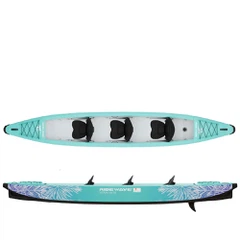
The Science of Drop-Stitch Mastery: The bedrock of our rigidity protocol is our advanced high-pressure drop-stitch technology. While standard inflatables rely on simple air-chamber pressure to maintain a "rounded" shape, our drop-stitch floor panels are engineered with thousands of high-tensile, vertical polyester threads that connect the top and bottom fabric layers. When inflated to high PSI, these threads lock into a rock-solid, non-deformable platform. We have pushed this technology further by customizing the density and tension of these fibers specifically for the high-load, multi-paddler environment of a kayak. This creates a floor that doesn't just "hold air"-it functions as a rigid, load-bearing deck that provides the stability and responsiveness typically reserved for fiberglass or polyethylene boats.
-
-
Proprietary Structural Hardening Architecture: Beyond the drop-stitch core, we implement a comprehensive side-tube reinforcement system designed to eliminate hull oscillation. By utilizing multi-layered, high-denier laminates that are UV-stabilized and abrasion-resistant, our tubes maintain their precise geometric integrity even under extreme thermal stress-whether in the blistering heat of a high-noon summer or the chilling conditions of early-spring meltwater. We have fundamentally eliminated the "soft-spot" or sagging effect commonly associated with entry-level inflatables, ensuring that the bow and stern maintain a sharp, piercing profile that tracks effortlessly through the water without drifting.
-


-
Precision Heat-Welded Seam Integrity: In the world of high-performance inflatables, the seam is the most common point of failure. Traditional mechanical glue joints are porous and prone to degradation under UV light and physical stress. RIDEWAVE has abandoned outdated gluing methods in favor of industrial-grade heat-welding technology. By using controlled heat to create a molecularly fused bond between fabric layers, we transform the kayak into a single, unified structure. This provides an airtight integrity and sheer strength that chemical adhesives simply cannot replicate. For your retail catalog, this is the ultimate "peace-of-mind" feature; it means your inventory is protected against delamination and air leaks, keeping your customer satisfaction levels high and your RMA (Return Merchandise Authorization) paperwork virtually non-existent.
-
-
-
The "Hard-Shell Feel" without the Logistical Burden: The ultimate goal of the RIDEWAVE Protocol is to bridge the performance gap between performance and portability. We don't just "inflate" a shape; we build a high-performance portable platform. When your customers step into one of our kayaks, they experience an immediate sense of stability-no wobbling, no structural deformation, and none of the "wasted energy" common in low-pressure boats. It is this specific tactical advantage that empowers your sales team to command a premium price point. You aren't just selling a boat; you are selling a high-performance experience that justifies the investment, turning the first-time buyer into a lifelong brand advocate.
-

The ROI of High-Performance Inventory: Turning Specs into Sales
For the professional wholesale distributor and retail brand owner, performance is not just a technical benchmark-it is a Profit & Loss (P&L) lever. Stocking high-rigidity inflatable gear does more than just impress customers on the showroom floor; it fundamentally optimizes your business's financial health by reducing operational friction and increasing your "sell-up" potential.
Minimizing "Buyer's Remorse" and RMA Costs:
In the B2B outdoor sector, the most expensive sale is the one that comes back as a return. Low-rigidity inflatables frequently suffer from structural failure, seam delamination, or perceived "cheapness," all of which trigger costly Return Merchandise Authorization (RMA) processes. By partnering with RIDEWAVE, you leverage our precision-engineered rigidity to virtually eliminate these post-purchase complaints. When a customer receives a boat that feels as solid and reliable as a hard-shell vessel, their trust in your brand deepens, and your customer acquisition costs (CAC) stay stable because you aren't wasting resources on warranty management.
01
Capturing the "Premium Performance" Segment:
Retailers who only stock entry-level, soft-hulled inflatables are trapped in a "race to the bottom" on price. By integrating high-rigidity kayaks into your catalog, you gain the ability to capture the lucrative performance-oriented market-serious anglers, expedition paddlers, and fitness enthusiasts who prioritize equipment reliability. These customers are significantly less price-sensitive and more focused on the on-water performance metrics. Selling a boat that tracks straight and holds its shape allows your retail partners to command a higher price point, effectively increasing the margin per unit sold.
02
The "Bundle Potential" of Performance Gear:
High-performance hardware creates a platform for high-margin accessory sales. A rigid, stable inflatable kayak is not just a standalone boat; it is a specialized base for customization. Customers who invest in a high-rigidity model are naturally inclined to outfit their craft with advanced accessories-GPS mounts, specialized fishing rod holders, performance-tuned seats, and electric high-pressure pumps. By positioning your catalog around performance, you are opening doors to higher average order values (AOV) across your entire accessory ecosystem.
03
Brand Authority as a Competitive Moat:
In an era of online saturation, your brand's reputation is your strongest competitive moat. When you supply high-rigidity gear that consistently delivers on its performance promises, you move your retail brand from the "discount category" into the "professional outfitter" tier. This authority is what keeps customers returning to your shop for their next purchase. Reliability creates loyalty; in the inflatable kayak industry, rigidity is reliability.
04
Measuring Performance: A Practical Guide for Wholesale Buyers
As a professional buyer, you shouldn't have to rely on marketing brochures alone to determine if an inflatable kayak is truly performance-grade. You need objective ways to verify structural integrity before committing to a bulk purchase. Educated sourcing is the first step in building a high-performance inventory.
-The "Deflection & Deformation Test": When evaluating samples, perform a simple static load test. Place the kayak on two raised platforms (at the bow and stern) and apply a localized weight (e.g., 80kg–100kg) to the center of the cockpit. A low-quality, "soft" inflatable will show immediate, deep sagging, indicating poor structural rigidity. A high-performance RIDEWAVE kayak, thanks to our --high-pressure drop-stitch architecture, will demonstrate minimal deflection. This "bridge-like" rigidity is what you should look for in every sample.
-Material Density & PSI Thresholds: Always demand the technical specification sheet (TSS). A professional-grade inflatable kayak must be rated for higher operating pressures (e.g., 6–10 PSI for floors). If a manufacturer suggests lower pressures, they are essentially admitting that their seam technology cannot withstand the stress of a rigid platform. High-density 1000D PVC is the industry standard for durability; if a supplier is using thinner material, it will eventually lose its shape under thermal expansion.
-The "Seam Pull" Inspection: Rigidity is useless if the seams are not built to contain it. Inspect the seam overlaps. Professional heat-welding leaves a clean, narrow bond, whereas manual gluing often leaves uneven, sticky residue. When testing, apply firm pressure to the seam area-if you see "whitening" (stress marks) in the fabric near the seam, the material quality or the welding temperature is inconsistent, which is a major red flag for future durability.
-Independent Lab Certification: Never accept "marketing promises." Request third-party test reports (such as SGS or TUV) that specifically cover structural load-bearing capacity and material burst pressure. A manufacturer that proactively shares these dossiers is a manufacturer that stands behind its technical claims.
Building the Future of Your Catalog: A Strategic Partnership
In a market saturated with generic inflatables, your catalog's strength lies in your ability to curate products that transcend the "toy" category. By transitioning to high-rigidity, performance-grade inventory, you are not just updating your SKU list-you are positioning your retail brand as a destination for serious outdoor enthusiasts.
-Audit Your Current Pipeline: The most successful distributors are those who audit their suppliers relentlessly. Does your current catalog deliver on the promise of performance? If your existing models rely on outdated glue-seams or low-pressure designs, you are losing money to unnecessary returns and missed cross-selling opportunities. It is time to align your inventory with the market's demand for professional-grade reliability.
-Performance as a Value Anchor: Remember, your customers do not care about the technicalities of PSI or 1000D materials until they experience a failure. By choosing a partner like RIDEWAVE, you are guaranteeing that they never encounter those failures. Our protocol-driven manufacturing ensures that your reputation remains spotless, allowing you to focus on growth rather than damage control.
-The RIDEWAVE Advantage: We don't just manufacture high-performance inflatable kayaks; we provide the operational consistency that allows your business to scale with confidence. Our integrated manufacturing, unified technical documentation, and performance-driven design philosophy ensure that every unit in your warehouse is a high-value asset, not a liability.
Ready to optimize your catalog for the upcoming season? Don't leave your inventory performance to chance. Let's analyze your local market trends together and build a customized, high-velocity order mix that ensures your business stays ahead of the curve.
Related Articles