

Defining the New Standard for the Inflatable Kayak Market
In 2026, the global watersports landscape is witnessing a definitive transition. The market for portable watercraft has matured significantly, moving away from entry-level recreational toys toward high-performance, durable equipment designed for the modern adventurer. For B2B distributors, wholesalers, and retail brand owners, this shift represents a critical window of opportunity: the chance to capture a growing demographic that demands both the agility of an inflatable kayak and the structural integrity of a traditional hard-shell vessel.

Success in this category no longer depends on volume alone; it requires precision in procurement. Professional buyers are now prioritizing supply chain stability, material innovation, and retail-ready versatility. As a manufacturer, RIDEWAVE has observed that the most successful retail portfolios are those that bridge the gap between "adventure-ready" performance and "logistics-friendly" portability. By leveraging advanced drop-stitch technology and rigorous quality control standards, we help our partners navigate the complexities of the global kayak market-turning inventory into a high-turnover asset rather than a warehouse burden.
This guide explores the 10 defining trends shaping the industry this year. We will examine how iKayak design is evolving to meet the needs of rental fleets, urban explorers, and premium outdoor brands alike. Whether you are looking to scale your current product line or launch a new private label kayak series, the insights below are designed to optimize your strategy, mitigate logistical risks, and ensure your brand stands out in a crowded marketplace.
Trend 1 : The Rise of Drop-Stitch Hybrid Design (Performance Parity)
In the 2026 outdoor equipment market, the most significant technological disruption driving high retail turnover is the widespread adoption of high-pressure drop-stitch technology in inflatable kayak manufacturing. For decades, the industry was constrained by a functional dichotomy: consumers were forced to choose between the high-performance tracking and rigidity of hard-shell rotomolded or fiberglass boats, or the convenience of lightweight, inflatable vessels that often lacked structural integrity. That division is now effectively obsolete.

Modern iKayak models have revolutionized this landscape by integrating thousands of high-tensile polyester internal threads. When inflated to professional-grade pressure, these threads create a hull that exhibits the same structural rigidity, speed, and responsiveness as a traditional hard-shell craft. For B2B stakeholders, this represents a massive expansion of the "addressable market." You are no longer just selling a "toy" to recreational beachgoers; you are selling a high-performance touring kayak to enthusiasts who previously demanded hard-shell gear but lacked the storage space to accommodate it.
The commercial impact of this "Performance Parity" cannot be overstated. By stocking RIDEWAVE models that utilize this hybrid architecture, retailers can confidently promise customers that they aren't sacrificing hydrodynamic efficiency, tracking, or stability. In an era where "van-life" and urban apartment living are the dominant lifestyle trends, the ability to offer a professional-grade vessel that deflates into a standard carry-bag creates a unique value proposition that drives higher conversion rates. Furthermore, this structural stiffness minimizes hull deformation under load-a common failure point in legacy inflatable designs-which drastically reduces product return rates and strengthens your brand's reputation for reliability.
When your retail staff or rental fleet operators demonstrate this rigidity during a demo, the psychological barrier to purchase disappears. The customer isn't buying an inflatable substitute; they are investing in a high-utility, professional-grade piece of equipment. For distributors and wholesalers, this means fewer customer support inquiries, shorter sales cycles, and a significantly higher volume of repeat business as your customers realize that RIDEWAVE provides the same on-water experience as a hard-shell boat, but with 90% less hassle.
Trend 2: Ultra-Modular Cabin Configurations (The "One-Size-Fits-All" Retail Solution)
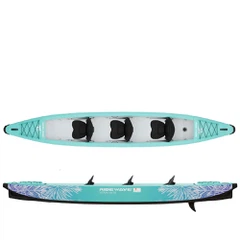
In 2026, the retail market is moving away from hyper-specialized, rigid product offerings toward the "Adaptive Platform" model. For B2B partners, managing inventory for a dozen different kayak variations-solo, tandem, fishing, touring-is a logistical and financial bottleneck. The emerging trend in inflatable kayak design is the "Ultra-Modular Cabin Configuration." By utilizing advanced, repositionable D-ring systems and adjustable, high-back ergonomic seats, a single 3-person inflatable kayak-such as the RIDEWAVE Viper 470-can now serve three distinct market segments without any structural modifications.

This modularity is the ultimate "shelf-space optimizer" for distributors and wholesalers. Instead of stocking three separate product lines, a retailer can offer a single SKU that adapts to the customer's immediate need: a solo expedition, a dual-paddler outing, or a family trip. For the end-user, this represents an unparalleled value proposition; they are not just buying a boat, but a platform that evolves as their lifestyle and skill level change. This modularity also simplifies your post-sale support. Because the seating and accessory components are universal, managing spare parts and warranty replacements becomes a unified, streamlined process rather than a multi-SKU headache.
Furthermore, this modularity directly addresses the "utility-per-dollar" concern of the modern buyer. When a customer understands that the RIDEWAVE kayak they are buying today can be reconfigured for fishing tomorrow or leisure the day after, the hesitation to invest in a premium-priced unit evaporates. The modular seat mounting systems allow for precise weight distribution, which is critical for balancing a versatile sit-on-top kayak for optimal tracking in varying wind conditions. For B2B sellers, this feature allows you to market the product as a "Lifetime Vessel," drastically increasing the perceived value and allowing for higher retail price points while maintaining a highly competitive entry cost.
Trend 3: Material Sustainability & ESG Compliance (The "Green Procurement" Mandate)
In 2026, the global outdoor industry is operating under a strict "Green Procurement" mandate. For B2B retailers and distributors, environmental, social, and governance (ESG) compliance is no longer a "nice-to-have"-it is a legal and reputational necessity. The market is shifting rapidly away from traditional, chemically intensive manufacturing toward eco-conscious watercraft production. By prioritizing manufacturers that utilize PFC-free coatings and high-durability, recyclable PVC alternatives, you are future-proofing your business against tightening import regulations in the EU, Canada, and California.
For RIDEWAVE, sustainability is not merely a marketing buzzword; it is an engineering directive. Our transition to heat-bonded (glue-free) construction serves two critical B2B functions. First, it eliminates the use of volatile organic compounds (VOCs) and toxic industrial glues, making the production environment safer and the final product healthier for the consumer. Second, it fundamentally changes the lifespan of the vessel. Glued seams are prone to delamination under intense UV exposure and extreme temperature fluctuations-a common cause of retail returns. Our heat-bonded inflatable kayak designs, by contrast, fuse the materials into a single, seamless structure, drastically extending the product's lifecycle.
This shift toward sustainability also resonates deeply with the "conscious consumer." Modern buyers are actively looking for brands that reflect their values. By stocking a kayak series that balances professional-grade performance with a reduced carbon footprint, you provide your retail partners with a powerful marketing narrative. You are essentially selling a "responsible adventure," which allows for a premium brand position in a crowded marketplace. Furthermore, as large-scale retailers and e-commerce platforms like Amazon introduce stricter sustainability reporting for vendors, having a partner who provides transparent, compliant, and durable gear becomes a massive competitive moat for your distribution business.
Trend 4: The "Turnkey Kit" Standard (Driving Retail-Ready Efficiency)
In the hyper-competitive 2026 retail landscape, consumer friction is the primary inhibitor of sales. Buyers are increasingly shying away from "modular" shopping experiences where they must navigate multiple categories-oars, pumps, storage bags, and seats-to assemble a functional craft. The industry has shifted firmly toward the "Turnkey Kit" Standard, where the inflatable kayak is positioned as a comprehensive, ready-to-launch ecosystem. For B2B partners, this is not just an added feature; it is an essential business strategy designed to eliminate cart abandonment and streamline the entire supply chain.

When you offer a RIDEWAVE kayak as a turnkey kit, you are effectively providing a "guarantee of readiness." A typical kit includes a high-pressure dual-action hand pump, ergonomic adjustable seats with reinforced back support, high-performance aluminum or carbon-fiber paddles, and a heavy-duty, puncture-resistant travel backpack. By packaging these components into a single, high-impact retail box, you are removing the buyer's anxiety regarding component compatibility and assembly. This comprehensive approach ensures that the end-user can transition from unboxing to paddling in under ten minutes. From a psychological standpoint, this "ready-to-go" promise is one of the most powerful conversion drivers in modern e-commerce and retail.
From a logistical and operational perspective, this standardization is a powerhouse of efficiency for B2B stakeholders. Managing a single SKU that contains all essential components is vastly more efficient than managing fragmented inventories for separate oars, pumps, and repair kits. This model significantly reduces warehouse picking complexity, as your team only handles one consolidated package rather than assembling orders from different stock locations. Furthermore, it optimizes container utilization and lowers shipping costs per unit by allowing for precision-engineered, space-saving packaging. Most importantly, it eliminates the "missing part" complaints and logistics headaches that plague so many retail operations. When your supply chain is simplified, your profit margins are protected. By delivering a complete solution, you are not just selling a boat; you are selling an immediate lifestyle experience that is easy to stock, easy to sell, and easy to enjoy.
Trend 5: Micro-Adventure Portability (The Van-Life Impact)
In 2026, the outdoor recreation market is undergoing a profound transformation driven by the "lightweight" movement. This lifestyle phenomenon, broadly categorized as "Micro-Adventure," has become the core value proposition for modern outdoor enthusiasts-particularly millennials and the booming "Van-Life" community. These consumers are pivoting away from multi-week, high-preparation expeditions in favor of spontaneous, weekend-ready excursions. This shift has elevated the portable watercraft from a seasonal novelty to an essential piece of "gear-on-the-go." For B2B distributors and retailers, understanding the logistical advantages of this trend is paramount to capturing significant market share.
The traditional kayak retail model has long been hampered by the "storage bottleneck." Rigid, rotomolded, or fiberglass boats are notoriously difficult to transport and store, effectively excluding urban apartment dwellers and travelers with limited vehicle space. RIDEWAVE's design philosophy addresses this directly: our inflatable kayak models are engineered to deflate into a footprint comparable to a standard piece of airline luggage. This drastic reduction in space requirement not only lowers the barrier to entry for the end-user but also revolutionizes inventory management for the retailer. By stocking collapsible kayaks, you can fit significantly more units into your warehouse compared to rigid alternatives, drastically increasing your sales-per-square-foot and optimizing inventory velocity.

Furthermore, the "Micro-Adventure" market demands rapid deployment. RIDEWAVE has integrated high-efficiency, rapid-inflation technology that allows a user to go from a parked car to the water's edge in under eight minutes. This "plug-and-play" user experience is a powerful social proof driver; when your customers showcase their weekend outings on social media, they are effectively advertising the convenience and freedom your products provide. This emotional connection fosters brand loyalty and encourages repeat purchases. Most importantly, the proliferation of the van-life lifestyle has transformed outdoor rental centers, campsites, and coastal resorts into massive B2B opportunities. These commercial operators no longer need to invest in expensive, space-consuming trailers or rigid racks; they can now manage an entire fleet of kayaks on standard shelving units. For your B2B distribution network, this opens doors to institutional sales that were previously inaccessible, diversifying your revenue streams beyond the traditional retail consumer.
Trend 6: Advanced UV-Resistance for Professional Rental Fleets
In the professional sector, the longevity of equipment is the single most important metric for ROI. Rental operators in coastal areas, lake resorts, and river activity centers are currently facing a crisis of depreciation: traditional inflatable gear often fails prematurely due to sustained exposure to harsh UV radiation, which causes the material to become brittle, lose color, and eventually suffer from microscopic cracks and seam delamination. For B2B retailers supplying these professional fleets, the goal in 2026 is to pivot away from "disposable-grade" inventory and toward high-durability, UV-stabilized inflatable kayaks.
RIDEWAVE has addressed this by integrating advanced anti-UV surface treatments and multi-layer material stabilization directly into the manufacturing process. Unlike standard coatings that wear off after a few months of intense sunlight, our UV-resistant barriers are bonded at the molecular level, ensuring that the inflatable kayak retains its structural integrity and aesthetic appeal even after thousands of hours of peak summer usage. For a B2B partner, this is a powerful selling point: it effectively lowers the "Total Cost of Ownership" (TCO) for your rental clients. By providing a product that lasts for multiple seasons rather than one, you secure the trust of commercial operators-a group that frequently buys in bulk and values reliability over the absolute lowest upfront price.

This professional-grade durability also acts as a "silent salesman." When rental operators experience fewer maintenance headaches and longer asset lifespans, they become your most loyal brand advocates. Furthermore, the ability to withstand high-salinity coastal environments and extreme temperature cycling without degrading makes our kayaks suitable for a broader range of global climates, significantly increasing the geographic scope of your B2B distribution network.
Trend 7: Customization as Brand Identity (The Private Label Kayak Revolution)
In a saturated global market, the greatest threat to a B2B retailer is commoditization-the "race to the bottom" where competitors compete solely on price. To combat this, the leading trend for 2026 is the transition from selling generic wholesale goods to establishing a unique brand identity through private label kayak programs. Modern distributors are no longer content with being mere middlemen; they are leveraging OEM/ODM services to create exclusive product lines that offer higher margins and long-term customer loyalty. By controlling the branding, colorways, and specific feature sets, a retailer can insulate their business from direct price comparisons on platforms like Amazon or Google Shopping.
RIDEWAVE empowers this transition by offering a sophisticated, high-flexibility customization interface. We understand that for a brand owner, the small details-such as the specific placement of a logo, a unique seasonal color palette, or a specialized D-ring configuration-are what define the user experience. Our B2B customization workflow allows wholesalers to specify technical enhancements that cater to their local micro-markets, whether that means reinforced scuff guards for rocky riverbeds or integrated action-camera mounts for the content-creator demographic. When you own the design, you own the narrative. You are no longer selling an "inflatable boat"; you are selling your brand's specific vision of adventure.

Furthermore, this trend is driven by the rise of "Store Brands" and "Direct-to-Consumer" (DTC) strategies in Europe and North America. By partnering with a manufacturer like RIDEWAVE that offers low-MOQ (Minimum Order Quantity) flexibility for custom runs, small-to-medium enterprises can compete with industry giants. This democratization of manufacturing means you can test niche inflatable kayak designs-such as specialized yoga platforms or lightweight photography-specific hulls-without the massive financial risk traditionally associated with custom tooling. Ultimately, building a private label line creates brand equity that stays with your company, turning every sale into an investment in your own business's future rather than someone else's brand.
Trend 8: Smart-Integration Readiness (Future-Proofing the Inflatable Kayak)
In 2026, the intersection of outdoor recreation and smart technology is no longer a futuristic concept-it is a functional necessity for the modern kayak enthusiast. As the sport of kayak fishing experiences a robust 20% year-on-year growth, the demand for vessels that support electronic ecosystems has skyrocketed. Retailers who offer "Smart-Ready" platforms are positioning themselves as the go-to suppliers for the high-value segment of the market. RIDEWAVE has identified this shift and is at the forefront of engineering iKayak models that serve as stable, integrated bases for today's essential tech.
Modern adventurers now carry a suite of digital tools: GPS navigation units, depth finders for anglers, and action cameras for content creation. Traditional inflatable watercraft models often struggle to provide secure mounting points, leading to makeshift, unreliable setups. Our "Smart-Integration" design philosophy eliminates this friction. By incorporating standardized, reinforced accessory tracks and universal mounting ports directly into the deck layout, we enable users to attach fish finders, GoPro mounts, and navigation hardware with professional-grade stability. For a B2B partner, this turns a basic vessel into a high-utility, modular workstation. It allows you to cross-sell electronics and accessories alongside your core inventory, effectively increasing the Average Order Value (AOV) for every customer transaction.
Furthermore, this readiness for hardware integration is a crucial "future-proofing" strategy for your retail portfolio. By stocking RIDEWAVE models that are designed to evolve with technology, you ensure that your inventory remains relevant for years. You are not just selling a static piece of plastic; you are selling an expandable infrastructure. This makes your brand highly attractive to the professional and semi-professional angler demographic-a group characterized by high brand loyalty and significant disposable income. When you present your inventory as a "Smart-Ready Platform," you shift the conversation from the price of the boat to the utility of the entire setup. This positions your retail business not just as a supplier, but as a technical expert in the rapidly digitizing world of modern watersports, securing your relevance in an increasingly tech-savvy market.
Trend 9: The "Democratized" Maintenance Model (Right to Repair)
In the B2B water sports market, the silent profit-killer is the "Warranty & Repair" cycle. For years, the inflatable industry relied on a "replace rather than repair" model, where a small puncture or a faulty valve meant a total write-off of the asset. By 2026, the industry is shifting toward a "Democratized" Maintenance Model, driven by the global "Right to Repair" movement. For retail distributors, this shift is revolutionary: it moves the burden of maintenance from your central warehouse and customer service team to the end-user, while simultaneously increasing brand trust through transparency.
RIDEWAVE has pioneered this shift by engineering our inflatable kayak series with user-serviceable components. Instead of proprietary, factory-sealed systems, our current product line utilizes standardized, modular valves, easily swappable D-rings, and accessible seam-repair kits that require no industrial-grade machinery. This design approach creates a compelling value proposition for your retail clients: they are purchasing an adventure kayak that is designed for longevity, not planned obsolescence. By providing your customers with clear, step-by-step instructional content (such as digital repair guides or video tutorials), you effectively reduce the number of warranty claims that eat into your profit margins.
For distributors, this democratized model is a logistical asset. A "Warranty Claim" on a 3-person inflatable boat is a nightmare involving high shipping costs, long wait times, and high administrative overhead. By offering a product that allows the owner to resolve 90% of common issues with a simple, inexpensive repair kit provided in the package, you keep the product in the customer's hands and the capital in your business. This autonomy empowers the user, builds deep brand confidence, and distinguishes your inventory from "disposable" low-cost alternatives. In the B2B space, the product that doesn't come back to the warehouse is the most profitable product you can stock.
Trend 10: Logistics-Optimized Packaging (Maximizing Container Efficiency)
In the B2B landscape of 2026, the cost of global shipping has evolved from a variable operational expense into the primary determinant of profit margins. For wholesalers and distributors, the "hidden" cost of oversized packaging is a silent profit killer that restricts how many units you can fit into a 40-foot container. The final trend defining the modern inflatable kayak industry is Logistics-Optimized Packaging. As global freight markets prioritize volumetric efficiency, manufacturers like RIDEWAVE are redefining how we box, stack, and ship products to ensure that every square inch of container space translates directly into revenue for our partners.
Our "Logistics-First" design philosophy involves re-engineering the retail box to be as compact as possible without sacrificing the safety of the product inside. By utilizing high-density folding techniques and precise vacuum-sealing, we have reduced the box volume of our premium iKayak models by approximately 20-30% compared to legacy designs. For a large-scale distributor, this optimization is transformative: it allows you to fit significantly more units into a single shipment, which effectively lowers your "landed cost per unit." When you reduce your freight footprint, you are not only improving your own bottom-line margins but also lowering the carbon footprint of your distribution network, which is increasingly vital for ESG-compliant retail reporting.

Furthermore, these optimized dimensions simplify your internal warehouse management. Smaller, uniform, and stackable packaging makes palletizing, loading, and unloading faster and safer. It reduces the physical strain on your warehouse staff and minimizes the risk of product damage during transit-damage that often leads to costly insurance claims. When you source from a manufacturer that treats packaging engineering as an extension of the product itself, you are securing a competitive advantage in logistics speed and reliability. In 2026, the brands that win are not just those with the best products, but those that can move the most product from factory to shelf with the lowest logistical friction.
Partnering for Resilience and Growth in the 2026 Watersports Market
The trends outlined in this guide-from the structural advancements of drop-stitch hybrid designs to the operational efficiency of logistics-optimized packaging-illustrate a clear evolution in the inflatable kayak industry. We are moving past the era of generic mass production. The 2026 market belongs to those who prioritize technical substance, retail-ready solutions, and sustainable growth.
For distributors, wholesalers, and retail brand owners, the challenge is no longer just "sourcing a product"; it is about curating a high-performance ecosystem. By aligning with a manufacturing partner that views product engineering, digital marketing support, and logistics efficiency as part of the same mission, you gain more than just inventory-you gain a competitive advantage that directly impacts your bottom line.
RIDEWAVE is committed to being that partner. We don't just build inflatable watercraft; we architect the growth of your brand by providing:
Technical Excellence: Advanced, high-pressure hulls that outperform traditional options.
Strategic Flexibility: OEM/ODM programs that allow you to own your brand narrative without the financial risk of traditional manufacturing.
Operational Intelligence: Shipping and maintenance models designed to maximize your profit margins and minimize administrative overhead.
The water is waiting, and the market for high-quality, eco-conscious, and portable inflatable kayaks is expanding globally. Are you ready to scale your portfolio with a partner that understands the nuances of the 2026 retail environment?
Take the Next Step:
Request a Product Catalog: Explore our latest range of touring, fishing, and modular kayaks.
Join Our Partner Program: Learn how we can support your brand's private-label expansion.
Schedule a Virtual Factory Tour: See our heat-bonded manufacturing process and quality control standards in real-time.
[Call-to-Action Button: Partner With RIDEWAVE – Build Your Brand Today]
Related Articles
How To Scale Your Watersports Business With Wholesale Inflatable Kayaks
Inflatable Kayak Buying And Usage Guide
What Is A Touring Inflatable SUP? Key Features & Who It's For
Are Inflatable Paddle Boards Worth It? A Complete Guide For New Buyers
Inflatable Vs. Hard SUP Boards: Which Is Better For Family & Touring Use?