

In Part 1, we explored how a great SUP is crafted-from material selection and design to finishing touches and quality inspections. Understanding the factory process provides valuable insight into what makes a board perform and last.
Part 2 focuses on leveraging that knowledge for business success. For distributors, retailers, and B2B buyers, understanding how to select, customize, and market SUPs is crucial in 2025. Whether it's creating a unique brand identity, optimizing logistics, or tapping into emerging markets, the journey from factory to customer requires strategic planning.
By combining production knowledge with business insights, B2B buyers can ensure they deliver high-quality SUPs that meet consumer demand while maximizing profitability.
SUP Customization for B2B Buyers: Colors, Prints, and Accessories

Customization is one of the most powerful tools for B2B buyers. OEM and ODM solutions allow distributors to differentiate their products with branded colors, graphics, and unique accessories.
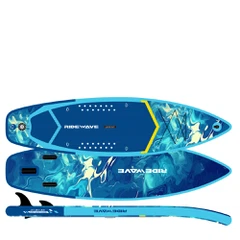
Colors influence customer perception and can be tailored to match seasonal trends or regional preferences. For example, bright neon colors may sell better in summer-heavy markets, while muted tones appeal to professional rental fleets. Graphics, including logos and patterns, can enhance brand recognition and retail appeal.
Accessories such as carry bags, leash systems, and fin options can further personalize SUP offerings. Ridewave collaborates closely with B2B partners to provide these customization options, ensuring each board is unique and market-ready.
SUP Brand Building: Ensuring Consistency Across Products
Building a SUP brand goes beyond just producing boards-it requires consistent messaging and product quality. A brand's identity is reflected in everything from board graphics and packaging to online presence and promotional materials.
Visual consistency across all touchpoints is critical. Packaging should match the board's aesthetics, manuals should reflect brand messaging, and websites should showcase products clearly. Consistency not only improves customer trust but also strengthens brand recognition in competitive markets.
B2B buyers should register trademarks and establish clear brand guidelines early, which ensures all future products and marketing materials align with the brand vision. Ridewave provides support for brand registration and offers templates for packaging and manuals to maintain a professional, cohesive appearance.

SUP Quality Assurance for International Distribution

International B2B buyers face a unique and often underestimated challenge: ensuring that the SUPs they source maintain consistent, top-tier product quality across multiple borders and diverse market requirements. When a board is exported globally, it is not enough for it to simply look good-it must meet a range of strict safety, durability, and performance standards that vary from region to region. For instance, in the European Union, boards often require CE certification to demonstrate compliance with consumer safety regulations, while in other markets, ISO standards or even specific water sports safety labels may be mandatory.
To achieve this level of compliance, a robust quality assurance system for international distribution is essential. This includes multi-stage inspections starting from raw material checks, moving through in-process evaluations during manufacturing, and concluding with final pre-shipment examinations. Load testing is performed to simulate real-world stress conditions, ensuring the board can handle weight and movement without structural compromise. Leak testing-particularly for inflatable SUPs-is critical to identify any microscopic punctures or seam weaknesses that could cause product failure once in use.
Beyond performance testing, packaging plays a decisive role in preserving quality. Long-distance shipping subjects SUPs to varying temperatures, humidity, and handling conditions. Without the right protection, even a perfectly made board can arrive damaged. Leading manufacturers implement double-boxing techniques, reinforced corners, impact-resistant foam padding, and waterproof protective wrapping to safeguard the product from rough handling, stacking pressure, and environmental exposure during transit.
By partnering with a reliable and experienced factory like Ridewave, B2B buyers gain access to a proven quality management system that integrates rigorous testing with premium packaging solutions. This approach not only ensures that every board leaving the factory meets or exceeds global performance expectations, but also significantly reduces return rates, protects brand reputation, and enhances end-user satisfaction. In an increasingly competitive market, maintaining this level of consistent quality across borders isn't just a nice-to-have-it's a decisive factor in long-term business success.
SUP Pricing Strategy: Maximizing Profit While Maintaining Quality
Pricing is a delicate balance for B2B buyers. Boards must be priced competitively while reflecting their quality and brand positioning.
Factors affecting pricing include materials, labor, customization, accessory packages, and shipping costs. MOQ (minimum order quantity) impacts unit cost significantly; larger orders generally lower per-unit cost but require higher upfront investment.
Understanding target markets is essential. Retailers may prioritize affordability for high-volume sales, while boutique rental operators may pay more for premium, highly customized SUPs. Ridewave provides transparent pricing structures and guidance for B2B partners to create profitable pricing models without compromising quality.

SUP Logistics Planning: Fast Shipping Without Compromise

Efficient logistics can make or break B2B success. Delays in shipping can disrupt retail launches or rental seasons. SUP logistics planning includes choosing appropriate transportation methods, calculating delivery times, and ensuring proper handling during transit.
Inflatable SUPs are easier to ship than hardboards, but care must still be taken to avoid punctures or compression damage. Sea freight is cost-effective for bulk orders, while air freight is suitable for urgent shipments. Local warehousing or drop-shipping models can also improve delivery speed for distributors.
Ridewave works closely with partners to optimize logistics planning, offering advice on packaging, shipping options, and lead times to meet tight market deadlines.
SUP Market Expansion: Opportunities in Europe, USA, and Asia
Global demand for SUPs continues to grow, with regional variations influencing distribution strategies. Europe shows strong interest in SUP yoga and touring, while the USA favors all-round and racing SUPs. Asia presents emerging opportunities with increasing recreational water sports adoption.
B2B buyers can leverage these trends by aligning inventory and marketing strategies with local demand. Factory insights, such as which models are most frequently produced, help buyers anticipate which products will succeed in specific markets.
Ridewave supports global expansion by providing market insights, assisting with localized branding, and offering scalable production options to meet international demand efficiently.

SUP Future Innovations: What's Next for 2025 and Beyond

The future of SUP is driven by innovation. In 2025, manufacturers are experimenting with lighter, eco-friendly materials, hybrid construction methods, and modular accessory systems. Technology integration, such as GPS tracking or app-connected boards, is emerging in high-end models.
B2B buyers who stay informed on these innovations can offer cutting-edge products to their customers, positioning themselves as leaders in the market. Ridewave continues to invest in research and development, ensuring that distributors receive access to the latest designs, materials, and customization technologies.
By combining factory insights, market trends, and innovation awareness, B2B buyers can create a SUP product lineup that is competitive, profitable, and highly desirable to consumers worldwide.
From understanding factory processes to mastering brand building, customization, quality assurance, pricing, logistics, and market expansion, B2B buyers now have a comprehensive roadmap for SUP success in 2025.
"By leveraging the insights from both Part 1 and Part 2, distributors and retailers can ensure that their SUP products are not only high-performing but also tailored to meet evolving market demands. Explore Ridewave's full range of SUP solutions, from OEM customization to global distribution support, and turn factory expertise into business excellence."
If you found this article insightful, you may also enjoy our other blogs focused on helping retailers and distributors grow in the global SUP industry:
"The Paddle Board Buyer's Handbook for International Distributors"
"Top Selling Inflatable SUP Models for the Danish Outdoor Market"
"Capitalizing on the UK's Paddle Board Craze: A Guide for B2B Buyers"
"The Growing SUPs Industry in Poland: What B2B Buyers Should Know"
"Why More French Water Sports Retailers Are Turning to ODM Solutions in 2025"
These articles dive deeper into regional trends, branding tactics, supply chain optimization, and more to help your outdoor retail business thrive in 2025 and beyond.