

Why Is Fishing SUP Stability the Ultimate Performance Metric for Global Distributors?
When evaluating the commercial viability of modern marine recreational fleets, global distributors, procurement managers, and outdoor sports equipment brands frequently encounter a critical bottleneck: the fundamental engineering variance between standard leisure personal watercraft and a dedicated, heavy-duty utility platform. In the rapidly evolving global outdoor marketplace, sourcing a high-quality inflatable fishing paddle board that successfully safeguards an angler's expensive gear while facilitating high-leverage casting is no longer a luxury-it is an absolute operational baseline. For B2B buyers looking to capture market share in North America, Europe, and Australia, understanding the underlying physics of primary and secondary stability in a fishing SUP is the key to minimizing high warranty claim rates, eliminating costly product returns, and generating recurring commercial fleet orders.

Primary Stability vs. Secondary Stability: Traditional stand up paddle boards designed for recreational flatwater fitness optimize primary stability-the initial equilibrium when the board rests flat on calm water. However, a professional-grade inflatable angling platform demands exceptional secondary stability, which represents the hull's mechanical resistance against capsizing when dynamic lateral forces are applied, such as when an angler leans over the rail to net a heavy predatory fish or battles unpredictable cross-currents.
Volumetric Hull Distribution: Standard all-around inflatable SUPs feature tapered rails and progressive rock lines that reduce water resistance but severely sacrifice weight-bearing capacity at the perimeter. RIDEWAVE's advanced engineering team has re-architected the classic inflatable SUP board by implementing a synchronized parallel rail configuration, expanding the effective surface-area-to-water ratio and ensuring that the platform's maximum buoyancy is distributed precisely where the user stands and mounts heavy hardware.
The B2B Margin Safeguard: From a logistics and brand equity standpoint, introducing a highly stable heavy-duty fishing SUP into your retail inventory directly mitigates localized customer service pain points; when independent retailers and outfitters stock a premium inflatable paddle board built on proven naval architecture, they report a near-zero incidence rate of structural instability complaints, effectively preserving your wholesale distribution margins and enhancing long-term contract value.
As global market data continuously proves, the strategic intersection of specialized sport angling and portably deployed watersports gear is no longer a temporary trend but a permanent, high-value commercial shift. For a broader, data-driven analysis of how this sector is performing across various distribution channels, you can explore our comprehensive market intelligence report on [The Rising Demand For Inflatable Fishing SUPs: Why Your Retail Business Needs To Stock Them Now] . To see how these stability mechanics transfer directly into product specifications, view our latest commercial-grade fleet options on the [RIDEWAVE Official Fishing SUP Product Collection Page]
How Does Drop-Stitch Density Directly Impact the Rigidity of an Inflatable Fishing Platform?
To comprehend how a flexible multi-layer polymer structure transforms into a rock-solid, unyielding standing platform, one must examine the internal microstructure of premium inflatable SUP board manufacturing. For high-volume sports equipment brands and regional outdoor distributors, sourcing an inflatable fishing paddle board that eliminates the catastrophic "taco effect"-where the hull sags under concentrated structural weight-is paramount to securing premium retail placements. The mechanical rigidity of any high-pressure fishing SUP is directly proportional to its internal core arrangement, specifically the geometric alignment and volumetric distribution of the structural drop-stitch filaments that bind the top and bottom deck skins together.
Linear vs. Cross-Drop-Stitch Arrays: Traditional, low-cost commercial manufacturing typically utilizes a linear drop-stitch pattern with a sparse allocation of nylon threads, leading to localized shear stress and deformities when an angler shifts weight during high-leverage casting. RIDEWAVE mitigates this structural vector by employing a highly advanced, dense cross-woven drop-stitch matrix within every heavy-duty fishing SUP, creating a continuous internal truss system that uniformly disperses downward force across the entire continuous surface area.
Deflection Metrics Under Heavy Load: When a professional angler stands on a premium inflatable paddle board outfitted with a heavy cooler, auxiliary battery, and dynamic tackle rigs, the concentrated load can exceed 150 kilograms. Our structural engineering lab tests confirm that increasing the internal needle density to a precise threshold allows the stand up paddle boards to easily sustain working pressures of 18 to 20 PSI, resulting in zero measurable hull deflection and providing a stance that feels indistinguishable from a traditional hard-shell composite vessel.
Mitigating Delamination and Micro-Leaks: For B2B procurement professionals, long-term durability directly dictates fleet lifecycle asset value; by utilizing industrial-grade, premium-coated base fabrics rather than standard consumer-grade materials, RIDEWAVE's high-pressure internal chambers resist internal thread shearing even under extreme cyclic inflation, eliminating the micro-leaks and structural degradation that plague lesser-grade wholesale inventories.

The technical difference between a standard flatwater board and a specialized, high-rigidity angling vessel becomes immediately apparent when analyzing maximum load thresholds and seam integrity. To cross-reference how these internal fabric specifications affect long-term commercial performance across diverse global rental and distribution networks, consider reviewing our technical breakdown on [The Rising Demand For Inflatable Fishing SUPs: Why Your Retail Business Needs To Stock Them Now] . For wholesale partners interested in inspecting our physical material architecture, detailed core samples and tensile testing certificates are accessible via the [RIDEWAVE Manufacturing Quality Control and Certification Portal]
3. What Structural Design Breakthroughs Allow RIDEWAVE Boards to Combat Lateral Roll?
Navigating open water with dynamic cargo requires specialized hydrodynamic balancing that standard multi-purpose watercraft simply cannot provide. For professional watercraft outfitters and international procurement entities, introducing a commercial-grade inflatable fishing paddle board into a highly competitive regional market depends on solving the physics of lateral roll-the rhythmic, dangerous rocking motion triggered by shifted weight or cross-currents. To safeguard both the operator and high-value gear from capsizing, a professional fishing SUP must incorporate broad-beam stability geometry that dampens rolling forces without adding unnecessary hydrodynamic drag or destroying tracking efficiency.

Multi-Stage Outrigger Rail Geometry: Traditional wide-beam stand up paddle boards achieve basic balance by extending uniform width from nose to tail, which severely compromises paddling ergonomics and forward speed. RIDEWAVE's naval architects solved this constraint by creating a multi-stage outrigger rail contour, featuring a streamlined center hull flanked by dual integrated side pontoons that act as secondary stability chambers, expanding the effective righting moment only when the board experiences asymmetric tilting forces.
The Science of Hydrodynamic Righting Moments: When an angler hooks a powerful predatory fish or leans heavily over the side rail to manage a net, the center of gravity shifts drastically outward. Our proprietary pontoon architecture counteracts this movement by leveraging a multi-chamber design; as the heavy-duty fishing SUP begins to tilt, the submerged secondary chamber increases displacement exponentially, creating a progressive righting moment that firmly locks the hull's lateral axis against rolling.
Optimal Aspect Ratios for Commercial Fleets: For global distributors evaluating bulk inventory, a premium inflatable paddle board must accommodate a wide variety of user skill levels; by tuning our hull aspect ratio to an optimized 36-to-38-inch width footprint combined with parallel running straight rails, RIDEWAVE provides retail dealers with a highly versatile stock product that guarantees instant confidence for novice sport anglers while meeting the rigid performance demands of seasoned open-water guides.
This advanced structural balancing architecture ensures that the vessel remains perfectly composed during sudden transitions from active paddling to high-leverage casting. To analyze how adding this specialized anti-roll hull design to your inventory can capturing a broader segment of the premium outdoor retail sector, please see our strategic industry insight post on [Еxploring The Multi Billion Dollar SUP Fishing Market: Trends And Opportunities For Outdoor Retailers] . To explore our full product specifications or to request a physical CAD design file for custom OEM branding projects, visit the [RIDEWAVE Custom Hydrodynamic Design and Wholesale Specification Center]
How Does MSL Fusion Technology Balance Heavy-Duty Construction with Weight Efficiency?
For procurement executives managing global container shipping allocation and multi-location retail distribution networks, product gross weight is just as critical as structural durability. In the competitive outdoor recreation industry, selecting an inflatable fishing paddle board that features industrial-grade reinforcement often meant accepting a heavy, unwieldy hull that increased shipping costs and frustrated end-users. RIDEWAVE eliminates this logistical tradeoff by utilizing advanced MSL (Monocoque Structural Laminate) Fusion technology across our entire production line, offering international wholesale buyers a high-capacity fishing SUP that delivers unmatched material stiffness while optimizing weight distribution for global logistics channels.

The Mechanical Evolution of Fusion Layering: Traditional multi-layer inflatable SUP board construction relies on manual adhesive application to bond secondary reinforcement sheets to the raw drop-stitch base. This outdated method introduces up to 2 kilograms of erratic, non-structural glue weight, which increases the risk of human error and seam delamination under extreme heat. RIDEWAVE's automated MSL process replaces manual gluing with a calibrated thermal laminating machine that fuses a heavy-duty outer polymer layer directly to the inner drop-stitch core under high tension, creating a uniform, single-structure composite material.
Logistical Optimization for B2B Importers: Implementing MSL Fusion material mechanics directly reduces total package weight by 20% to 25% compared to conventional double-layer glued boards, without compromising structural stiffness. For international buyers ordering high-volume containers, this weight reduction allows for more efficient pallet stacking, lowers shipping costs per unit, and satisfies strict European and North American manual labor handling weight regulations for retail store personnel.
Torsional Stiffness Under Dynamic Marine Loads: A high-end stand up paddle board built on MSL technology features significantly higher torsional stiffness-the material's resistance to twisting forces when navigating uneven chop. This engineering refinement ensures that when an angler anchors in running water or mounts heavy accessories like electric trolling motors, the premium inflatable paddle board remains a rigid, stable platform rather than twisting along its longitudinal axis.
By upgrading the raw material composite architecture, commercial outfitters can offer a highly portable product that delivers the heavy-duty field performance expected of a rigid hull. To analyze how incorporating light-yet-rugged MSL technology into your product line can expand your market share among wilderness anglers and overland travelers, review our dedicated market report on [Еxploring The Multi Billion Dollar SUP Fishing Market: Trends And Opportunities For Outdoor Retailers]. To calculate bulk weight metrics or receive a breakdown of container load capacities for your regional logistics hubs, consult the RIDEWAVE Global B2B Freight Logistics and OEM Procurement Center
Why Did a Major North American Outfitter Choose RIDEWAVE Over Standard OEM Manufacturers?
In the commercial B2B procurement sector, theoretical engineering data must always be verified by long-term field performance and real-world commercial viability. For international supply chain managers and global sourcing agents, partnering with a dependable inflatable fishing paddle board manufacturer requires more than just reviewing attractive digital product catalogs; it demands choosing a production partner capable of eliminating systematic structural defects that lead to costly consumer warranty claims. A prominent North American outdoor outfitter and wilderness guide network recently faced this exact challenge, leading them to transition their entire commercial fleet operations to RIDEWAVE's high-rigidity fishing SUP platform.
The Structural Challenge with Traditional Supply Chains: The North American outfitter had previously sourced a generic private-label inflatable SUP board fleet from a standard mass-market factory. Within the first ninety days of seasonal deployment, they experienced an unacceptable 6.8% fleet failure rate due to seam delamination, micro-leaks around high-pressure valves, and structural twisting caused by heavy accessory setups, including localized tracking motor mounts and rigid angling coolers.
The Targeted RIDEWAVE Engineering Solution: Our technical team conducted a complete structural evaluation of their failure vectors and implemented an upgraded production protocol. We manufactured their fleet using our proprietary double-wall rail sealing technology combined with reinforced pre-laminated MSL fabric, explicitly integrating 4 tactical structural D-rings and dual-track reinforcement plates designed to handle severe dynamic torques without stressing the internal chambers of the heavy-duty fishing SUP.
The Commercial Outcome and Fleet Performance: Following a strict 48-hour deep-water inflation testing regimen at our manufacturing plant, the initial 2,000-unit pilot batch was deployed across diverse wilderness guide operations in Canada and the United States. The outfitter reported a near-zero failure rate (less than 0.2%) during the first season of intense usage, significantly reducing their localized localized product return costs and prompting them to secure a 3-year exclusive manufacturing contract for their extended stand up paddle boards product lines.

This real-world operational success highlights how factory-level manufacturing adjustments can directly safeguard a distributor's bottom line and protect retail brand equity. To understand why modern outdoor retail chains are upgrading their core inventory to specialized, high-durability platforms, read our extensive market overview on [Еxploring The Multi Billion Dollar SUP Fishing Market: Trends And Opportunities For Outdoor Retailers] . For wholesale procurement entities who wish to discuss custom specifications, production line capacity, or review our full case study documentation, please contact the [RIDEWAVE B2B Client Success and OEM Case Study Archive]
Which On-Board Integration Features Turn an Inflatable Paddle Board Into a Professional Fishing Rig?
For strategic outdoor retailers and mass-volume sports equipment brands, expanding into the premium utility sector requires more than offering a wide platform; it requires providing a platform designed for seamless hardware integration. In the global competitive landscape, an premium inflatable fishing paddle board must act as a reliable tactical station capable of supporting heavy, specialized angling gear without causing material fatigue or compromising hull pressure. RIDEWAVE addresses this design challenge by engineering factory-installed, structurally reinforced attachment points directly into the hull layout, allowing global wholesalers to deliver a highly customizable fishing SUP that eliminates the need for unstable, third-party aftermarket strap-on accessories.
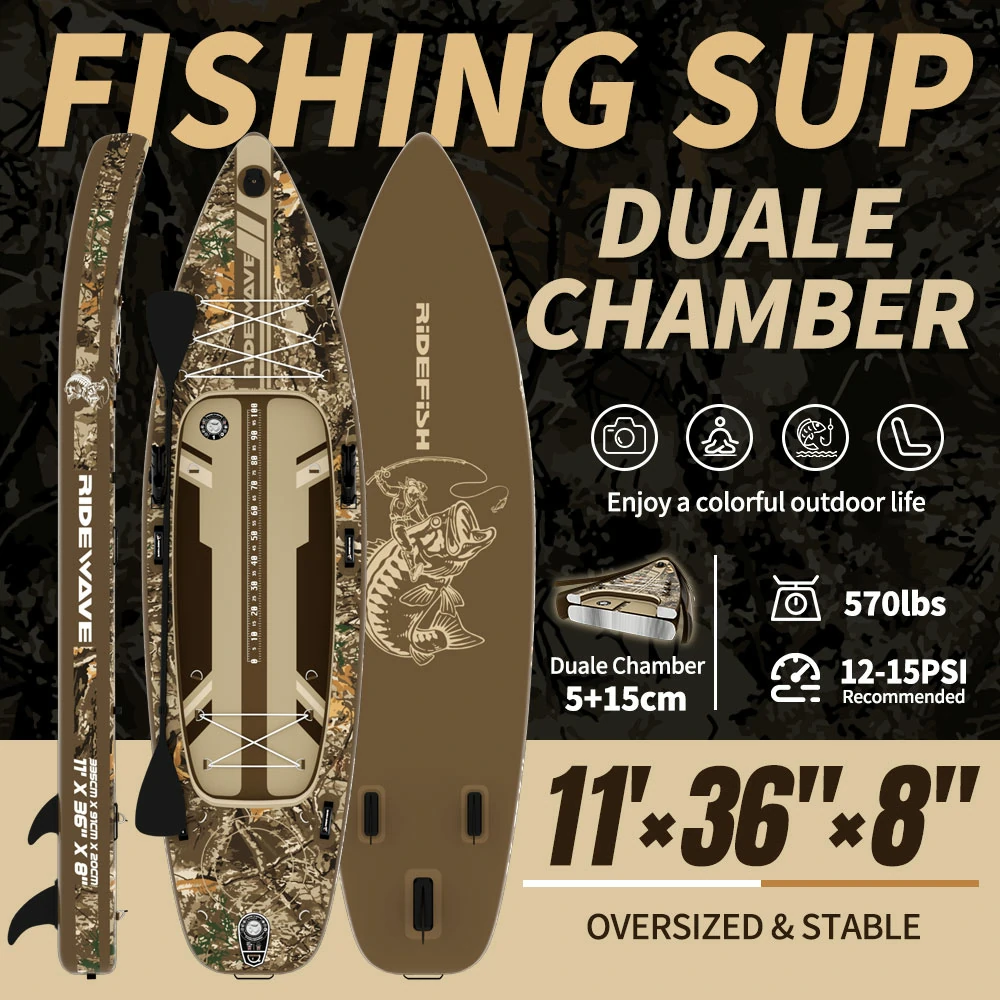
Integrated Multi-Point Universal Gear Mounts: Traditional recreational stand up paddle boards lack the structural reinforcement required to mount heavy hardware, often leading to hull twisting or punctured PVC when modifications are made by the user. RIDEWAVE incorporates standardized, heavy-duty accessory bases-fully compatible with premium global systems such as Scotty and Railblaza-directly into the pre-laminated MSL composite layer, enabling anglers to securely lock in articulating rod holders, fish-finder displays, and action cameras.
Heavy-Duty Stern Transom and Trolling Motor Readiness: The modern angling market is experiencing a significant shift toward motorized personal watercraft, driven by users seeking to reach remote fishing grounds quickly. Our engineers have reinforced the stern profile of our heavy-duty fishing SUP with localized internal dual-layer PVC plates, creating a rigid foundation that securely supports customized electric trolling motor mounts and auxiliary battery boxes without causing the deck to bend under torque.
Expansive Multi-Zone Cargo Stabilization Arrays: Professional watercraft outfitters catering to wilderness anglers in Canada, Europe, and Australia demand secure, high-capacity storage zones for extended multi-day trips. By strategically positioning marine-grade stainless steel D-rings across the bow and stern, this premium inflatable paddle board provides distinct tie-down matrices for large cooler boxes, live-wells, and waterproof dry-pack systems, ensuring optimal weight distribution and keeping the center of gravity low.
These factory-integrated technical features transform a standard paddling experience into a highly efficient, professional-grade fishing operation. To learn more about how adding these advanced, hardware-ready models can help your retail business appeal to high-spending kayak anglers and sport fishermen, explore our comprehensive commercial analysis on [The Rising Demand For Inflatable Fishing SUPs: Why Your Retail Business Needs To Stock Them Now] . To customize your wholesale order with specific hardware layouts or to browse our complete accessories catalog for brand-exclusive bundles, visit the [RIDEWAVE OEM Hardware Integration and Accessory Configuration Portal]