
For many B2B buyers, placing an Inflatable SUP factory order feels like a straightforward sourcing task-compare prices, review samples, confirm delivery time, and move forward. In reality, this decision is far more strategic and far more consequential than it initially appears.
Inflatable SUP products sit at the intersection of performance engineering, material science, seasonal demand, and brand reputation. A single weak link in the supply chain-whether unstable materials, inconsistent welding, poor communication, or limited production scalability-can trigger a cascade of problems: delayed launches, customer complaints, rising warranty costs, and long-term damage to brand credibility.
Experienced distributors and private-label brands understand one core truth:
The real cost of an Inflatable SUP order is not the unit price-it is the operational risk embedded in the factory behind it.
That is why professional buyers do not start with how much, but with how capable, how stable, and how scalable the manufacturer truly is.
This article is designed as a practical, decision-driven guide for B2B buyers who are preparing to place an Inflatable SUP factory order. Rather than focusing on marketing claims, it breaks down the ten most critical questions that reveal whether a factory can support your business not just for one season, but for years to come.
Throughout this guide, we will also reference real-world manufacturing practices adopted by professional suppliers such as Hebei Dashuai Outdoor Products Co., Ltd., as well as market-oriented brands like Ridewave, to illustrate how strong factory foundations translate into reliable products and long-term commercial value.
Inflatable SUP Factory Experience & Specialization

One of the most important questions a B2B buyer can ask is also one of the simplest:
Is Inflatable SUP manufacturing the factory's core business, or merely one category among many?
This distinction matters more than most buyers realize. Factories that treat Inflatable SUP as a side product often lack deep process optimization, consistent quality benchmarks, and long-term product iteration capability. In contrast, a specialized Inflatable SUP factory builds its entire operational system around board performance, durability, and scalability.
A factory that truly specializes in Inflatable SUP will usually demonstrate several clear characteristics.
First, it maintains dedicated production lines for SUP boards rather than sharing equipment with inflatable toys, tents, or low-pressure products. SUP boards require higher air pressure tolerance, tighter welding standards, and stricter dimensional control. Mixing production lines almost always leads to compromises.
Second, specialization is reflected in technical language and decision logic. When you discuss board stiffness, rail reinforcement, or drop-stitch density, a professional factory answers with data, tolerances, and trade-offs-not vague assurances.
Third, experienced Inflatable SUP manufacturers actively segment their product development. They understand the structural differences between entry-level all-round boards, touring models, rental-grade boards, and performance-oriented designs. This segmentation is critical for B2B buyers serving different channels and price tiers.
Manufacturers such as Hebei Dashuai Outdoor Products Co., Ltd., which focus heavily on inflatable water sports products, illustrate how specialization creates consistency. By supporting brands like Ridewave, they align factory processes with market feedback, allowing continuous refinement rather than one-off production.
For buyers, working with a specialized factory reduces learning costs, communication friction, and long-term quality volatility.
Inflatable SUP Materials & Construction Standards
Material quality is the single most decisive factor in Inflatable SUP performance, lifespan, and customer satisfaction. Yet many B2B buyers rely on surface-level descriptions such as "double-layer PVC" or "drop-stitch construction" without fully understanding what those terms actually mean in practice.
In reality, two boards labeled with identical material descriptions can perform very differently over time.
Professional buyers should evaluate materials across four core dimensions.
The first is PVC grade and formulation. High-quality Inflatable SUP boards use reinforced PVC blends that balance flexibility with puncture resistance. Inferior PVC may look acceptable at first but becomes brittle, discolored, or prone to leakage after repeated folding and UV exposure.
The second dimension is drop-stitch density and uniformity. A higher density core provides stiffness and load stability, especially important for rental operations and heavier paddlers. Consistency matters as much as density; uneven internal structure leads to soft spots and premature deformation.
Third, buyers should understand the lamination or fusion process. Traditional glue-based lamination increases weight and introduces long-term delamination risk. Modern fusion technologies reduce weight and improve bonding consistency, but require stricter process control.
Finally, attention must be paid to reinforcement zones-rails, standing areas, and fin boxes. These areas absorb the highest stress during use and transportation. Brands like Ridewave emphasize balanced reinforcement rather than excessive layering, achieving durability without unnecessary weight.
Factories such as Hebei Dashuai Outdoor Products Co., Ltd. that openly explain their material logic and construction trade-offs demonstrate a level of transparency that B2B buyers should actively seek.

Inflatable SUP Quality Control Process

For B2B buyers, quality control is not a single checkpoint-it is a system. One of the most critical mistakes buyers make is assuming that a final inspection alone is sufficient to guarantee Inflatable SUP quality. In reality, by the time a defect is visible at final inspection, the cost of correction is already high, and the risk of hidden issues remains.
Professional Inflatable SUP factories embed quality control throughout the entire production cycle. This process typically begins long before any board is assembled.
The first stage is incoming material inspection. PVC rolls, drop-stitch cores, adhesives, and valves must be checked for thickness consistency, tensile strength, surface defects, and batch stability. Without strict incoming checks, even the most advanced production process cannot compensate for inconsistent raw materials.
The second stage is in-process quality monitoring. During cutting, welding, lamination, and rail assembly, trained QC personnel monitor temperature control, pressure application, and dimensional accuracy. Small deviations at this stage can lead to air leakage, uneven stiffness, or premature structural fatigue.
The third stage is air pressure and stress testing. High-standard Inflatable SUP factories inflate boards to working pressure and hold them for extended periods to observe pressure loss, seam behavior, and shape deformation. Some factories also conduct over-pressure testing to evaluate safety margins.
Finally, pre-shipment inspection ensures that cosmetic quality, accessory completeness, packaging integrity, and labeling accuracy meet agreed specifications. This step is especially important for private-label brands, where visual consistency directly affects brand perception.
Factories such as Hebei Dashuai Outdoor Products Co., Ltd., which support the production of Ridewave Inflatable SUP boards, emphasize multi-stage QC rather than reliance on a single inspection point. This approach significantly reduces return rates and after-sales disputes for B2B buyers.
From a buyer's perspective, asking detailed questions about QC structure reveals far more than a factory's marketing claims. It demonstrates whether the manufacturer understands risk management-or merely reacts to problems after they occur.
Inflatable SUP Lead Time & Production Capacity
Lead time reliability is one of the most underestimated risk factors in Inflatable SUP sourcing. Because SUP demand is highly seasonal, delays do not simply affect logistics-they directly impact sales windows, cash flow, and customer relationships.
Many factories claim "fast production" or "large capacity," but experienced B2B buyers know that true capacity is measured not by peak output, but by consistent, repeatable delivery under pressure.
A reliable Inflatable SUP factory demonstrates capacity in three key areas.
First is baseline production planning. Professional manufacturers establish realistic lead times based on material availability, labor stability, and historical peak-season performance. Overpromising short lead times often signals inexperience or poor planning discipline.
Second is scalability management. As order volumes increase, factories must maintain quality, communication, and scheduling accuracy. This requires trained labor pools, buffer capacity, and standardized workflows-not last-minute outsourcing or uncontrolled overtime.
Third is risk transparency. Reputable factories proactively communicate potential delays caused by raw material shortages, regulatory changes, or seasonal surges. Silence or vague updates are often warning signs.
Manufacturers like Hebei Dashuai Outdoor Products Co., Ltd. have supported Ridewave through seasonal demand cycles by aligning production schedules with market forecasts and maintaining capacity flexibility. This level of coordination allows B2B buyers to plan inventory with confidence rather than react to uncertainty.
For buyers, the key question is not "How fast can you produce once?" but rather "How reliably can you deliver, season after season?"


Inflatable SUP Customization Details

For many B2B buyers, Inflatable SUP customization is often misunderstood as a simple branding exercise-add a logo, choose a color, and finalize packaging. In reality, effective customization is a strategic tool that shapes market positioning, customer perception, and long-term competitiveness.
True Inflatable SUP customization operates on multiple layers, each with direct commercial implications.
The first layer is visual identity customization. This includes color palettes, graphic layouts, printing techniques, and finish treatments. High-quality factories offer UV printing, multi-layer graphics, and fade-resistant inks that maintain appearance after prolonged sun exposure and water use. Visual consistency across product lines is especially important for brands building recognition in crowded retail environments.
The second layer involves structural and functional customization. Board length, width, thickness, fin configurations, deck pad textures, and handle placement all influence how a board performs for different user profiles. Rental operators may prioritize stability and durability, while retail brands may seek lighter weight or faster glide. A capable factory does not force a one-size-fits-all solution, but instead adjusts designs to match channel needs.
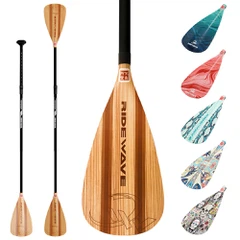
The third layer is accessory and bundle customization. Pumps, paddles, backpacks, leashes, repair kits, and even kayak conversion components affect both perceived value and end-user satisfaction. Professional SUP manufacturers guide buyers toward balanced accessory packages that align with pricing strategy rather than simply adding cost.
The final layer is packaging and unboxing experience customization. Carton structure, protective inserts, labeling language, and compliance markings all play a role in logistics efficiency and brand presentation. For international B2B buyers, packaging that balances protection, volume efficiency, and regulatory clarity reduces damage rates and customs complications.
Factories such as Hebei Dashuai Outdoor Products Co., Ltd., which work closely with brands like Ridewave, approach customization as a system rather than a checklist. By integrating design, engineering, and production planning, they enable brands to differentiate without sacrificing manufacturability or delivery stability.
For B2B buyers, the key question is not whether a factory offers customization-but whether it understands how customization impacts cost, lead time, and long-term scalability.
Inflatable SUP Certifications & Compliance
Certifications and compliance are often treated as formalities, yet they play a decisive role in whether Inflatable SUP products can legally and smoothly enter specific markets. For B2B buyers selling into Europe, North America, or other regulated regions, compliance failures can result in shipment holds, recalls, fines, or forced delisting.
A qualified Inflatable SUP factory should clearly understand the regulatory expectations of different markets. This includes product safety standards, material regulations, labeling requirements, and documentation readiness. Buyers should not hesitate to ask for existing test reports, certification samples, and compliance experience with similar destinations.
Beyond certificates themselves, the factory's compliance mindset matters. Manufacturers accustomed to working with export-oriented brands-such as those supporting Ridewave-tend to integrate compliance considerations into design, material selection, and packaging from the outset, rather than treating them as last-minute add-ons.
Hebei Dashuai Outdoor Products Co., Ltd., for example, has experience aligning production with international standards, helping B2B buyers reduce regulatory friction and speed up market entry.

Inflatable SUP OEM & ODM Capabilities


For B2B buyers, OEM and ODM capabilities are not technical buzzwords-they are strategic levers that directly influence brand positioning, speed to market, and long-term competitiveness in the Inflatable SUP industry.
At a basic level, OEM manufacturing focuses on executing an existing design efficiently and consistently. This model suits buyers with mature product specifications, stable demand forecasts, and internal product development teams. However, relying solely on OEM can limit a brand's ability to adapt quickly to market trends, differentiate visually, or optimize products based on customer feedback.
True ODM capability goes far beyond logo placement or color changes. A factory with real Inflatable SUP ODM strength participates in product definition itself. This includes early-stage design consultation, material recommendations based on target price points, structural optimization for performance or durability, and proactive suggestions aligned with market trends. In practice, ODM-oriented factories act as an extension of the buyer's product team.
For growing brands like Ridewave, ODM capability has been a critical growth enabler. By working closely with manufacturing partners who understand both production constraints and end-market expectations, Ridewave has been able to shorten development cycles, refine board performance, and launch differentiated Inflatable SUP models without sacrificing manufacturing stability or quality consistency.
When evaluating an Inflatable SUP factory's OEM and ODM claims, buyers should look beyond marketing language. Key indicators include the presence of dedicated product engineers, structured sampling and revision processes, documented material libraries, and the ability to explain why certain design or construction decisions are recommended. A capable ODM factory can articulate trade-offs clearly-cost versus durability, weight versus stiffness, or aesthetics versus production efficiency.
Hebei Dashuai Outdoor Products Co., Ltd. exemplifies this balanced approach. Rather than positioning itself as a passive order executor, the company collaborates with B2B clients during the development phase, aligning design intent with manufacturability. This reduces downstream risks such as repeated sampling, unexpected cost increases, or quality inconsistencies during scale-up.
From a long-term perspective, strong OEM and ODM capabilities protect buyers from stagnation. As Inflatable SUP markets become increasingly crowded, brands that depend on generic, factory-led designs struggle to maintain differentiation. Factories that invest in design understanding, engineering feedback, and iterative development enable buyers to evolve their product lines strategically rather than reactively.
In short, an Inflatable SUP factory should not merely ask, "What do you want us to make?" but rather, "What market are you trying to win-and how can we help you build the right product to compete there?"
Inflatable SUP MOQ & Order Flexibility
Minimum order quantity and order flexibility directly affect how B2B buyers manage risk. Factories with rigid MOQs often suit large, established brands but pose challenges for emerging or testing-stage businesses.
Flexible manufacturers allow buyers to validate designs, test markets, and scale gradually. Brands like Ridewave benefited from structured order flexibility during early growth stages, enabling controlled expansion rather than overcommitment.
Hebei Dashuai Outdoor Products Co., Ltd. demonstrates how reasonable MOQ structures can align factory efficiency with buyer sustainability.

Inflatable SUP Packaging & Logistics Support

Packaging and logistics are not afterthoughts in Inflatable SUP sourcing. Poor packaging increases damage rates, while weak logistics coordination causes delays and cost overruns.
Professional factories design packaging that balances protection, space efficiency, and compliance. They also understand export documentation, palletization, and shipping modes.
Factories serving brands like Ridewave often develop logistics routines that reduce friction across international supply chains.
Inflatable SUP After-Sales & Warranty Policy

After-sales support is often invisible until something goes wrong. Clear warranty policies, spare parts availability, and response speed define the real cost of Inflatable SUP sourcing.
Factories committed to long-term partnerships provide structured after-sales processes rather than ad hoc responses. This approach reduces friction and protects brand reputation.
Placing an Inflatable SUP order is far more than a transactional step-it is the foundation of your brand's supply chain, quality reputation, and long-term growth. By asking detailed questions about materials, quality control, OEM/ODM capabilities, lead times, customization, compliance, and after-sales support, B2B buyers can make informed decisions that minimize risk and maximize profitability.
Factories like Hebei Dashuai Outdoor Products Co., Ltd., supporting brands such as Ridewave, demonstrate how transparent processes, robust QC, flexible customization, and proactive collaboration can turn a manufacturing partner into a strategic ally.
Investing time in vetting your SUP supplier today saves countless headaches tomorrow and positions your brand for global success.
To deepen your understanding of the Inflatable SUP market and improve sourcing strategies, we recommend reading these in-depth articles:
OEM vs ODM Inflatable Paddle Boards
How to Choose a Reliable Inflatable SUP Manufacturer for Bulk Orders?
From Design to Delivery: How SUP Board Manufacturing Controls Branding, Scale, and OEM Risk
These resources provide actionable insights, real-world examples, and step-by-step guidance for B2B buyers looking to strengthen their SUP supply chain and brand positioning.