
SUP Board Design Is No Longer Just Visual

In the early stages of the inflatable SUP industry, SUP board design was largely treated as a surface-level consideration. Colors were simple, logos were minimal, and most graphics served only one purpose: basic brand identification. For many manufacturers and distributors, visual design was secondary to structure, materials, and price. As long as a SUP board floated well and met entry-level durability expectations, appearance was rarely a deciding factor.
That reality has changed significantly.
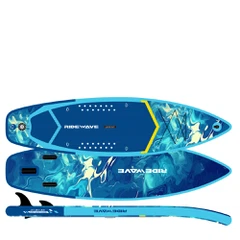
Today, SUP board design has become a core part of product competitiveness, particularly in crowded retail and distribution markets. From European specialty water sports stores to North American online marketplaces, visual differentiation now plays a direct role in customer attention, conversion rates, and brand recall. For B2B buyers, this shift means that design quality is no longer cosmetic-it is commercial.
More importantly, advanced design places real demands on manufacturing capability. Complex gradients, multi-color transitions, full-deck artwork, and precise logo placement are not simply graphic design challenges. They test whether a SUP board factory can maintain consistency, control tolerances, and execute repeatable processes at scale. In many cases, the SUP boards that look the most impressive on screen are also the most difficult to manufacture correctly.
This is where advanced UV printing enters the discussion. Unlike basic printing methods, UV printing exposes every weakness in a production line. Alignment errors, material instability, uneven surfaces, and inconsistent curing all become visible. As a result, SUP board design has become a transparent indicator of real manufacturing strength rather than a superficial branding choice.
At Ridewave, design development is always approached in coordination with manufacturing feasibility. As a production-oriented SUP board brand supported by Hebei Dashuai Outdoor Products Co., Ltd., Ridewave treats design complexity as a controlled variable, not a risk. Every visual concept is evaluated against material behavior, surface flatness, curing parameters, and batch consistency before it reaches mass production.
For B2B buyers, this evolution sends a clear message: when evaluating SUP board suppliers today, design quality should be analyzed not as artwork, but as evidence of process control, technical discipline, and factory maturity.
Why UV Printing Matters on SUP Board
UV printing has become a defining technology in high-quality SUP board manufacturing because it directly addresses the limitations of traditional printing methods. In earlier production models, most inflatable SUP boards relied on screen printing or basic heat transfer techniques. While these methods were sufficient for simple logos or solid colors, they struggle when designs become layered, detailed, or color-sensitive.
For a SUP board, the printing surface is not rigid or uniform. PVC layers expand slightly under heat, tension varies across panels, and seams introduce micro-level distortions. UV printing is effective precisely because it adapts to these challenges rather than ignoring them. By curing ink instantly under ultraviolet light, the process minimizes bleeding, deformation, and post-print distortion.
From a commercial perspective, UV printing matters because it directly affects how a SUP board ages in real-world use. Poorly bonded graphics fade faster under sunlight, crack under flex, or wear unevenly in high-contact areas. These failures do not simply impact appearance; they influence warranty claims, customer complaints, and brand credibility.
For B2B buyers and distributors, especially those operating in rental, resort, or high-turnover retail environments, UV printing provides measurable advantages:
Improved resistance to UV exposure and saltwater
Higher abrasion tolerance during transport and storage
Consistent appearance across multiple production batches
At Ridewave, UV printing is not treated as an add-on process. It is integrated into the overall SUP board production workflow. Surface preparation, ink formulation, curing cycles, and post-print inspection are aligned to ensure that visual complexity does not compromise structural reliability. This approach is only possible because Ridewave production is supported by Hebei Dashuai Outdoor Products Co., Ltd., whose manufacturing infrastructure is designed for repeatable, high-precision output rather than short-term visual effects.
For brands sourcing SUP boards under OEM or ODM models, understanding why UV printing matters is critical. It determines not only how a board looks on day one, but how it performs visually after months or years in the market. In that sense, UV printing is not a marketing feature-it is a quality control mechanism.


Complex Graphics Challenge SUP Board Manufacturing


Complex SUP board graphics are often underestimated. From the outside, a multi-color gradient or layered deck print may appear to be a simple design choice. Inside the factory, however, these graphics represent one of the most demanding aspects of inflatable SUP board production.
Each additional color, layer, or transition introduces variables that must be controlled precisely. Ink thickness affects curing speed. Color density influences heat absorption. Alignment tolerance becomes tighter as graphics approach seams, rails, or functional zones. Any inconsistency in these factors can result in visible defects-misalignment, uneven gloss, or color drift between boards in the same order.
For many SUP board factories, this is where limitations become apparent. Designs that look acceptable in samples may fail during mass production. Batch-to-batch inconsistency is common when printing systems are not calibrated for scale. In some cases, factories are forced to simplify designs mid-production, creating discrepancies between approved samples and delivered goods.
Ridewave addresses these challenges by treating complex graphics as an engineering problem rather than an artistic one. Before a SUP board design enters production, printing simulations are conducted alongside material stress evaluations. This ensures that visual elements align with structural zones and that ink behavior remains stable throughout the curing process.
Hebei Dashuai Outdoor Products Co., Ltd. plays a critical role in this capability. With stable production lines and standardized quality control protocols, the factory environment allows complex SUP board graphics to be reproduced consistently-not just once, but across large-volume orders. This is particularly important for distributors who rely on visual consistency to maintain brand identity across different markets and sales channels.
For B2B buyers, complex graphics should prompt the right questions:
Can the factory reproduce this design reliably at scale?
How are alignment and color consistency controlled?
What happens when reorders are placed months later?
When a SUP board supplier can answer these questions confidently, design complexity becomes a competitive advantage rather than a production risk.
Multi-Layer UV Technology on SUP Board
As SUP board design continues to evolve, single-layer printing is no longer sufficient to meet market expectations. Multi-layer UV printing has emerged as a defining requirement for brands seeking depth, texture, and long-term visual performance. This technique involves applying multiple layers of UV-cured ink in controlled sequences, each layer serving a distinct functional and aesthetic purpose.
From a manufacturing perspective, multi-layer UV printing significantly increases process complexity. Each layer must bond correctly to both the PVC substrate and the adjacent ink layers. Improper curing timing can lead to surface brittleness, while insufficient adhesion between layers may cause peeling or micro-cracking during flex. On an inflatable SUP board, where constant pressure changes and surface deformation are normal, these risks are amplified.
The value of multi-layer UV printing lies in its ability to create visual depth without sacrificing durability. Gradients appear smoother, fine details remain sharp, and color saturation stays consistent even under prolonged sun exposure. For premium SUP board lines, especially those positioned for specialty retail or branded OEM programs, this level of finish directly supports higher perceived value.
At Ridewave, multi-layer UV printing is treated as an integrated production system rather than a standalone process. Layer sequencing, curing intensity, and surface preparation are standardized across production batches. This allows Ridewave SUP boards to maintain design integrity even when scaled for large-volume orders. Such consistency is only achievable within a stable manufacturing framework, which is where Hebei Dashuai Outdoor Products Co., Ltd. provides critical infrastructure support.
For B2B buyers evaluating SUP board suppliers, multi-layer UV capability is a clear indicator of factory maturity. It reflects not only printing skill, but also an understanding of material behavior, environmental exposure, and long-term product lifecycle. In competitive markets, this distinction often separates reliable partners from visually impressive but operationally fragile suppliers.


SUP Board Color Consistency in Mass Production

Color consistency is one of the most underestimated challenges in SUP board manufacturing. While achieving accurate colors on a single prototype is relatively straightforward, maintaining that same appearance across hundreds or thousands of units is far more demanding. For distributors and brand owners, inconsistency in color tone can undermine brand identity and erode customer trust.
Several variables influence color consistency on a SUP board. Ink formulation, curing temperature, ambient humidity, PVC surface tension, and even production timing can all affect final appearance. Without strict control, colors may appear warmer, cooler, darker, or flatter between batches-differences that are immediately noticeable when products are displayed side by side.
UV printing provides a technical advantage, but it does not guarantee consistency on its own. True color control requires standardized calibration, repeatable curing profiles, and disciplined quality inspection. This is particularly critical for OEM SUP board programs, where reorders must match previous shipments precisely.
Ridewave addresses this issue through batch-level color reference management. Approved color standards are documented and referenced throughout production, ensuring that each SUP board aligns with the original specification. Deviations are identified early rather than discovered after shipment. This approach reduces costly rework and protects downstream distribution partners from avoidable issues.
Hebei Dashuai Outdoor Products Co., Ltd. supports this process by maintaining stable production conditions and consistent equipment calibration. The result is a manufacturing environment where SUP board color consistency is treated as a measurable quality metric, not a subjective judgment.
For B2B buyers, consistent color output translates into practical benefits:
Reliable brand presentation across markets
Reduced risk of customer complaints
Simplified inventory management
In a market where visual differentiation matters, the ability to reproduce color accurately and repeatedly is a core manufacturing competence rather than a cosmetic detail.
SUP Board Durability Standards for UV Printing
Durability is where advanced UV printing on a SUP board proves its real value. Visual appeal may attract initial attention, but long-term resistance to wear, sunlight, and environmental exposure determines whether a product maintains its commercial viability. For many B2B buyers, durability performance is directly linked to warranty costs, customer satisfaction, and brand reputation.
A SUP board is exposed to some of the harshest conditions in consumer sports equipment. Prolonged UV radiation, saltwater contact, sand abrasion, and repeated folding place constant stress on printed surfaces. Inferior printing methods often fail under these conditions, leading to fading, cracking, or peeling within a single season.
UV-cured inks offer superior resistance, but only when applied and cured correctly. Over-curing can make surfaces brittle, while under-curing compromises adhesion. Achieving the right balance requires precise control and experience-factors that cannot be improvised at scale.
Ridewave SUP boards are tested against real-use durability standards rather than theoretical benchmarks. Printed surfaces are evaluated for abrasion resistance, color stability, and flex endurance. This ensures that visual quality remains intact throughout the expected product lifecycle, even in rental or high-frequency use scenarios.
Hebei Dashuai Outdoor Products Co., Ltd. reinforces this durability focus through consistent quality control protocols and material verification. By aligning UV printing performance with structural testing, the manufacturing process treats durability as an integrated outcome rather than an isolated feature.
For B2B buyers, durability standards should be evaluated alongside design appeal. A SUP board that maintains its appearance over time protects brand equity and supports repeat business. In this context, UV printing is not simply a design upgrade-it is a strategic investment in product longevity.

As SUP board design continues to move toward higher visual complexity, advanced UV printing is no longer a standalone technical feature. From multi-layer printing structures to color consistency and durability standards, the first half of this discussion has shown that visual quality is inseparable from manufacturing discipline.
However, technical capability alone does not guarantee success in real-world production. When SUP board designs enter mass production, additional challenges emerge-graphic alignment, brand consistency, scale-related risks, and OEM execution all place new demands on the manufacturing system.
In the next article, we will shift focus from printing technology itself to what happens when complex SUP board designs are scaled, customized, and delivered under real OEM and ODM conditions. By examining registration precision, branding execution, and production risk control, we will explore how manufacturing depth ultimately determines whether advanced SUP board designs become a competitive advantage or a long-term liability.
As SUP board designs become more complex and market expectations continue to rise, understanding the manufacturing logic behind visual quality is increasingly important. Advanced UV printing is only one part of a broader system that defines product reliability, brand consistency, and long-term commercial success.
If you are exploring deeper insights into SUP board manufacturing, OEM decision-making, or market trends, we invite you to read our related articles. These blogs examine topics such as SUP structural design, material selection, OEM vs. ODM strategies, and regional market demand-helping B2B buyers make informed, future-proof sourcing decisions.
How to Choose the Right Manufacturer: 10 Key Questions Every B2B Buyer Must Ask
OEM vs. ODM: Which Is Better for Your SUP Business?
How to Customize Your SUP Brand: Colors, Prints, Packaging & Accessories That Sell
What Retailers Should Look For in A Reliable Inflatable SUP Manufacturer
Low MOQ, Fast Launch: Why B2B Brands Choose Ridewave to Get Started
How to Build a Paddle Board Brand: The Ultimate B2B Success Roadmap