






Can an ankle leash be used for training large animals to run? This is a question that has piqued the curiosity of many animal trainers and enthusiasts alike. As a supplier of high - quality ankle leashes, I am well - positioned to delve into this topic and provide some in - depth analysis.
The Concept of Ankle Leashes
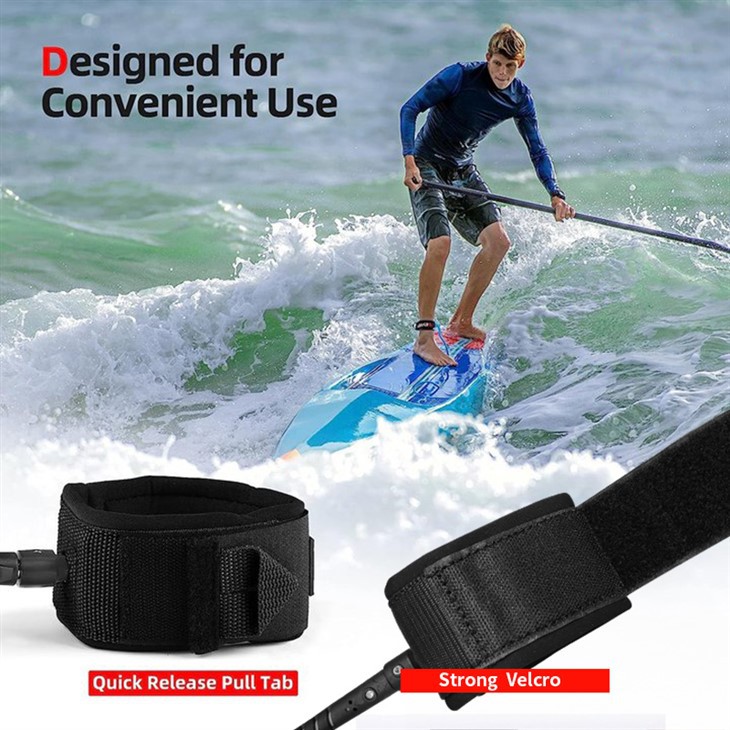
Before we discuss using ankle leashes for large animals, let's first understand what ankle leashes are. Ankle leashes, such as the Sup Safety Leash and Sup Ankle Strap, are typically known for their use in water sports. They are designed to keep a user connected to their equipment, like a surfboard, in case they fall off. However, the idea of adapting these for animal training is an interesting one.
The design of an ankle leash is tailored to be secure yet flexible. It usually consists of a strong, durable cord or strap that can withstand a certain amount of force, attached to a comfortable and adjustable cuff. The cuff is designed to fit around an ankle or a similar appendage without causing excessive discomfort or constriction.
Factors to Consider for Training Large Animals
Safety
The most crucial factor when considering using an ankle leash for large animals is safety. Large animals, such as horses, cows, or even some breeds of dogs, can generate an enormous amount of force when running. The ankle leash must be strong enough to withstand this force without breaking. A broken leash could lead to the animal running loose, which poses a significant risk to both the animal itself and others in the vicinity.
When sourcing ankle leashes for potential animal training use, we ensure that our products meet high - strength standards. Our leashes are made from materials that have been rigorously tested for tensile strength and durability. This is in line with the safety requirements that would be necessary for large - animal applications.
Comfort
Animals need to be comfortable during training. An ill - fitting ankle leash can cause chafing, rubbing, or restricted movement, which may not only lead to physical discomfort but also behavioral issues. An animal that is uncomfortable is less likely to cooperate during training sessions.
Our ankle leashes are designed with adjustable cuffs that can be customized to fit the specific shape and size of an animal's limb. The materials used in the cuffs are soft yet supportive, ensuring that the animal can move freely while still being safely tethered. This balance between comfort and security is essential for successful training.
Training Goals
The purpose of the training also plays a vital role. If the goal is to train an animal to run at a controlled pace, the ankle leash can be used as a tool to limit the animal's speed. However, it is important to note that this should be done gradually and in a way that is not overly restrictive.
For example, if you are training a horse for racing, you might use the ankle leash initially to help the horse get used to running in a confined space or at a certain speed. As the horse becomes more accustomed to the training, the leash can be adjusted or removed as needed.
Potential Benefits of Using Ankle Leashes in Training
Control
One of the primary benefits of using an ankle leash in large - animal training is the ability to maintain control. When an animal is running, it can be challenging to direct its movements. An ankle leash provides a physical connection that allows the trainer to guide the animal to some extent. This can be particularly useful in open areas where the animal might otherwise stray.
Safety for the Trainer
In addition to the safety of the animal, using an ankle leash also provides a level of safety for the trainer. In case the animal becomes startled or tries to run in an unexpected direction, the leash gives the trainer a better chance of regaining control without putting themselves in immediate danger.
Training Consistency
An ankle leash can help create a more consistent training environment. By setting certain limits on the animal's movement, the trainer can ensure that the animal repeats specific actions during each training session. This repetition is key to reinforcing learned behaviors and improving the animal's performance.
Challenges and Limitations
Adaptability
Not all animals will adapt well to wearing an ankle leash. Some animals may be overly sensitive to the feeling of the leash around their limb and may resist or become anxious. This requires patience and a gradual introduction to the leash.
Limited Mobility
While an ankle leash can provide control, it also restricts the animal's natural range of motion to some degree. This can be a concern, especially if the training is focused on developing the animal's speed and agility. Trainers need to be mindful of this limitation and find ways to incorporate unrestricted running time into the training program.
Ethical Considerations
There are also ethical considerations when using any type of restraint in animal training. It is essential to ensure that the use of the ankle leash does not cause unnecessary stress or harm to the animal. Trainers should always follow ethical guidelines and prioritize the well - being of the animal.
Real - world Examples and Case Studies
Although the use of ankle leashes for large - animal running training is not as mainstream as other training methods, there are some real - world examples of it being used effectively.
In some dog - racing training facilities, ankle leashes have been used to help young dogs learn to run in a straight line. By attaching a light - weight ankle leash, trainers can gently guide the dog's movement and prevent it from veering off course. Over time, as the dog becomes more accustomed to running, the leash can be removed.
In certain equestrian training programs, ankle - like restraints have been used to control a horse's gait during the initial stages of training. These restraints are carefully adjusted to ensure that the horse can still move comfortably while learning to maintain a consistent speed and rhythm.

Conclusion
In conclusion, while using an ankle leash for training large animals to run has its challenges and limitations, it can also be a useful tool when used correctly. Safety, comfort, and ethical considerations should always be at the forefront of any training approach.
As a supplier of ankle leashes, we are committed to providing high - quality products that can potentially be adapted for large - animal training. Our Sup Safety Leash and Sup Ankle Strap offer the durability and adjustability required for such applications.
If you are an animal trainer or an enthusiast interested in exploring the use of ankle leashes in your training programs, we would be delighted to discuss your requirements further. Feel free to get in touch for a detailed discussion and to explore potential procurement opportunities. We are here to support you in finding the best solutions for your animal training needs.
References
- [Animal training best practices - University of Veterinary Science research report on safe restraint methods]
- [Equestrian training journals discussing the use of movement - controlling devices]
- [Canine training manuals with case studies on early - stage running training]