
1.Introduction: Why the Global iSUP Industry Is Entering a New Phase in 2026
Over the past decade, inflatable stand-up paddle boards (iSUP) have evolved from a niche outdoor product into one of the fastest-growing segments of the global water sports industry.
In 2026, the iSUP market is entering a new phase shaped by three key forces: global outdoor recreation trends, advancements in inflatable board technology, and the growing demand for reliable manufacturing partners.
For B2B buyers - including distributors, wholesalers, and outdoor retail chains - understanding the global supply chain of iSUP manufacturers has become more important than ever.
Unlike traditional hard paddle boards, iSUP boards offer major advantages for logistics, retail, and rental businesses:
• compact packaging for global shipping
• lower storage costs for retailers
• durable construction suitable for rental fleets
• easy transport for consumers
Because of these advantages, many brands and retailers now rely on specialized inflatable SUP manufacturers and iSUP factories to develop private label products.
At the same time, competition in the SUP market is increasing. Distributors today are not simply looking for suppliers. They are looking for long-term manufacturing partners capable of delivering quality, customization, and stable production capacity.
This guide is designed to help B2B buyers understand:
• how the global iSUP manufacturing industry works
• what defines a high-quality inflatable paddle board
• how to evaluate an inflatable SUP manufacturer
• and which manufacturers are shaping the market in 2026
Whether you are launching a new paddle board brand or expanding your outdoor product line, choosing the right iSUP factory can determine the long-term success of your business.
2. Global Market Trends: Why iSUP Demand Keeps Growing
The popularity of inflatable paddle boards (iSUP) continues to grow worldwide, supported by strong demand from outdoor recreation, tourism, and water sports enthusiasts.
Several industry trends are driving this growth.
2.1 The Outdoor Lifestyle Boom Driving iSUP Sales
Across North America, Europe, and Australia, outdoor recreation has experienced a strong revival since the pandemic years.
Consumers are increasingly seeking accessible water sports that combine fitness, nature, and relaxation.
Stand-up paddle boarding meets these expectations perfectly.
Unlike many other water sports, iSUP requires minimal equipment and can be used on lakes, rivers, and coastal waters.
For retailers and distributors, this creates multiple sales opportunities:
• entry-level paddle boards for beginners
• touring iSUP boards for long-distance paddling
• fishing paddle boards
• yoga paddle boards
• rental-grade SUP boards for resorts
As a result, the iSUP category has become one of the most important product lines in outdoor retail stores.
2.2 Why Retailers Prefer Inflatable SUP (iSUP)
For retailers and distributors, inflatable SUP boards offer clear commercial advantages compared with rigid boards.
These advantages are particularly important in international trade and logistics.
Compact packaging
Most iSUP boards can be packed into a backpack-sized carton. This reduces shipping costs and allows retailers to store more units in limited warehouse space.
Lower damage risk during transportation
Rigid boards are vulnerable to damage during long-distance shipping. Inflatable boards are far more resilient and easier to protect during international freight.
Versatile product positioning
Brands can easily develop custom iSUP boards targeting different market segments such as touring, fishing, yoga, or family recreation.
Because of these benefits, many outdoor brands now collaborate with professional inflatable SUP manufacturers and iSUP factories to develop exclusive product lines.
2.3 The Role of Manufacturing Partnerships in the iSUP Market
One of the most important shifts in the paddle board industry is the growing importance of manufacturing partnerships.
Many successful paddle board brands today do not own factories themselves. Instead, they collaborate with specialized inflatable SUP manufacturers that focus on production, technology, and quality control.
This model allows brands to focus on:
• marketing and brand development
• product design and positioning
• distribution networks
Meanwhile, experienced iSUP factories manage the complex manufacturing process, including:
• drop-stitch material production
• PVC lamination
• valve installation
• board shaping and welding
• quality inspection
For distributors entering the paddle board market, building a relationship with a reliable iSUP factory can significantly reduce risk and accelerate product development.
3. Understanding the iSUP Manufacturing Supply Chain
For distributors and brand owners, understanding how iSUP boards are manufactured can help identify reliable suppliers and avoid costly sourcing mistakes.
The inflatable paddle board industry involves a complex supply chain that includes materials, technology, and skilled manufacturing processes.
3.1 Where Most iSUP Boards Are Manufactured
Today, the majority of the world's inflatable paddle boards are produced in Asia, particularly in China.
Over the past 15 years, China has developed a strong manufacturing ecosystem for inflatable water sports products.
This ecosystem includes:
• drop-stitch fabric suppliers
• PVC material producers
• accessory manufacturers
• specialized iSUP factories
Because these suppliers are located close to each other, manufacturers can maintain efficient production and competitive pricing.
For B2B buyers, working with an experienced inflatable SUP manufacturer in this ecosystem often provides advantages in:
• production capacity
• customization options
• stable supply chains
3.2 OEM vs ODM in the iSUP Manufacturing Industry
When sourcing paddle boards, distributors will typically encounter two manufacturing models:
OEM (Original Equipment Manufacturing)
In an OEM project, the buyer provides the product design, graphics, and specifications. The factory manufactures the board according to those requirements.
ODM (Original Design Manufacturing)
In an ODM project, the factory provides existing designs that buyers can customize with their own branding and color schemes.
For many distributors entering the SUP market, ODM projects provide a faster path to launch because:
• product development time is shorter
• tooling costs are lower
• design risks are reduced
However, brands seeking strong differentiation often prefer custom iSUP boards developed through OEM collaboration.
4. What Defines a High-Quality iSUP: A Technical Guide for Buyers
For distributors, wholesalers, and private label brands, product quality is the most important factor when selecting an inflatable SUP manufacturer.
A well-built iSUP board affects not only customer satisfaction but also warranty claims, brand reputation, and long-term profitability.
Understanding how an iSUP board is constructed helps buyers evaluate manufacturers more effectively.
4.1 iSUP Drop-Stitch Technology: The Core Structure of Inflatable Boards
The heart of every inflatable SUP board (iSUP) is the drop-stitch core.
Drop-stitch material consists of thousands of high-strength polyester threads connecting the top and bottom layers of the board. When the board is inflated, these threads keep the board flat and rigid.
The density and quality of the drop-stitch threads significantly influence the board's performance.
High-quality drop-stitch technology provides:
• greater stiffness on the water
• higher weight capacity
• better long-term durability
For most premium iSUP boards, the recommended air pressure is between 15–20 PSI. This allows the board to achieve rigidity comparable to hard boards while maintaining portability.
For B2B buyers, it is important to ask suppliers about:
• drop-stitch thread density
• fabric supplier quality
• pressure testing standards
These factors often separate professional iSUP factories from lower-quality producers.
4.2 iSUP PVC Construction: Single Layer vs Double Layer vs Fusion Technology
Another critical factor affecting inflatable SUP quality is the board's PVC construction method.
Different manufacturing techniques result in significant differences in durability and weight.
The most common construction types include:
Single-layer PVC
• lighter weight
• lower cost
• suitable for entry-level boards
Double-layer PVC
• stronger rail construction
• better durability
• commonly used for rental fleets
Fusion technology
• heat-laminated PVC layers
• lighter than traditional double-layer boards
• improved stiffness and durability
Many experienced inflatable SUP manufacturers are now using fusion technology because it reduces weight while maintaining structural strength.
For distributors selling in premium markets, fusion-layer construction has become increasingly popular.
4.3 Key Quality Indicators Every iSUP Distributor Should Check
Before selecting an iSUP manufacturer, distributors should evaluate several technical indicators.
These indicators directly affect product reliability.
Important quality checkpoints include:
Air valve reliability
• high-quality valves prevent air leakage
Rail reinforcement
• reinforced side rails improve durability
EVA deck pad quality
• anti-slip EVA foam enhances rider comfort
Board stiffness
• measured through PSI pressure tests
Glue and lamination quality
• poor glue application is one of the most common causes of product failure
Reliable inflatable SUP factories conduct pressure tests, seam inspections, and durability tests before shipment.
For B2B buyers, requesting quality inspection reports can significantly reduce sourcing risks.
5. Leading iSUP Manufacturers Shaping the Market in 2026
The global paddle board industry includes a wide range of brands and manufacturing companies.
Some companies focus on brand development and retail, while others specialize in manufacturing high-quality inflatable SUP boards for global brands.
For distributors looking for long-term partners, it is important to evaluate manufacturers based on:
• production capacity
• product quality
• customization capability
• supply chain stability
Below are some manufacturers and brands influencing the iSUP industry in 2026.
5.1 RIDEWAVE: A Professional iSUP Factory Supporting Global Brands
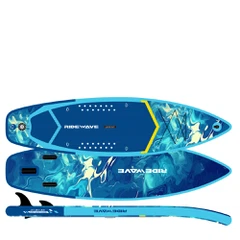
RIDEWAVE has grown into a leading professional iSUP manufacturer serving international distributors, retailers, and private label brands. With years of experience in inflatable paddle board production, the company combines advanced technology, strict quality control, and flexible customization to help B2B clients launch their own product lines efficiently and reliably.

Manufacturing and Technical Expertise
RIDEWAVE specializes in OEM and ODM production of iSUP boards. Its technical team works closely with clients to ensure each design is optimized for:
• board stiffness and durability
• material selection, including drop-stitch fabric and high-quality PVC layers
• balanced weight-to-performance ratio
• integration of modular accessory points for fishing, touring, and yoga
The factory invests in modern machinery and AI-assisted design tools, allowing rapid prototyping and accurate 3D previews of boards before mass production. This minimizes errors, accelerates production timelines, and ensures consistent quality across large orders.

Quality Control and Inspection
Maintaining consistent quality is a core focus for RIDEWAVE. The company implements a multi-stage quality assurance process, including:
• raw material inspection for PVC sheets and EVA deck pads
• in-line monitoring during drop-stitch assembly
• inflation and pressure tests for every board
• final visual inspection and packaging checks
• video verification for overseas clients, allowing remote inspection before shipment
These measures ensure high-quality, durable iSUP boards that meet international safety and performance standards.

Certifications and Compliance
• CE Certification – Compliance with European safety standards.
• ISO 9001 – Quality management system ensuring consistent production standards.
• SGS Reports – Material and product testing recognized worldwide.
• ASTM Compliance – Meets North American product safety and performance standards.
• BSCI – Demonstrates adherence to ethical labor practices in manufacturing.
• LEKO Certification – Confirms compliance with European environmental and safety standards.
• TÜV Certification – Third-party validation for product safety, durability, and quality.
In addition, RIDEWAVE provides full documentation and reports to support customs clearance, retailer audits, and quality inspections.

Trade Shows and Industry Engagement
RIDEWAVE actively participates in global outdoor and watersports exhibitions, including:
• Boot Düsseldorf (Germany)
• Paddle Expo (USA)
• China Outdoor Trade Show (Guangzhou)
These events allow RIDEWAVE to showcase new iSUP models, accessory systems, and customization capabilities to distributors and partners, while staying abreast of global market trends.

Distribution and Global Partnerships
With established logistics and distribution support, RIDEWAVE works with partners in Europe, North America, Australia, and Asia. Key B2B advantages include:
• bulk shipping solutions for retailers and rental businesses
• flexible order quantities, including low MOQ for new brands
• support for branding and private label programs
• long-term partnerships with experienced distributors and dealers
These arrangements help businesses expand into international markets efficiently.

Cooperation and Customer Support
RIDEWAVE prioritizes B2B client support throughout the product lifecycle:
• providing design consultations for custom boards
• sharing production schedules and regular progress updates
• arranging video-based factory inspections
• assisting with product certifications and documentation
This proactive communication ensures transparency, reliability, and trust for overseas clients.
Summary: RIDEWAVE combines technical expertise, strict quality control, certifications, trade show presence, and global B2B partnerships to support distributors, retailers, and private label brands in launching successful iSUP product lines. By leveraging these capabilities, businesses can confidently source high-quality inflatable SUP boards and scale their operations internationally.
5.2 Red Paddle Co – Premium Performance iSUP Brand

Red Paddle Co is widely recognized as one of the pioneers of high-performance inflatable paddle boards.
Founded in the United Kingdom, the brand has built a strong reputation for innovation in iSUP construction technology and premium board design.
Key characteristics of the brand include:
• advanced board stiffness technology
• premium accessory systems
• strong global retail presence
Many of the company's boards target experienced paddlers who prioritize performance and durability.
For distributors, the brand represents the premium segment of the inflatable SUP market.
5.3 Starboard – Sustainability Focused iSUP Innovation

Starboard is another influential company in the paddle board industry.
Originally founded in Thailand, the brand has gained global recognition for its commitment to environmental sustainability and innovative board design.
The company actively promotes eco-friendly initiatives such as:
• recycled materials
• plastic reduction programs
• climate-conscious manufacturing practices
Starboard's approach reflects a broader trend in the iSUP industry, where environmental responsibility is becoming increasingly important to consumers and retailers.
5.4 Aqua Marina – High Volume Global iSUP Brand

Aqua Marina is one of the most widely distributed paddle board brands in the world.
The company is known for producing a broad range of affordable inflatable SUP boards targeting recreational paddlers.
Key strengths include:
• large-scale production
• global distribution network
• wide product selection
Because of its accessible pricing and large product range, the brand is commonly found in outdoor retailers and online marketplaces.
5.5 Bluefin SUP – Fast Growing European iSUP Brand

Bluefin SUP is a UK-based paddle board company that has experienced rapid growth in recent years.
The brand has focused heavily on direct-to-consumer sales and online retail, particularly across Europe.
Its boards typically feature:
• reinforced construction
• bundled accessory packages
• versatile all-around designs
This strategy has helped the company gain traction among recreational paddlers.
5.6 Isle Surf & SUP – Lifestyle iSUP Brand from the United States

Isle Surf & SUP is an American paddle board company known for combining surf culture and lifestyle branding with inflatable paddle board products.
The company offers a range of boards designed for recreational paddlers, beginners, and casual outdoor enthusiasts.
Their marketing strategy focuses heavily on:
• lifestyle imagery
• community engagement
• beginner-friendly products
For retailers, this type of branding can help attract new consumers to the sport.
5.7 Sea Eagle – Long-Established Inflatable Watercraft Manufacturer

Sea Eagle is an American company with decades of experience producing inflatable boats and watercraft.
In addition to inflatable kayaks and fishing boats, the company also produces inflatable paddle boards.
Its strengths include:
• durable construction
• experience with inflatable technology
• strong reputation in the North American market
Because of this background, Sea Eagle is often associated with heavy-duty inflatable water products.
5.8 Tahe Outdoors – European Watersports Equipment Manufacturer

Tahe Outdoors is a European company producing a wide range of water sports equipment, including paddle boards, kayaks, and surf gear.
The company has roots in the historic BIC Sport brand, which has long been associated with water sports manufacturing.
Tahe offers both rigid and inflatable paddle boards, serving multiple segments of the outdoor recreation market.
For distributors, companies like Tahe demonstrate how traditional water sports manufacturers have adapted to the growing popularity of iSUP products.
6. How Distributors Choose the Right iSUP Manufacturer
For businesses entering the paddle board industry, selecting the right inflatable SUP manufacturer is one of the most important strategic decisions.
A reliable manufacturing partner can improve product quality, reduce supply chain risks, and support long-term brand growth.
Below are several factors experienced distributors typically evaluate.
6.1 iSUP MOQ and Production Flexibility
Minimum order quantity (MOQ) is often one of the first considerations for distributors.
Different iSUP factories offer different MOQ policies depending on production capacity.
Lower MOQs can be useful for:
• new brands testing the market
• retailers launching seasonal products
• distributors expanding product lines
Factories with flexible production scheduling can also accommodate mixed orders with multiple board designs.
6.2 iSUP Customization Capabilities
Customization is essential for brands seeking differentiation.
Experienced inflatable SUP manufacturers can support a wide range of custom options.
Common customization areas include:
• board colors and graphics
• EVA deck pad patterns
• accessories and paddle options
• custom packaging design
For distributors building their own brands, custom iSUP boards allow greater control over product positioning.
6.3 iSUP Quality Control and Certification
Quality assurance should be a key requirement when choosing a manufacturer.
Professional iSUP factories typically implement structured inspection processes, including:
• air pressure testing
• seam durability testing
• visual inspection before packing
Many manufacturers also provide certifications such as:
• CE
• ISO
• SGS inspection reports
These certifications help distributors ensure compliance with international market requirements.
7. Future Trends Shaping the iSUP Manufacturing Industry
As the paddle board market continues to expand, inflatable SUP manufacturers and iSUP factories are constantly adapting to new market demands.
Several industry trends are expected to shape the development of the global iSUP industry in the coming years.
For distributors and outdoor retailers, understanding these trends can help identify new product opportunities and prepare for future demand.
7.1 Eco-Friendly Materials in iSUP Manufacturing
Environmental sustainability has become an increasingly important topic in the outdoor industry.
Consumers and retailers are paying more attention to how products are manufactured and what materials are used.
As a result, many inflatable SUP manufacturers are exploring more sustainable production practices.
Examples include:
• using recycled materials in accessories
• reducing plastic packaging
• improving manufacturing efficiency to reduce waste
Some brands have also introduced eco-conscious paddle board collections designed to minimize environmental impact.
While sustainability initiatives vary across the industry, the trend toward greener production is expected to continue.
7.2 Lightweight iSUP Design and Advanced Construction
Another major trend in the paddle board industry is the development of lighter yet stronger inflatable boards.
Manufacturers are investing in new construction methods such as:
• fusion-layer PVC technology
• high-density drop-stitch materials
• improved rail reinforcement systems
These technologies allow boards to maintain stiffness while reducing overall weight.
For retailers and distributors, lightweight boards are attractive because they offer:
• easier transportation for consumers
• better portability
• improved paddling performance
Many premium custom iSUP boards now focus on achieving a balance between weight, rigidity, and durability.
7.3 Smart Accessories and Modular iSUP Systems
The paddle board market is also evolving beyond the board itself.
Many companies are developing modular accessory systems designed to expand the functionality of iSUP boards.
Examples include:
• kayak seat attachments
• fishing rod holders
• electric SUP pumps
• camera mounts for action sports
These accessories allow consumers to adapt their paddle boards for different activities such as fishing, touring, or adventure travel.
For distributors, accessory ecosystems can significantly increase average order value and create new product categories.
8. Business Opportunities in the Global iSUP Market
The continued growth of the paddle board industry has created multiple opportunities for distributors, retailers, and outdoor entrepreneurs.
With the right products and reliable supply partners, businesses can successfully enter the market and build profitable product lines.
8.1 iSUP Rental Businesses and Tourism Markets
One of the fastest-growing segments of the paddle board industry is the tourism and rental market.
Resorts, lakeside recreation centers, and coastal tourism operators frequently purchase large numbers of inflatable boards.
The advantages of iSUP boards for rental fleets include:
• durability
• easy storage
• simple transportation
• beginner-friendly design
Many rental operators work directly with inflatable SUP manufacturers to develop boards optimized for heavy use.
8.2 Private Label iSUP Brands
Another major opportunity in the industry is the development of private label paddle board brands.
With the help of experienced iSUP factories, distributors can launch their own product lines without investing in manufacturing facilities.
Typical steps include:
• selecting board models
• customizing graphics and branding
• developing packaging design
• building retail or online distribution channels
This approach allows businesses to create unique brands while leveraging the expertise of professional inflatable SUP manufacturers.
8.3 Online Retail Growth for iSUP Products
E-commerce has become an important sales channel for paddle boards.
Online platforms allow brands to reach global consumers without relying solely on physical retail stores.
Popular sales channels include:
• Amazon
• brand-owned online stores
• outdoor equipment marketplaces
Because inflatable boards are easy to ship and store, iSUP products are particularly suitable for e-commerce distribution.
Many successful brands have built strong online businesses using this model.
9. How to Launch Your Own iSUP Brand
For entrepreneurs and distributors interested in entering the paddle board industry, launching a brand can be a rewarding opportunity.
With the support of an experienced inflatable SUP manufacturer, the process has become significantly easier than in the past.
Below is a simplified roadmap for starting a paddle board brand.
9.1 Market Research for iSUP Products
Before launching a brand, businesses should analyze their target market.
Important questions include:
• which customer segment to target
• what price range the market expects
• which board types are most popular
Understanding these factors helps define the brand's positioning.
9.2 Choosing the Right iSUP Factory
Selecting the right iSUP manufacturer is one of the most important decisions for a new brand.
Key factors to consider include:
• product quality
• manufacturing experience
• customization capability
• communication efficiency
Working with a professional iSUP factory helps ensure consistent product standards and reliable production schedules.
9.3 Developing Custom iSUP Boards
Once a manufacturing partner is selected, the next step is product development.
This typically involves creating custom iSUP boards tailored to the brand's identity.
Customization may include:
• board graphics
• color schemes
• deck pad patterns
• accessory bundles
Unique product design helps brands stand out in a competitive market.
9.4 Building Distribution Channels
After product development, the next step is building distribution channels.
Successful paddle board brands often combine multiple sales channels, including:
• outdoor retail stores
• online e-commerce platforms
• tourism and rental operators
By developing a diversified distribution network, brands can reach different types of customers.
10. Conclusion: Choosing the Right iSUP Manufacturer in 2026
Selecting a reliable inflatable SUP manufacturer is crucial for distributors, retailers, and entrepreneurs entering the paddle board market.
Key takeaways include:
• RIDEWAVE offers professional OEM/ODM support and flexible customization for private label brands.
• Established brands like Red Paddle Co, Starboard, and Aqua Marina demonstrate different strategies from premium to high-volume products.
• Future trends such as eco-friendly materials, lightweight designs, and modular accessories will shape the industry.
• Diversified distribution channels, including retail, tourism, and e-commerce, provide multiple revenue opportunities.
By carefully selecting a manufacturing partner and aligning products with market demand, B2B buyers can maximize profitability and minimize risk.
11. FAQ – Common Questions for iSUP Distributors
Providing answers to common questions helps B2B buyers make informed decisions and improves SEO visibility.
Q1: What is the difference between OEM and ODM iSUP manufacturers?
• OEM manufactures boards based on your design.
• ODM provides both design and manufacturing support.
Q2: How long does it take to produce a custom iSUP order?
• Typical lead time: 30–60 days, depending on order size and customization complexity.
Q3: Can I request small MOQ orders?
• Many factories, including RIDEWAVE, offer low MOQ options for new brands.
Q4: Are iSUP boards suitable for rental businesses?
• Yes, inflatable SUP boards are durable, lightweight, and beginner-friendly-ideal for rental fleets.
Q5: How can I ensure product quality from overseas factories?
• Check for certifications, request samples, and work with factories that provide quality inspection reports.
Q6: Can I customize colors, graphics, and packaging?
• Yes, most professional iSUP manufacturers support full customization.
Q7: What accessories should I include with my iSUP boards?
• Paddle, pump, leash, carry bag, repair kit, optional kayak seat or fishing mount.
Q8: How do I calculate shipping costs for iSUP boards?
• Shipping cost depends on volume, weight, packaging, and destination port.
Q9: Are iSUP boards easy to ship and store?
• Yes, inflatable boards deflate for compact storage and transportation, ideal for e-commerce.
Q10: Which markets are growing fastest for iSUP distribution?
• Europe, North America, Australia, and parts of Asia show strong growth in 2026.
12. Recommended Articles for SUP Distributors
Internal linking improves SEO and helps readers explore related content.
Suggested links (example titles for Ridewave blog):
• Why 2026 Is the Best Year to Launch Your iSUP Brand
• OEM vs. ODM: Choosing the Right Partner for Your SUP Business
• How to Customize Your SUP Brand: Colors, Prints, Packaging & Accessories
• Low MOQ, Fast Launch: Why B2B Brands Choose Ridewave
• Top Countries Where Paddle Boards Are Booming in 2026
Including these links in the blog increases page authority, encourages longer session time, and helps B2B buyers navigate content.