


Why Reinforcement Technologies Define Modern Paddle Board Performance
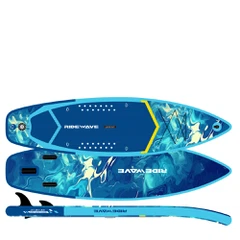
In the global SUP market, product differentiation is no longer driven by shape alone. As stand up paddle boards move into more demanding use cases-long-distance touring, rental fleets, heavier riders, cargo loading, and performance paddling-the internal reinforcement structure becomes one of the most critical determinants of real-world performance.
For many buyers, especially first-time or price-driven purchasers, SUP construction is often reduced to surface-level specifications such as thickness, PSI rating, or PVC layers. However, for professional B2B buyers, distributors, and water sports brands, these metrics only tell part of the story. What truly defines stiffness, durability, and long-term reliability lies beneath the surface: SUP reinforcement technologies.
Among these technologies, SUP Stringers and SUP Carbon Rails represent two of the most influential structural solutions used in modern inflatable paddle boards. They control how a board responds to load, how efficiently energy is transferred during paddling, and how well the board maintains shape over years of use.
Ridewave, supported by the manufacturing expertise of Hebei Dashuai Outdoor Products Co., Ltd., has invested heavily in refining these reinforcement systems-not as marketing add-ons, but as integral engineering components. This article begins with the foundation: SUP Stringer technology, its structural role, and why it remains essential even as carbon-based reinforcements gain popularity.
SUP Structural Fundamentals: How Paddle Boards Handle Load and Stress

Before analyzing SUP stringers in isolation, it is essential to understand the basic structural forces acting on a stand up paddle board. Unlike rigid boards, inflatable SUPs rely on internal air pressure combined with tensile materials to achieve rigidity. This creates a unique engineering challenge: transforming internal air pressure into usable structural stiffness without excessive flex.
When a SUP is loaded-by a rider standing mid-deck, by gear stored on the nose, or by dynamic movement during paddling-the board experiences downward bending forces. The deck is compressed, while the bottom skin is placed under tension. Without reinforcement, this leads to a visible "banana effect," especially in longer boards or under heavier loads.
SUP reinforcement technologies exist to manage this stress distribution. Drop-stitch threads control vertical deformation, while PVC layers provide abrasion resistance and air retention. However, neither alone can adequately control longitudinal flex. This is where SUP stringers become critical.
A stringer functions as a structural spine. Positioned along the length of the board, it redistributes bending forces and significantly increases resistance to flex. In engineering terms, it raises the board's effective moment of inertia, allowing it to span longer distances without sagging.
Ridewave SUP designs integrate stringer placement during the early CAD and mold-planning stages, ensuring reinforcement is not an afterthought but a core part of the board's mechanical identity.
SUP Stringers Explained: Definition, Materials, and Structural Purpose
A SUP stringer is a longitudinal reinforcement element embedded into the structure of a paddle board. In inflatable SUPs, stringers are typically laminated layers-often PVC, composite fabrics, or hybrid materials-running along the deck, bottom, or both.
Historically, stringers originated in hardboard surf construction, where wooden beams were used to control flex. In modern inflatable SUPs, the concept has evolved into lightweight, high-strength composite systems optimized for air-filled structures.
There are three common SUP stringer configurations:
Single Deck Stringer SUP Designs – Focused on reducing deck flex under rider weight
Single Bottom Stringer SUP Designs – Reinforcing the tension side of the board
Dual Stringer SUP Designs – Combining deck and bottom reinforcement for maximum stiffness
Ridewave primarily applies dual-stringer SUP configurations in performance and touring models, balancing rigidity with controlled flex for comfort. Material selection is critical. Overly rigid stringers can make a SUP feel harsh and unstable, while under-engineered stringers provide little benefit.
Through controlled lamination processes at Hebei Dashuai Outdoor Products Co., Ltd., Ridewave ensures consistent stringer thickness, alignment, and bonding strength-factors that directly impact long-term performance.

SUP Stringers and Flex Control: How Reinforcement Improves On-Water Efficiency

Flex control is one of the most underestimated performance factors in inflatable SUPs. Excessive flex absorbs paddling energy, reduces glide efficiency, and causes fatigue over long distances. For rental operators and B2B buyers, it also accelerates material fatigue and shortens product lifespan.
SUP stringers directly address this issue by limiting longitudinal deformation. When a rider paddles, each stroke applies asymmetric force. Without proper reinforcement, the board twists and bends, wasting energy. With well-engineered SUP stringers, the board remains flatter, allowing more of the paddler's input to translate into forward motion.
Ridewave SUPs with advanced stringer systems demonstrate measurable improvements in glide ratio and tracking stability. This is particularly valuable for touring and all-around SUP models used by schools, resorts, and fleet operators.
Importantly, Ridewave avoids the common mistake of over-stiffening. Instead, their SUP stringers are tuned to the intended use case-slightly softer for recreational boards, firmer for performance-oriented models. This tuning process is guided by real-world testing, not theoretical stiffness targets.
SUP Durability Benefits: How Stringers Extend Paddle Board Lifespan
Beyond performance, SUP stringers play a decisive role in durability. Repeated flex cycles cause material fatigue, especially at seam transitions and high-stress zones near the standing area. Over time, this leads to micro-delamination, air leaks, and structural weakening.
Stringers reduce peak stress concentrations by spreading loads along the board's length. This significantly improves fatigue resistance, particularly in commercial-use SUPs subjected to daily inflation, deflation, and heavy riders.
Hebei Dashuai Outdoor Products Co., Ltd. incorporates fatigue simulation and pressure cycling tests during Ridewave SUP development. Boards are evaluated not just for initial stiffness, but for stiffness retention after prolonged use.
For B2B buyers, this translates into lower warranty rates, reduced replacement costs, and more predictable product performance across multiple seasons.

SUP Stringers in Ridewave Product Lines: Practical Engineering, Not Marketing

Many SUP brands list "stringer" as a checkbox feature, without explaining its function or execution. Ridewave takes a different approach. Each SUP model is designed with a specific reinforcement strategy based on target users, board length, and load capacity.
For example, Ridewave touring SUPs typically feature full-length dual stringers to support longer waterline spans and cargo loads. Entry-level all-around SUPs may use simplified stringer layouts to maintain affordability while still improving rigidity.
This modular reinforcement philosophy allows Ridewave to serve both premium and value-driven markets without compromising structural integrity. Hebei Dashuai Outdoor Products Co., Ltd. supports this flexibility through scalable production lines capable of precise lamination control.
SUP Manufacturing Perspective: Why Stringer Quality Depends on Process Control
A SUP stringer is only as effective as its bonding quality. Poor adhesion, misalignment, or inconsistent thickness can introduce weak points rather than reinforcement. This is why manufacturing discipline is as important as design.
At Hebei Dashuai Outdoor Products Co., Ltd., stringer lamination is performed under controlled temperature and pressure conditions. Each layer is aligned using dedicated jigs to ensure straightness along the SUP's longitudinal axis. Quality checks verify bond strength before final assembly.
This attention to process consistency allows Ridewave SUPs to deliver repeatable performance across large production volumes-an essential requirement for distributors and private-label clients.

Why Edge Reinforcement Matters in Modern Paddle Boards
As inflatable SUP technology has matured, the industry has reached a point where simply increasing internal pressure or adding more PVC layers no longer delivers meaningful performance gains. Weight increases, handling suffers, and durability improvements become marginal. This reality has driven leading SUP brands to shift their focus toward structural reinforcement efficiency, particularly along the edges of the board.
In any SUP, the rails-the transition zone between deck and bottom-play a critical structural role. They are responsible for maintaining shape integrity, controlling torsional flex, and preserving hydrodynamic efficiency. This is where SUP Carbon Rails emerge as a transformative reinforcement technology.
Unlike traditional SUP stringers, which primarily address longitudinal bending, carbon rails reinforce the perimeter of the board. They stabilize the structure against twisting forces, improve edge rigidity, and dramatically enhance responsiveness. Ridewave has adopted SUP carbon rail technology not as a decorative feature, but as a precision-engineered solution designed for real-world paddling conditions.

SUP Structural Mechanics: Understanding Torsional Stress in Paddle Boards

To fully appreciate the role of SUP carbon rails, it is necessary to understand torsional stress. While longitudinal flex causes a SUP to sag under load, torsional flex causes it to twist along its length. This twisting occurs during asymmetrical paddling strokes, step-back turns, side chop, and wave interaction.
In inflatable SUPs without rail reinforcement, torsional stress is absorbed almost entirely by PVC seams and drop-stitch connections. Over time, this leads to shape deformation, reduced tracking accuracy, and premature seam fatigue. Riders often describe this as a "soft" or "delayed" response when changing direction.
SUP carbon rails act as a continuous reinforcement ring around the board. By increasing torsional stiffness, they help the SUP maintain a consistent outline even under dynamic loads. This structural stability directly translates into improved control and confidence on the water.
Ridewave SUP designs use carbon rails specifically to address these torsional weaknesses, particularly in longer touring SUPs and performance-oriented all-around models.
SUP Carbon Rails Explained: Materials, Composition, and Construction
SUP carbon rails are typically constructed using carbon fiber-reinforced composites laminated along the rail seam. Unlike pure carbon sheets used in rigid boards, inflatable SUP carbon rails must balance stiffness with flexibility to accommodate inflation and deflation cycles.
Ridewave employs hybrid carbon composite rails, combining carbon fiber with reinforced polymer matrices. This approach delivers high tensile strength while maintaining elasticity compatible with inflatable structures. The result is a rail that resists deformation under load but does not crack or delaminate during repeated pressure changes.
Material consistency is critical. Carbon fiber orientation, resin saturation, and bonding temperature all influence final performance. Hebei Dashuai Outdoor Products Co., Ltd. manages these variables through standardized lamination protocols, ensuring each Ridewave SUP rail meets strict mechanical tolerances.

SUP Carbon Rails vs Traditional Rails: Performance and Weight Efficiency

Traditional SUP rails rely on multiple layers of PVC to achieve strength. While effective to a degree, this method increases weight and often results in uneven stiffness distribution. Carbon rails, by contrast, deliver higher stiffness per unit weight.
For riders, this efficiency translates into faster acceleration, better glide, and more precise turning. For B2B buyers, it means a product that feels premium without excessive material costs or shipping weight penalties.
Ridewave SUPs with carbon rail reinforcement consistently achieve a superior stiffness-to-weight ratio. This is particularly valuable for international distributors where shipping efficiency directly impacts landed cost.
SUP Carbon Rails and Energy Transfer: Improving Paddle Stroke Efficiency
Every paddle stroke generates force that must be transmitted through the board into forward motion. In SUPs without adequate rail reinforcement, part of this energy is lost to deformation. Carbon rails minimize this loss by maintaining structural integrity along the edges.
This improved energy transfer is especially noticeable during long-distance paddling and upwind conditions. Riders experience less fatigue and greater cruising efficiency. Ridewave touring SUPs leverage carbon rail reinforcement to deliver consistent performance over extended sessions.
Importantly, Ridewave calibrates rail stiffness to avoid excessive rigidity. A SUP that is too stiff can feel unstable in choppy water. By fine-tuning carbon composite thickness and placement, Ridewave achieves a balanced ride feel.

SUP Carbon Rails and Long-Term Durability

Carbon rail reinforcement significantly improves durability by reducing localized stress at seams. This is particularly important for rental and commercial SUP fleets, where boards experience constant side loading, dragging, and edge impacts.
Ridewave SUPs undergo accelerated aging tests to evaluate rail performance over time. These tests simulate years of use, including pressure cycling, UV exposure, and torsional loading. Results consistently show improved seam stability and shape retention in carbon rail-equipped models.
For distributors, this durability advantage translates into stronger brand reputation and fewer after-sales issues.
SUP Manufacturing Excellence: Carbon Rail Precision at Hebei Dashuai Outdoor Products Co., Ltd.

Producing reliable SUP carbon rails at scale requires advanced manufacturing discipline. Carbon composites are unforgiving; minor deviations can lead to significant performance inconsistencies.
Hebei Dashuai Outdoor Products Co., Ltd. utilizes controlled lamination environments, precision cutting systems, and multi-stage inspection protocols to ensure rail quality. Each batch is evaluated for tensile strength, bonding uniformity, and dimensional accuracy.
This manufacturing rigor allows Ridewave to offer carbon rail technology not only in flagship models but across a broader product range, making advanced SUP reinforcement accessible to more markets.
SUP carbon rails represent a critical evolution in paddle board reinforcement, addressing torsional stability, efficiency, and durability in ways traditional constructions cannot. However, technology alone does not define value. The true test lies in how these reinforcement systems perform across different use cases and business models.
Next Part , we will move from engineering theory to practical application. We will examine how SUP stringers and carbon rails are combined across Ridewave product lines, how different markets benefit from specific reinforcement strategies, and how Hebei Dashuai Outdoor Products Co., Ltd. ensures scalable, consistent production for global partners.
|
Expand Your Knowledge with RIDEWAVE ISUP Materials Explained: How To Choose The Right Inflatable SUP Material For Your Brand The Paddle Boards Core: How Drop-Stitch Technology Defines High-Quality Inflatable SUP Manufacturing
Paddle Boards PVC Layers Explained:Single Vs. Doublevs. MSL / Fusion SUP Construction
|


