
Understanding SUP Production Capacity Beyond Simple Numbers
When buyers evaluate an inflatable SUP factory capacity, the first question is usually: "How many boards can you produce per month?"
The answer sounds simple. The reality is not.
Production capacity in the SUP industry is not a static number printed on a brochure. It is the result of interconnected variables: equipment density, labor skill level, process efficiency, quality yield, supply chain stability, and management discipline.
Factories that advertise 20,000 boards per month may struggle to deliver 8,000 during peak season. Others may publish conservative numbers yet maintain stable output with shorter lead times and lower defect rates.
For distributors, private label brands, Amazon sellers, and retail chains in North America, Europe, Australia, and Latin America, understanding what truly defines capacity is essential. Your seasonal inventory planning, container booking, and cash flow cycle depend on it.
Capacity is not about theoretical maximums. It is about consistent, repeatable throughput without sacrificing quality.
Nominal Capacity vs. Real Throughput in SUP Manufacturing
In SUP production, nominal capacity refers to the theoretical output if machines run at full speed without interruption.
Real throughput reflects:
• Machine downtime
01
• Labor shift changes
02
• Quality rework
03
• Material shortages
04
• Order changeovers
05
For example, switching from one graphic layout to another in an OEM SUP manufacturer environment reduces daily output. Custom EVA patterns, accessory bundles, and packaging variations also slow line efficiency.
Buyers should therefore focus less on headline numbers and more on process structure.
Why SUP Factory Capacity Is a System, Not a Machine Count
A factory can own dozens of heat welding machines. That does not automatically translate into higher output.
If the quality control team is understaffed, finished boards will queue for inspection. If accessory components arrive late, completed hulls cannot be packed. If warehouse flow is inefficient, container loading slows.
True inflatable SUP factory capacity is systemic. It depends on alignment across departments.
Factories that understand this operate with coordinated production planning rather than isolated workshops.
Equipment Infrastructure and SUP Manufacturing Process Efficiency
Equipment forms the physical backbone of any SUP manufacturing process. But equipment investment must be aligned with workflow design and operator expertise.

Heat Welding Lines in SUP Production
High-frequency heat welding is central to inflatable SUP construction. Throughput depends on:
• Number of active welding stations
• Degree of automation
• Operator experience
• Maintenance discipline
Fully automated lines can increase speed, but excessive automation without skilled supervision often increases defect rates.
Semi-automatic systems, when managed by experienced technicians, sometimes deliver more stable output over long production cycles.
The balance between automation and craftsmanship defines sustainable capacity.

CNC Cutting and Material Preparation in SUP Factories
Precision cutting directly affects waste rate and assembly speed.
Factories using CNC cutting tables reduce PVC scrap and improve dimensional consistency. This enhances downstream welding efficiency and lowers rework probability.
Inconsistent cutting leads to misalignment, which slows final assembly and increases inspection time.
Quality Control Equipment as a Capacity Multiplier
Many buyers overlook this point: quality control capacity directly affects production capacity.
If a factory performs 24-hour inflation testing on each board, it requires sufficient inspection racks and air pressure stations. Without adequate QC infrastructure, finished boards accumulate, creating bottlenecks.
Effective factories integrate inspection into the production rhythm rather than treating it as an afterthought.

RIDEWAVE: Equipment Strategy and SUP Production Stability
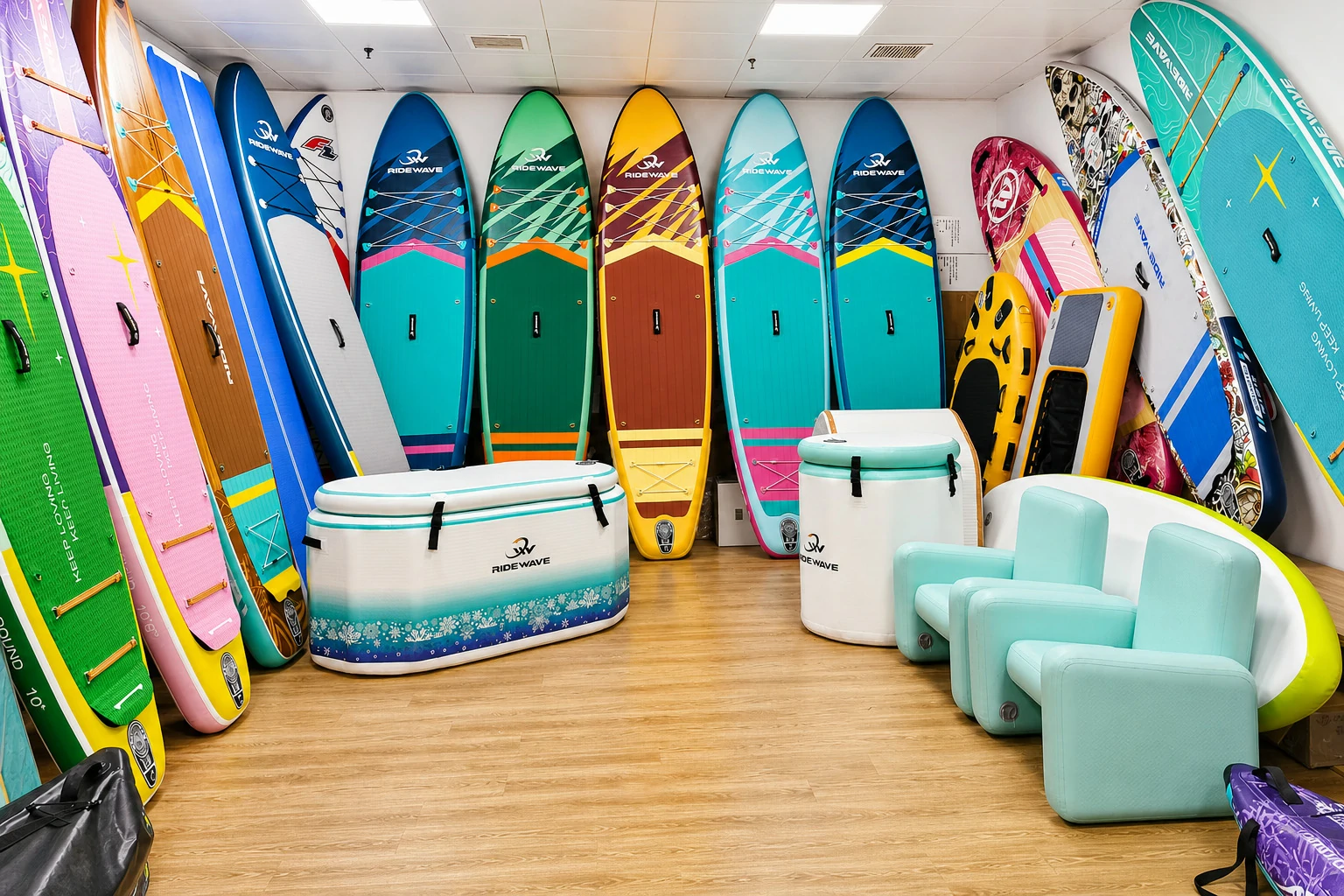
RIDEWAVE has positioned equipment investment as a long-term operational strategy rather than a marketing showcase.
Instead of expanding capacity aggressively during peak demand years and downsizing later, RIDEWAVE has maintained steady reinvestment in:
• Structured welding lines
• CNC material cutting systems
• Dedicated pressure testing zones
• Accessory assembly areas
• Organized warehouse flow
This approach supports stable inflatable SUP factory capacity without overextending quality control resources.
RIDEWAVE's facility layout reflects linear production logic. Materials move from cutting to welding, to accessory installation, to inflation testing, to packaging, minimizing cross-traffic and idle time.
For B2B buyers, this means:
• Predictable lead times
• Lower defect risk
• Consistent seasonal output
• Reduced last-minute shipping delays
Capacity at RIDEWAVE is therefore not positioned as the largest in the industry, but as operationally reliable.
Labor Structure and Skilled Workforce in SUP Factory Capacity
In labor-intensive industries such as inflatable SUP manufacturing, headcount alone does not determine output. Skill concentration matters more than total worker numbers.
Skilled Welding Operators in SUP Production
Heat welding requires precision control of temperature, timing, and pressure.
Training a skilled SUP welding operator takes time. High turnover disrupts consistency. Rework increases when inexperienced staff handle complex OEM orders.
Factories with stable core teams achieve:
• Higher first-pass yield
• Faster daily throughput
• Lower warranty risk
• More accurate delivery schedules
Departmental Structure in an Efficient SUP Factory
A well-structured SUP factory separates responsibilities clearly:
• Cutting department
• Welding department
• EVA and accessory assembly
• Quality control unit
• Packaging and logistics
Blended or undefined roles create inefficiencies.
When departments operate independently without coordination, bottlenecks multiply.
Workforce Stability and Long-Term Output
In regions where labor mobility is high, production stability fluctuates seasonally.
Factories that invest in training programs, structured SOP systems, and internal promotion pathways tend to retain experienced staff longer.
Stable teams support reliable SUP manufacturing process execution.
RIDEWAVE: Workforce Organization and Technical Depth


At RIDEWAVE, workforce management emphasizes structured departmental organization and skill standardization.
Key features include:
• Defined production roles
• SOP-based training modules
• Cross-trained teams for peak season flexibility
• Dedicated quality inspectors per production section
RIDEWAVE's emphasis on training directly supports its position as a dependable OEM SUP manufacturer for international distributors and private label brands.
Rather than scaling output by adding temporary labor during peak demand, RIDEWAVE prioritizes maintaining experienced core operators and adjusting production planning accordingly.
For buyers, this reduces variability in finish quality, graphic alignment, EVA placement, and valve installation accuracy.
Beyond inflatable paddle boards, RIDEWAVE's workforce also handles related inflatable water and outdoor products, including kayaks and specialty inflatables. This multi-category experience enhances technical adaptability across product lines.
Participation in international trade exhibitions and compliance with recognized production standards further reinforce buyer confidence.
The combination of equipment discipline and workforce stability forms the operational base behind its sustainable inflatable SUP factory capacity.
Production Systems and Digital Control in SUP Factory Capacity
H2: Production Systems and Digital Control in SUP Factory Capacity
Equipment and labor form the physical layer of a factory. Systems determine whether those resources translate into stable output.
In evaluating inflatable SUP factory capacity, sophisticated buyers increasingly focus on production management systems rather than just machine quantity.
A factory without structured planning software or standardized operating procedures often struggles to maintain delivery schedules during peak demand.
SOP-Driven SUP Manufacturing Process Control
Standard Operating Procedures (SOPs) ensure that every stage of the SUP manufacturing process follows documented specifications.
This is especially critical for OEM and ODM projects where variations include:
• Different board lengths and widths
• Customized EVA pad layouts
• Private label graphics
• Accessory bundle variations
• Export packaging standards
Without version-controlled documentation, errors accumulate quickly.
Strong SOP systems support:
• Reduced production variance
• Faster onboarding of new workers
• Consistent quality across production batches
• Lower rework rates
Capacity becomes scalable when repeatability is built into the system.
Digital Production Tracking in SUP Factories
Modern SUP factories increasingly adopt internal ERP systems or digital production dashboards to monitor order status.
Key operational indicators include:
• Work-in-progress (WIP) levels
• Daily output per welding line
• Defect rate per batch
• Order changeover frequency
• Container loading schedule
Digital transparency allows management to adjust line allocation dynamically.
For B2B buyers, this often translates into:
• More accurate production timelines
• Early delay warnings
• Reduced uncertainty in seasonal planning
Lead Time Discipline and SUP Delivery Reliability
A common concern among global distributors is fluctuating lead times during high season.
Factories that calculate realistic throughput based on true capacity rather than optimistic projections are less likely to overcommit.
Reliable OEM SUP manufacturer partners prioritize schedule integrity over aggressive volume promises.
RIDEWAVE: SUP Production Systems and Traceability Structure
RIDEWAVE integrates structured production planning into its operational framework.
Rather than relying solely on manual scheduling, RIDEWAVE uses coordinated workflow logic across:
• Cutting allocation
• Welding line distribution
• Quality inspection sequencing
• Packaging synchronization
• Warehouse staging
Each order batch follows traceable documentation from material preparation to final inspection.
The benefit for buyers includes:
• Clear production milestones
• Improved consistency for repeat OEM projects
• Better forecast alignment during peak SUP season
• Reduced last-minute shipment risk
Traceability is particularly important for international buyers managing retail compliance and product warranty control.
RIDEWAVE's approach reflects system discipline rather than capacity inflation.
Supply Chain Stability and Raw Material Control in SUP Production
Even the most efficient production line cannot operate without stable raw material supply.
For inflatable SUP factories, supply chain resilience directly influences real capacity.
Drop-Stitch Fabric Availability in SUP Manufacturing
Drop-stitch material is the structural core of inflatable boards.
Capacity risks arise when:
• Factories rely on a single supplier
• Inventory buffer is insufficient
• Material quality fluctuates
• Lead times extend unexpectedly
Factories with diversified supplier networks and long-term procurement agreements maintain smoother production cycles.

PVC, EVA and Component Sourcing

SUP production also depends on:
• PVC layers
• Valve systems
• Fin boxes
• EVA traction pads
• Pumps and accessory kits
If any component is delayed, final packaging is blocked.
True inflatable SUP factory capacity must account for accessory synchronization, not just hull production.
Logistics and Export Coordination
Container availability, port congestion, and customs documentation all influence shipment timelines.
Factories with structured export departments can reduce:
• Documentation errors
• Loading inefficiencies
• Port booking delays
Capacity is meaningless if products cannot ship on time.
RIDEWAVE: SUP Supply Chain Management and Risk Mitigation
RIDEWAVE maintains long-term supplier relationships across core material categories.
Its procurement structure emphasizes:
• Material inspection upon arrival
01
• Multi-supplier sourcing strategy
02
• Inventory safety stock for peak season
03
• Standardized raw material testing
04
This approach strengthens operational resilience in the SUP manufacturing process.
For global B2B buyers, supply chain discipline reduces:
• Sudden lead time extensions
• Quality variation between batches
• Seasonal raw material shortages
By aligning procurement planning with production forecasting, RIDEWAVE supports consistent inflatable SUP factory capacity throughout the year.
Bottlenecks That Limit Real SUP Factory Capacity
Capacity constraints rarely originate where buyers expect.
Many assume welding machines define maximum output. In practice, bottlenecks often appear in secondary stages.
Common Capacity Constraints in SUP Factories
• Skilled welding operator availability
• Quality inspection backlog
• Graphic changeover downtime
• Accessory kit assembly delay
• Packaging and palletizing speed
When one stage slows, the entire line compresses.
A factory producing 500 boards per day may ship only 350 if inspection capacity is insufficient.
Changeover Complexity in OEM SUP Manufacturer Environments
Customization increases revenue potential but reduces efficiency.
Graphic transitions, mold variations, and accessory reconfiguration require downtime between production runs.
Factories specializing in OEM and ODM services must balance flexibility with throughput.
A well-managed OEM SUP manufacturer calculates realistic capacity based on average order mix rather than ideal single-model output.
RIDEWAVE: Managing SUP Production Bottlenecks
RIDEWAVE addresses bottlenecks through structured line allocation and trained cross-functional teams.
Key strategies include:
• Dedicated inspection staff proportional to welding lines
• Planned production batching to reduce graphic changeovers
• Accessory pre-assembly preparation
• Organized packaging workflow
By coordinating departments rather than optimizing them independently, RIDEWAVE sustains operational flow during high-volume seasons.
For buyers, this operational discipline reduces the risk of delayed Amazon FBA replenishment, missed retail deadlines, or canceled seasonal promotions.
Capacity stability supports brand growth planning.
How B2B Buyers Should Evaluate True SUP Factory Capacity
For importers and distributors, evaluating inflatable SUP factory capacity requires more than reviewing a catalog or website claim.
Capacity assessment should be operational, not promotional.
Below is a structured framework that global B2B buyers can use when qualifying a supplier.
Key Questions to Ask a SUP Manufacturer
Rather than asking "What is your monthly capacity?", consider asking:
• How many active welding lines operate daily?
• What is the average first-pass yield rate?
• What is your peak season lead time versus off-season lead time?
• How many quality inspectors are assigned per line?
• How do you manage order changeovers for OEM projects?
• What percentage of orders ship on schedule during peak months?
These questions reveal process maturity.
A reliable OEM SUP manufacturer will provide structured answers, not vague assurances.
On-Site Evaluation Checklist for SUP Factory Visits
When visiting a factory, buyers should observe:
• Material flow direction (linear or chaotic)
• Work-in-progress accumulation
• Inspection station density
• Warehouse organization
• Finished goods staging area
• Order board visibility
An organized factory environment typically correlates with stable output.
Warning Signs of Overstated SUP Capacity
Buyers should remain cautious when:
• Capacity numbers appear disproportionate to facility size
• Production areas are idle during claimed peak season
• No visible quality testing infrastructure exists
• Lead times fluctuate significantly between inquiries
Real capacity leaves operational evidence.
Balancing SUP Production Capacity and OEM Customization
Many buyers assume higher customization automatically reduces factory efficiency.
In reality, balance is possible.
Factories that specialize in private label and ODM development often build modular production systems.
Customization Impact on SUP Manufacturing Process
Customization influences:
• Graphic printing changeovers
• EVA cutting variation
• Accessory bundling
• Packaging configuration
• Documentation requirements
Each variable affects throughput.
Factories inexperienced in OEM complexity may struggle when order diversity increases.
However, structured systems allow customization without excessive disruption.
RIDEWAVE: Scaling SUP Capacity While Supporting OEM and ODM
RIDEWAVE positions customization as an integrated function rather than an interruption.
Its development and R&D structure supports:
Our factory & quipment
Lorem ipsum dolor sit, amet consectetur adipisicing elit.

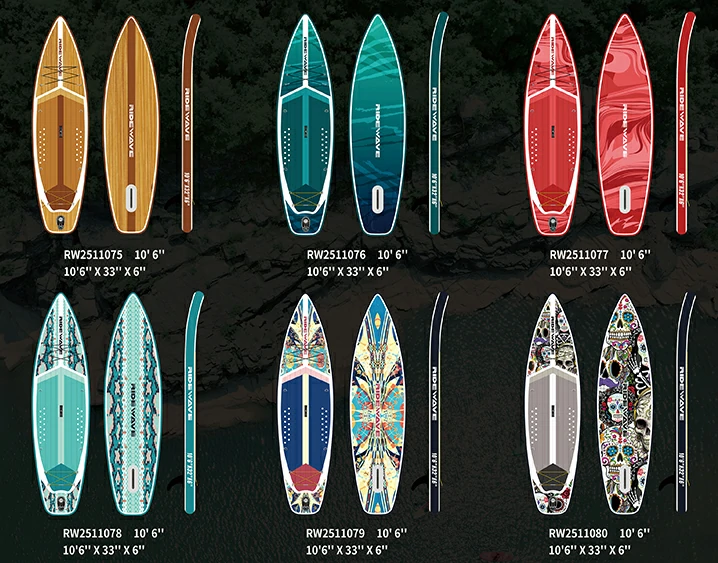


Instead of running fully random production, RIDEWAVE batches orders strategically to reduce changeover inefficiency.
This operational model supports consistent SUP manufacturing process flow while maintaining flexibility.
For buyers, this means:
• Private label identity without severe lead time inflation
• Controlled MOQ structures
• Repeatable design updates across seasons
• Stable quality across customized batches
Customization does not have to compromise capacity when planning discipline exists.
Why SUP Factory Capacity Determines Your Brand's Growth Ceiling
For distributors and retail brands, supplier capacity directly influences business scalability.
An unstable inflatable SUP factory capacity can create:
• Missed seasonal sales
• Retail contract penalties
• Amazon inventory stockouts
• Cash flow disruption
• Brand reputation damage
Reliable capacity enables:
• Confident marketing campaigns
• Large retailer onboarding
• Multi-country distribution planning
• Forecast-based procurement
Capacity becomes a strategic growth factor, not just a production metric.
RIDEWAVE: Capacity as a Long-Term Partnership Foundation
RIDEWAVE's operational approach emphasizes long-term cooperation over aggressive short-term expansion.
Its portfolio extends beyond inflatable SUP boards to include related inflatable water and outdoor products, expanding technical expertise across categories.
Participation in international trade exhibitions strengthens global market visibility, while structured production systems support consistent delivery performance.
For buyers in North America, Europe, Australia, and Latin America, this translates into:
• Predictable seasonal restocking
• Reduced operational stress
• Professional documentation support
• Structured quality assurance practices
Capacity stability enhances partnership value over time.
SUP Capacity Is Built on Systems, Not Claims
True inflatable SUP factory capacity is not defined by brochures or peak production claims.
It is built on four pillars:
• Equipment discipline
• Skilled workforce structure
• Standardized production systems
• Resilient supply chain management
Factories that integrate these elements can sustain stable throughput across seasonal cycles.
For B2B buyers seeking an OEM SUP manufacturer, the most reliable partner is not necessarily the one promising the highest output, but the one demonstrating operational transparency and structural consistency.
Capacity is a function of systems. Systems create predictability. Predictability supports brand growth.
In the competitive global paddle board market, that distinction matters.
Related Articles