


Introduction: The Growing Popularity of Inflatable SUPs
Inflatable stand-up paddle boards (SUPs) have become a dominant force in the water sports industry due to their versatility, portability, and accessibility. Unlike rigid boards, inflatable SUPs provide an easy-to-transport solution for paddlers of all skill levels, whether they are exploring calm lakes, rivers, or taking on ocean waves. Over the past decade, the growth of the inflatable SUP market has been fueled by advances in manufacturing technology, improved materials, and a focus on user-centric design.
High-quality inflatable SUPs stand out not just for their convenience, but also for their performance, durability, and safety. The success of a board depends on several key factors, including material selection, structural design, manufacturing precision, and quality control. Brands and B2B buyers in the paddle board industry are increasingly aware that working with an experienced SUP manufacturer is essential to delivering products that meet market expectations and ensure customer satisfaction. By understanding what goes into producing a top-tier inflatable SUP, distributors and retailers can make informed sourcing decisions and offer products that perform consistently across a variety of conditions.
Advanced Materials: Drop-Stitch Technology and Beyond
One of the most significant innovations in inflatable SUP manufacturing is drop-stitch technology. This method involves thousands of tiny threads connecting the top and bottom layers of the board, allowing it to be inflated to high pressures while maintaining rigidity similar to that of a hardboard. This technology enables the board to retain its shape and structural integrity even under heavy loads and rough water conditions. A high-quality inflatable SUP uses military-grade PVC combined with drop-stitch cores to provide strength, durability, and stability.
Beyond drop-stitch material, premium boards often incorporate multiple layers of reinforced PVC or eco-friendly alternatives. The outer layers are designed to withstand abrasion, UV exposure, and minor impacts, ensuring that the board maintains its performance over time. Advanced lamination and coating techniques improve water resistance and reduce friction, enhancing glide efficiency. For B2B buyers seeking high-quality SUPs, evaluating the materials used in production is essential, as it directly impacts the longevity, usability, and customer satisfaction of the final product.

RIDEWAVE Drop-Stitch Technology
Precision Design: Balancing Performance and Versatility
Design plays a crucial role in determining the performance of an inflatable SUP. Board dimensions, shape, rocker profile, tail design, and fin placement all affect stability, speed, and maneuverability. All-round SUPs prioritize balance and ease of use, making them suitable for beginners and recreational paddlers. In contrast, touring SUPs and racing boards emphasize speed, tracking, and efficiency, catering to advanced paddlers and competitive users.
Designers use computer-aided design (CAD) and simulation tools to optimize hydrodynamics and paddler ergonomics. Deck pads, bungee systems, and handle placements are carefully considered to enhance comfort and functionality. Ergonomic design ensures that the paddler maintains proper posture and stability, reducing fatigue during long sessions. Furthermore, color schemes, graphics, and branding options are increasingly important for differentiation in the competitive SUP market. OEM and ODM services allow brands to customize their boards, creating unique products tailored to their target audience while maintaining performance standards.
Rigorous Quality Control: Guaranteeing Safety and Durability
A high-quality inflatable SUP cannot succeed without a robust quality control (QC) system. From raw material inspection to final packaging, each board must undergo multiple checkpoints to ensure consistent quality. Pressure testing, seam inspection, and fin system verification are standard procedures that prevent defects and ensure the board meets its design specifications.
Experienced manufacturers implement SOPs (Standard Operating Procedures) that cover every stage of production. The use of precision machinery and skilled technicians ensures uniformity across batches, reducing the risk of failures during use. Certifications such as CE, SGS, and BSCI further validate compliance with international quality standards. For distributors and retailers, partnering with a SUP manufacturer that prioritizes QC minimizes after-sales issues and strengthens customer trust, providing a competitive advantage in the market.

RIDEWAVE Quality Control
OEM and ODM Capabilities: Customization for Brand Differentiation
The ability to provide OEM and ODM services is a significant advantage for SUP manufacturers. Many B2B buyers seek boards that reflect their brand identity, including customized shapes, colors, logos, EVA deck patterns, fin systems, and packaging. By offering flexible customization options, manufacturers can support retailers in launching unique products that stand out in a crowded market.
Ridewave, for example, works closely with brands to develop tailored solutions. Using advanced prototyping, material selection, and design collaboration, Ridewave ensures that custom boards meet both aesthetic and functional requirements. Whether launching a premium touring board line or an all-round recreational range, B2B clients benefit from seamless integration of branding and technical performance, enhancing market competitiveness and customer loyalty.

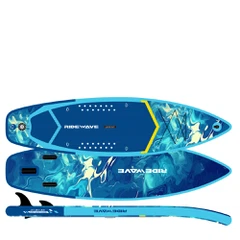
RIDEWAVE SUP
Manufacturing Process: From Concept to Completion
High-quality inflatable SUPs are the result of a carefully managed manufacturing process. This process typically begins with conceptual design and material selection, followed by prototyping, mold creation (if applicable), and assembly. Key steps include:
- Material Sourcing: Selecting PVC, drop-stitch cores, and other components that meet durability and performance criteria.
- Cutting and Layering: Precision cutting ensures uniform board shapes, while multi-layer lamination enhances structural integrity.
- Sealing and Welding: Advanced heat-sealing and gluing techniques create airtight chambers and reinforce seams.
- Inflation Testing: Each board is inflated to recommended pressures and checked for leaks or deformation.
- Accessory Installation: Fins, handles, deck pads, and bungee systems are installed with precision.
- Final Inspection and Packaging: Boards undergo final visual and functional checks before packaging for shipment.
By optimizing each step, manufacturers like Ridewave maintain high-quality standards while meeting production timelines and global demand.
User-Centric Features: Ensuring a Superior SUP Experience
Beyond materials and manufacturing, the user experience defines the true value of an inflatable SUP. High-quality boards provide stability, comfort, and ease of use, enabling paddlers to enjoy various activities such as touring, yoga, fitness, and recreational paddling. Features such as ergonomic handles, non-slip deck pads, and integrated storage systems enhance usability.
Furthermore, reliable boards minimize maintenance concerns, resist deformation, and maintain performance even after repeated use. B2B clients can confidently market these features to end-users, knowing that a well-constructed SUP supports long-term satisfaction and repeat purchases.
Logistics and Global Distribution
Efficient logistics are critical for delivering high-quality SUPs worldwide. Manufacturers coordinate shipping options, including DDP, DAP, and door-to-door delivery, to ensure timely arrival. Reinforced packaging, protective materials, and container optimization prevent damage during transit. By integrating production and logistics planning, companies like Ridewave reduce supply chain disruptions and meet distributor expectations.
Sustainability Considerations
Sustainability is increasingly important in SUP manufacturing. Selecting eco-friendly PVC alternatives, using recyclable packaging, and implementing energy-efficient production processes reflect a growing demand for environmentally responsible products. High-quality manufacturers balance performance, durability, and sustainability to appeal to environmentally conscious consumers, particularly in European markets where regulations and consumer awareness are strong.
Conclusion: Ridewave's Commitment to Excellence
In conclusion, high-quality inflatable SUPs combine advanced materials, precision design, rigorous quality control, OEM/ODM flexibility, and attention to user experience. Each element-from drop-stitch construction to customized branding-contributes to performance, safety, and market appeal. Ridewave exemplifies these principles, offering B2B clients globally a reliable partner for premium inflatable SUP products. By integrating technology, design, and quality, Ridewave ensures that distributors and retailers deliver boards that perform consistently, enhance paddler satisfaction, and build strong brand recognition.
You may be interested in these articles:
- OEM & ODM Manufacturing: Building A Brand That Reflects Your Market
- The Best Stand Up Paddle Boards of 2025
- Balancing Price and Quality: How to Choose the Right SUP Factory
- B2B Sales Models in the SUP Industry: OEM, ODM & Private Label Explained
- Future of SUP: Innovation, Sustainability & New Market Opportunities