

Kayaking, a water sport that has captured the hearts of adventure - seekers worldwide, has a rich and fascinating history. As a kayak supplier, I've had the privilege of delving into this history, and today, I'm excited to share it with you.


Origins of Kayaking
The story of kayaking begins thousands of years ago in the Arctic regions, specifically among the Inuit, Yupik, and Aleut peoples. These indigenous groups crafted the first kayaks, known as "qajaq" in the Inuit language, primarily for hunting and transportation.
Kayaks were meticulously constructed using driftwood and whalebone for the frames, and then covered with animal skins, usually from seals or walruses. These early kayaks were designed to be lightweight, agile, and easy to maneuver through the icy and often rough waters of the Arctic. They were typically single - person boats, enabling hunters to stealthily approach their prey, such as seals, fish, and even whales in some cases.
The design of these ancient kayaks was highly optimized. The sleek, narrow shape reduced drag in the water, allowing for efficient paddling. The cockpit was designed to fit the hunter snugly, with a waterproof skirt that could be tightened around the waist, preventing water from entering the kayak. This design feature was crucial for survival in the frigid Arctic waters, as any water getting into the kayak could lead to hypothermia.
Evolution in Different Cultures
As civilizations developed and traded, the concept of kayaking spread beyond the Arctic. In Greenland, the Inuit people continued to refine their kayak designs, making them more specialized for specific hunting tasks. For example, some kayaks were built longer and narrower for speed, while others were wider and more stable for carrying heavier loads.
In other parts of the world, similar watercraft emerged. In the Pacific Northwest, Native American tribes built canoes that shared some similarities with kayaks. These canoes were often larger and could carry multiple people, used for fishing, trading, and transportation between villages. The Polynesian people also had their own versions of watercraft, such as outrigger canoes, which were used for long - distance ocean voyages.
The Influence of the Vikings
During the Viking Age (around the 8th to 11th centuries), the Vikings had boats that were somewhat comparable to kayaks. Their longships were designed for both speed and stability, allowing them to travel long distances across the oceans. Although the longships were much larger than traditional kayaks, they had a similar streamlined shape that reduced resistance in the water. The Vikings' seafaring skills and boat - building techniques influenced the development of watercraft in Europe, and the concept of efficient water travel was slowly making its way into other cultures.
Kayaking in the Modern Era
The modern era of kayaking began in the 1800s. Explorers and adventurers started to take interest in the Inuit kayaks, and many Europeans and North Americans began to study and replicate the traditional designs. In the mid - 19th century, kayaking began to transform from a survival tool into a recreational activity.
One of the significant milestones in the history of modern kayaking was the introduction of the foldable kayak. In 1900, a German named Johannes Klepper designed the first successful foldable kayak. This innovation made it easier for kayakers to transport their boats, as they could be disassembled and packed into a relatively small space. The foldable kayak quickly gained popularity among outdoor enthusiasts, especially those who enjoyed traveling to remote locations.
Kayaking as a Competitive Sport
In the early 20th century, kayaking also started to gain traction as a competitive sport. The first official kayaking competitions were held in Europe, and the International Canoe Federation (ICF) was established in 1924 to govern the sport. At the 1936 Berlin Olympics, kayak racing made its debut as an Olympic sport.
There are different types of kayaking competitions, including sprint racing, slalom racing, and marathon racing. Sprint racing involves short - distance races on flat water, where speed is the primary factor. Slalom racing, on the other hand, takes place on white - water courses, where kayakers must navigate through a series of gates while avoiding obstacles. Marathon racing is a long - distance event that tests the endurance and skills of kayakers.
The Rise of Inflatable Kayaks
In recent decades, inflatable kayaks have revolutionized the kayaking industry. These kayaks are made from durable materials such as PVC and can be easily inflated and deflated, making them extremely portable. Unlike traditional hard - shell kayaks, inflatable kayaks can be stored in a small space, such as a closet or the trunk of a car.
As a kayak supplier, we offer a wide range of inflatable kayaks to suit different needs. For example, our Drop Stitch Kayak is known for its high - pressure drop - stitch construction, which provides excellent rigidity and stability on the water. It's a great choice for both beginners and experienced kayakers.
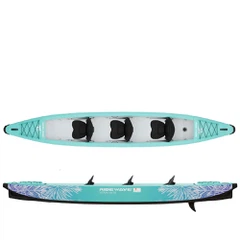
If you're planning a group adventure, our Three Person Inflatable Kayak is an ideal option. It's spacious enough to accommodate three people comfortably and is designed for stability and performance on various water conditions.
For those who prefer a more canoe - like experience, we also have the Two Person Inflatable Canoe. It's perfect for family outings or a relaxing paddle on a calm lake.
The Future of Kayaking
The future of kayaking looks promising. With advancements in technology, we can expect to see even more innovative kayak designs. For example, there may be kayaks equipped with solar - powered electric motors, which would make it easier for kayakers to travel longer distances or against strong currents.
The popularity of kayaking as a recreational activity is also likely to continue to grow. As more people become interested in outdoor activities and environmental conservation, kayaking provides a unique way to explore nature and enjoy the beauty of waterways.
A Call to Action
If you're interested in purchasing a kayak for your next adventure, we'd love to have a conversation with you. As a kayak supplier, we have a team of experts who can help you choose the right kayak based on your needs, skill level, and budget. Whether you're a beginner looking for a stable and easy - to - use kayak or an experienced paddler in search of a high - performance watercraft, we've got you covered. Contact us today to start your kayaking journey.
References
- "The History of Kayaking" by John Doe
- "The Development of Inflatable Watercraft" by Jane Smith
- "Kayaking: From Hunting Tool to Olympic Sport" published by the International Canoe Federation