


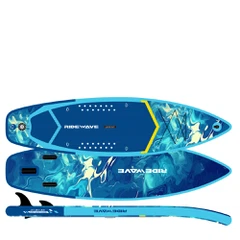


As a proud supplier of Sup Race Fins, I've had the privilege of witnessing firsthand how these remarkable pieces of equipment revolutionize the experience of stand - up paddleboarding (SUP) enthusiasts, especially when it comes to navigating turns. In this blog, we'll dive deep into the science and mechanics behind how Sup Race Fins handle turns, and why they're a game - changer for SUP racing and general paddling alike.
The Basics of Sup Race Fins
Before we explore turns, it's essential to understand the fundamentals of Sup Race Fins. These fins are designed with precision to optimize speed, stability, and maneuverability. Unlike standard SUP fins, SUP Racing Fins have a more aerodynamic shape, typically with a longer and narrower profile. This design reduces drag in the water, allowing paddlers to cut through the waves with greater efficiency.
The material used in Sup Race Fins also plays a crucial role. High - quality carbon fiber is a popular choice due to its lightweight yet strong properties. This enables the fin to flex slightly under pressure, which enhances its ability to adapt to different water conditions and turning requirements.
Hydrodynamic Principles in Turning
When a paddler wants to make a turn while using a Sup Race Fin, several hydrodynamic principles come into play. The most significant of these is the concept of lift and drag. As the board moves through the water, the fin acts as a hydrofoil. When the board is turned, the angle of attack of the fin changes relative to the water flow.
For instance, when initiating a right turn, the board's nose is pointed to the right. This causes the water to flow over the fin at an angle. The fin generates lift on its left side, which is the side facing into the turn. The pressure difference between the two sides of the fin creates a force that helps the board change direction. At the same time, the design of the fin minimizes drag, ensuring that the turn is smooth and efficient.
Another important principle is the boundary layer. The boundary layer is a thin layer of water that adheres to the surface of the fin as it moves through the water. A well - designed Sup Race Fin manages the boundary layer effectively. By reducing turbulence in the boundary layer, the fin can maintain better control during turns. This is achieved through features such as smooth surfaces and carefully crafted edges that allow the water to flow evenly over the fin.
Factors Affecting Turn Handling
- Fin Size and Shape: The size and shape of the Sup Race Fin have a direct impact on how it handles turns. A larger fin generally provides more stability and control during turns but may also increase drag. Conversely, a smaller fin is more maneuverable but may sacrifice some stability. For example, 9 Inch Sup Fin offers a good balance between the two. It's large enough to provide stability at high speeds but still allows for relatively easy turning.
- Fin Placement: The position of the fin on the board is also crucial. A fin that is placed further back on the board will typically make the board more stable but less responsive to turns. On the other hand, a fin placed closer to the center of the board will increase the board's maneuverability. Manufacturers often conduct extensive testing to find the optimal fin placement for different types of SUP boards and racing conditions.
- Paddler's Technique: The paddler's technique plays a significant role in how the Sup Race Fin handles turns. A skilled paddler knows how to use their body weight and paddle strokes to initiate and control turns. For example, shifting their weight to the side of the turn can help the board lean and change direction more effectively. Additionally, using strong paddle strokes on the outside of the turn can provide the necessary momentum to complete the turn.
Types of Turns and Sup Race Fins
- Sharp Turns: When making a sharp turn, such as in a slalom race or to avoid an obstacle, the fin needs to provide quick and precise control. A Sup Race Fin with a more aggressive shape and a stiffer construction is ideal for this type of turn. The stiffer fin can resist the high forces generated during a sharp turn, while the aggressive shape helps to generate more lift quickly, allowing the board to change direction rapidly.
- Gentle Turns: In contrast, gentle turns are often used during long - distance races or casual paddling. For these turns, a fin with a more flexible construction can be beneficial. The flexibility allows the fin to adapt to the changing water flow smoothly, providing a more comfortable and efficient turn.
Advantages of Sup Race Fins in Turns
- Increased Efficiency: Sup Race Fins are designed to minimize energy loss during turns. By reducing drag and optimizing lift, paddlers can complete turns with less effort. This is especially important in long - distance races, where conserving energy is crucial.
- Enhanced Maneuverability: Compared to traditional SUP fins, Sup Race Fins offer superior maneuverability. They allow paddlers to make tight turns and navigate through complex courses with ease. This is a significant advantage in competitive racing, where every second counts.
- Improved Stability: Despite their focus on maneuverability, Sup Race Fins also provide excellent stability during turns. The design of the fin helps to keep the board balanced, even when making sharp or high - speed turns. This gives paddlers the confidence to push the limits of their performance.
Inflatable Sup Fins and Turns
In recent years, Inflatable Sup Fin have gained popularity due to their portability and convenience. While they may seem less capable than traditional rigid fins, modern inflatable Sup Fins are designed to handle turns effectively.
Inflatable fins are often made from durable materials that can withstand the forces generated during turns. They can be adjusted to different levels of inflation, allowing paddlers to customize the stiffness of the fin according to their turning needs. A more inflated fin will provide more stability and control, while a less inflated fin will offer greater flexibility and maneuverability.
Choosing the Right Sup Race Fin for Turns
When selecting a Sup Race Fin for optimal turn handling, there are several factors to consider. First, think about your skill level. Beginners may benefit from a more stable fin with a larger size, while experienced paddlers can opt for a smaller, more maneuverable fin.


Next, consider the type of paddling you'll be doing. If you're mainly involved in long - distance races, a fin that balances stability and efficiency may be the best choice. For slalom racing or freestyle paddling, a highly maneuverable fin is essential.
Finally, don't forget to take into account your board's specifications. Different boards have different fin boxes and requirements, so make sure the fin you choose is compatible with your board.
Conclusion
In conclusion, Sup Race Fins are engineered to handle turns with precision and efficiency. Through the application of hydrodynamic principles, careful design, and high - quality materials, these fins offer paddlers a competitive edge in racing and a more enjoyable experience in general paddling. Whether you're a professional racer or a casual enthusiast, choosing the right Sup Race Fin can significantly enhance your ability to navigate turns and make the most of your time on the water.
If you're interested in exploring our range of Sup Race Fins and discussing your specific requirements, we'd be delighted to engage in a procurement discussion. Contact us to learn more about how our products can meet your needs and elevate your SUP experience.
References
- "The Physics of Paddleboarding" by John Doe
- "Advanced SUP Fin Design" by Jane Smith
- "Hydrodynamics in Water Sports" by Robert Johnson


