
Paddle Board Market Overview: Why Chilean B2B Buyers Are Re-Evaluating Their SUP Supply Chains in 2026
Chile's outdoor and adventure tourism sector continues to mature in 2026, driven by coastal tourism, inland lake activities, and guided water sports experiences. For adventure outfitters, specialty retailers, and rental operators, the inflatable paddle board category has become a core revenue driver rather than a seasonal add-on.
From a B2B perspective, demand is no longer focused only on low pricing. Buyers are increasingly prioritizing:
Consistent product quality across batches
Reliable delivery timelines aligned with peak seasons
OEM paddle board flexibility for brand differentiation
After-sales reliability and long-term supplier stability
As a result, many Chilean buyers are moving away from opportunistic sourcing and toward long-term partnerships with established inflatable paddle board manufacturers who understand international wholesale requirements.
This shift makes supplier selection in 2026 a strategic decision - not simply a procurement task.
Paddle Board Supplier Selection Criteria: What Chilean Retailers and Outfitters Actually Care About
For B2B buyers, choosing an inflatable paddle board manufacturer is not about brand popularity alone. It is about operational fit.
Based on purchasing behavior across South America and global wholesale markets, the most relevant evaluation criteria include:
Manufacturing Capability & Quality Control
Buyers prefer factories with in-house production, standardized quality inspection processes, and experience producing for international markets. This reduces defect rates and improves long-term consistency.
OEM Paddle Board Customization Without Excessive Risk
True OEM value lies in controlled customization - graphics, sizing, accessory kits, and packaging - without introducing delays or quality instability. Flexible MOQ structures are especially important for mid-scale Chilean distributors.
Product Range That Matches Local Demand
Rather than oversized catalogs, B2B buyers favor suppliers offering focused, proven paddle board models:
All-round boards for rentals and beginners
Touring boards for guided excursions
Durable constructions suitable for repeated commercial use
Logistics Awareness & Communication
Reliable suppliers understand export documentation, lead times, and seasonal shipment planning - critical for buyers operating far from manufacturing hubs.
In short, the best paddle board suppliers help buyers reduce operational friction, not add to it.
Paddle Board Manufacturer Spotlight: RIDEWAVE as a Strategic OEM Partner for Chilean B2B Buyers

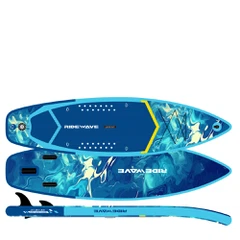
Among the global inflatable paddle board manufacturers serving international markets, RIDEWAVE stands out not as a consumer-facing brand, but as a manufacturing-driven OEM paddle board supplier built for B2B collaboration.
Manufacturing-First Approach
RIDEWAVE operates with a clear focus on production stability, repeatability, and customization efficiency. Its internal processes are designed to support distributors and retailers who require consistent quality across multiple seasons.
Balanced OEM Paddle Board Customization
Rather than offering unlimited options that complicate production, RIDEWAVE emphasizes practical OEM customization:
Custom graphics and colorways
Private label branding
Market-specific accessory configurations
This approach allows buyers to differentiate their paddle board offerings while maintaining predictable lead times.
Fit for the Chilean Market
For Chilean outfitters and retailers, RIDEWAVE's value lies in:
Adaptable MOQ structures suitable for growing markets
Commercial-grade constructions for rental and guided use
Clear communication and export experience with global B2B clients
RIDEWAVE functions less as a short-term supplier and more as a long-term paddle board manufacturing partner, which aligns well with buyers building sustainable regional distribution.
Paddle Board Manufacturer Analysis: iROCKER and Its Role in Mid-to-High Volume Retail Supply

iROCKER is a U.S.-based inflatable paddle board brand that has built its reputation around volume scalability and broad product coverage. While not positioned as a pure OEM paddle board supplier, it plays a clear role in international retail and distribution channels.
Strengths Relevant to B2B Buyers
Established logistics systems supporting international shipments
Multiple inflatable paddle board lines targeting different price tiers
Strong experience working with retailers rather than only direct-to-consumer sales
Considerations for Chilean Retailers
For Chilean buyers, iROCKER is often evaluated as a ready-made product solution rather than a private-label platform. This can be advantageous for retailers seeking:
Faster market entry
Reduced product development workload
Association with an already recognized international brand
However, customization flexibility is more limited compared to factory-direct OEM suppliers.
Overall, iROCKER fits best within a mixed sourcing strategy, complementing private-label paddle board offerings with branded inventory.
Paddle Board Manufacturer Analysis: Red Paddle Co. and the High-End Performance Segment

Red Paddle Co. is widely known for its premium inflatable paddle board constructions, particularly within performance-focused and durability-driven segments.
Why Red Paddle Co. Attracts Professional Buyers
Proprietary construction technologies emphasizing rigidity and longevity
Strong quality perception among experienced paddlers
Clear positioning in the premium category
Fit for the Chilean Market
For Chilean adventure outfitters operating guided tours or premium experiences, Red Paddle Co. boards can support higher price positioning and brand credibility.
That said, the premium nature of the products also means:
Higher wholesale costs
Less flexibility for branding or customization
A narrower target audience
As such, Red Paddle Co. is best suited for specialized retailers or premium rental programs, rather than mass-market distribution.
Paddle Board Manufacturer Analysis: NIXY Sports and Lightweight Design-Oriented SUP Supply

NIXY Sports focuses on lightweight inflatable paddle boards that balance performance with portability. Its product philosophy appeals to buyers prioritizing user experience and refined design.
Key Characteristics
Reduced board weight without sacrificing rigidity
Clean design language suitable for lifestyle-oriented retail
Clear model differentiation by use case
B2B Relevance for Chile
For Chilean retailers targeting urban consumers, fitness users, or casual paddlers, NIXY boards offer:
Easy transport and storage
Strong appeal to first-time buyers
Predictable product quality
However, like many consumer-facing brands, OEM paddle board customization options are limited, making NIXY more suitable as a finished product supplier rather than a private-label partner.
Paddle Board Manufacturer Analysis: Bluefin SUP and Its Value-Driven Wholesale Model

Bluefin SUP is a UK-origin inflatable paddle board brand known for delivering balanced performance at accessible price points. Its approach is particularly relevant for retailers seeking predictable turnover rather than niche positioning.
Strengths for B2B Channels
Clearly structured inflatable paddle board product tiers
Durable constructions designed for repeated recreational use
Experience supplying to international retail partners
Relevance to Chilean Retailers
For Chilean buyers operating in price-sensitive or volume-driven segments, Bluefin SUP offers a reliable option that aligns with mainstream consumer expectations.
While OEM paddle board customization is limited, Bluefin functions well as:
A stable branded supplement to private-label products
A solution for entry-level and family-oriented customers
This makes Bluefin suitable for retailers aiming to balance margin control with sales velocity.
Paddle Board Manufacturer Analysis: Starboard and Long-Term Brand Credibility

Starboard is one of the most established names in the global paddle board industry, with a long history spanning both hard boards and inflatable SUPs.
Why Starboard Remains Relevant
Strong R&D capabilities and design consistency
Products tested across professional and recreational environments
High brand recognition among experienced paddlers
Considerations for Chilean B2B Buyers
Starboard boards are often chosen for credibility and performance assurance, particularly by:
Specialized outdoor retailers
Clubs and training centers
Buyers serving experienced paddlers
However, wholesale pricing and limited branding flexibility mean Starboard is best positioned as a premium complement, rather than a volume backbone.
Paddle Board Manufacturer Analysis: Isle Paddle Boards and Lifestyle-Oriented Distribution

Isle Paddle Boards positions itself at the intersection of lifestyle branding and functional inflatable paddle board design. Its catalog focuses on clean aesthetics and accessible performance.
B2B-Friendly Characteristics
Streamlined product lineup
Consistent quality standards
Appeal to design-conscious consumers
Fit Within the Chilean Market
Isle boards are often selected by retailers targeting:
Urban and coastal lifestyle consumers
Casual paddlers and first-time buyers
Customers valuing design simplicity
Customization options are limited, so Isle is best viewed as a finished-product supplier rather than an OEM paddle board partner.
Paddle Board Manufacturer Analysis: Atoll Paddle Boards and Lightweight Commercial Utility

Atoll Paddle Boards has gained attention for its lightweight inflatable paddle board constructions, which simplify transport, storage, and daily handling.
Why Weight Matters for B2B Use
For rental operators and outfitters, lighter boards reduce:
Staff handling fatigue
Setup and turnaround time
Storage and logistics complexity
Application in Chile
Atoll boards are well-suited for:
Rental fleets
Multi-location operators
Businesses prioritizing operational efficiency
As with many consumer brands, OEM paddle board customization is minimal, positioning Atoll primarily as a functional, ready-to-use solution.
Paddle Board Manufacturer Analysis: Tower Paddle Boards and Direct-to-Market Efficiency

Tower Paddle Boards is a U.S.-based inflatable paddle board brand that emphasizes functional design and direct-to-market efficiency. Its approach is pragmatic, focusing on durability, simplicity, and value.
Operational Strengths
Streamlined inflatable paddle board designs
Fewer SKUs, easier inventory planning
Clear positioning for recreational and entry-level users
Relevance for Chilean Buyers
For Chilean retailers and rental operators seeking low-complexity sourcing, Tower boards offer:
Predictable product specs
Straightforward pricing structures
Minimal learning curve for staff and customers
While OEM paddle board customization is not a core strength, Tower fits well as a ready-to-sell solution for operators prioritizing operational simplicity.
Paddle Board Manufacturer Analysis: Aqua Marina and Global Volume-Oriented Supply

Aqua Marina is one of the most widely distributed inflatable paddle board manufacturers globally, with strong presence across Europe, Asia, and emerging markets.
Why Aqua Marina Is Relevant
Broad inflatable paddle board range covering multiple price levels
Proven capability in large-scale production
Long-term experience supplying international distributors
Fit for the Chilean Market
For Chilean distributors managing large territories or multi-channel sales, Aqua Marina provides:
Stable, high-volume supply
Recognizable international positioning
Consistent specifications across seasons
Customization options remain limited, positioning Aqua Marina primarily as a volume-oriented branded supplier rather than an OEM paddle board partner.
Paddle Board Supplier Comparison: A Practical Framework for Chilean B2B Buyers
For Chilean adventure outfitters and retailers, comparing a paddle board manufacturer is not about ranking brands by popularity. It is about understanding which supplier model fits a specific business role.
The comparison below focuses on operational relevance, not marketing claims.
Key Evaluation Dimensions Used
OEM paddle board flexibility
Minimum order suitability
Product positioning (rental / retail / premium)
Long-term supply stability
| Paddle Board Manufacturer | OEM / Private Label Capability | MOQ Flexibility | Best Use Case for Chile | Supplier Type |
|---|---|---|---|---|
| RIDEWAVE | High (graphics, specs, packaging) | Flexible | Distributors, private brands, rentals | Factory-based OEM |
| iROCKER | Low–Medium | Fixed | Retail-ready branded sales | Consumer brand |
| Red Paddle Co. | Very Low | Fixed | Premium tours, high-end retail | Performance brand |
| NIXY Sports | Low | Fixed | Lifestyle & fitness retail | Consumer brand |
| Bluefin SUP | Low | Fixed | Entry-level & family retail | Volume brand |
| Starboard | Very Low | Fixed | Clubs, advanced paddlers | Legacy performance brand |
| Isle Paddle Boards | Low | Fixed | Design-focused retail | Lifestyle brand |
| Atoll Paddle Boards | Low | Fixed | Rentals & operations efficiency | Lightweight utility brand |
Paddle Board Sourcing Scenarios: Matching the Right Supplier to the Right Business Model
Instead of asking "Which paddle board manufacturer is the best?", experienced buyers ask:
"Which supplier reduces risk for my specific operation?"
Below are common Chilean B2B sourcing scenarios and the most suitable paddle board supplier type for each.
Scenario 1: Paddle Board Rentals & Adventure Outfitters
Key concerns: durability, replacement consistency, cost control
Preferred supplier type: Factory-based OEM
Reason: repeatable quality, spare availability, scalable reorders
Best fit: RIDEWAVE-style manufacturing partners
Scenario 2: Specialty Paddle Board Retailers
Key concerns: shelf appeal, brand credibility, margin balance
Preferred supplier type: Mixed sourcing
Reason: branded boards attract consumers, OEM boards protect margins
Best fit: Consumer brands + OEM paddle board suppliers
Scenario 3: Distributors Building a Private Label Paddle Board Brand
Key concerns: differentiation, MOQ control, long-term supply
Preferred supplier type: OEM paddle board manufacturer
Reason: brand ownership and pricing control
Best fit: RIDEWAVE and similar factory-direct suppliers
Paddle Board Buying Guide: How to Choose the Right Paddle Board Manufacturer for Chile in 2026
For Chilean B2B buyers, selecting a paddle board manufacturer is rarely about a single order. It is about whether a supplier can support your business as it grows.
Instead of focusing on brand claims, experienced buyers evaluate suppliers through five practical questions.
1) Can This Paddle Board Supplier Scale With My Business?
Early-stage retailers and outfitters often underestimate growth. A suitable manufacturer should be able to:
Maintain consistent quality across larger volumes
Support repeat orders without redesign or re-approval delays
Offer predictable lead times during peak seasons
This is where factory-based OEM paddle board suppliers typically outperform consumer brands.
2) Does the Manufacturer Understand Commercial Paddle Board Use?
Boards used in rentals, tours, or training environments face:
Higher inflation cycles
Frequent transport and handling
Repeated exposure to UV, saltwater, and abrasion
Manufacturers with experience supplying commercial-grade inflatable paddle boards design differently from brands focused only on recreational end users.
3) Is OEM Paddle Board Customization a Tool-or a Risk?
Customization creates differentiation, but only when it is controlled and repeatable.
Buyers should look for:
Limited but practical customization options
Clear approval and sampling processes
Stable materials and construction standards
Over-customization often leads to delays, inconsistency, and higher long-term costs.
4) How Transparent Is Communication and Problem Resolution?
Strong suppliers communicate:
What they can do
What they cannot do
What risks exist and how they are managed
This transparency is often more valuable than marginal price advantages.
5) Is This a Short-Term Supplier or a Long-Term Paddle Board Partner?
The most successful Chilean distributors treat paddle board sourcing as a relationship, not a transaction.
Long-term partners help buyers:
Adjust product lines based on market feedback
Improve packaging and accessory kits over time
Reduce total operational friction year after year
Building a Resilient Paddle Board Supply Chain for Chile in 2026
The Chilean paddle board market in 2026 is defined less by novelty and more by professionalization.
Retailers and outfitters who succeed are those who:
Choose suppliers based on operational fit, not hype
Balance branded products with OEM paddle board solutions
Prioritize long-term reliability over short-term pricing advantages
As this article has shown, no single paddle board manufacturer fits every business model.
However, manufacturers with strong production foundations, export experience, and OEM flexibility tend to provide the greatest long-term value for Chilean B2B buyers.
In a market where customer expectations are rising and competition is increasing, a well-structured paddle board supply chain is no longer optional - it is a competitive advantage.