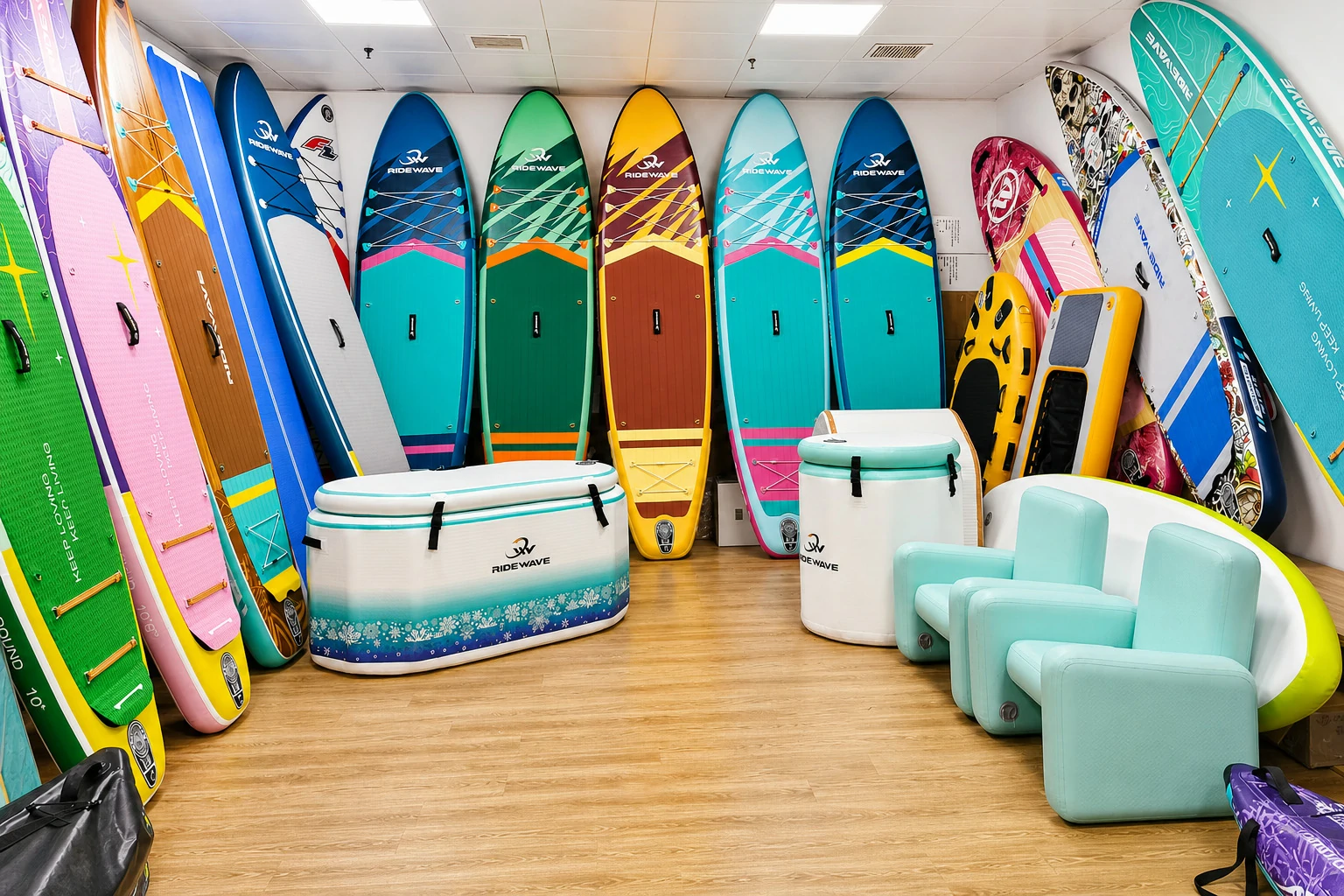


Quality consistency is a critical factor for B2B buyers sourcing inflatable stand-up paddle boards (iSUPs). While a single sample may perform well, distributing boards that vary in color, stiffness, or finish undermines brand reputation and increases after-sales costs. Leading manufacturers distinguish themselves not by producing one perfect board but by delivering uniform performance, durability, and aesthetics across every unit, every batch, and every season. This article explores how factories achieve such repeatable quality and why consistency is a key metric for B2B procurement decisions.
1. Material Standardization: Building Consistency from the Ground Up
Consistency begins long before production, with material sourcing and standardization. Top-tier factories rely on certified, stable suppliers for PVC, drop-stitch fabrics, adhesive films, EVA foams, valves, and accessories. These suppliers are selected not only for cost-effectiveness but also for their ability to deliver stable chemical composition, thickness, and mechanical properties over multiple deliveries.
PVC used in high-quality iSUPs must maintain uniform thickness, color, and elasticity across rolls. Even minor variations can affect lamination, bonding, and the final board stiffness. Drop-stitch fabric density directly influences the board's PSI capacity and midboard flex, so suppliers are carefully audited to ensure stitch count per square inch meets specifications. Adhesive films are selected for consistent viscosity and bonding strength, ensuring no delamination occurs under repeated use or high temperatures.
Top factories implement incoming quality control (IQC) for every batch of materials. Checks include:
- Color consistency under standardized lighting
- Drop-stitch tensile strength and density verification
- PVC thickness measurement
- Adhesive bonding tests
- EVA hardness and surface finish evaluation
Beyond sampling, most top-tier factories track every material roll with a lot ID, enabling full traceability. If a batch shows deviation during testing, all boards produced from that material can be quickly identified and isolated, preventing inconsistent boards from reaching clients.
2. Process Engineering: Repeatability Through Technology and Standards
While materials are the foundation, process engineering defines repeatable outcomes. Leading factories avoid relying solely on skilled operators' intuition; they document, standardize, and control every production step.
CNC cutters ensure precise panel dimensions for decks, bottoms, and rails, maintaining geometry within millimeter-level tolerances. Thermal bonding machines are programmed with digital temperature and pressure profiles, ensuring that rail tape adhesion is uniform across all boards. Even small differences in heating or pressure can result in uneven rail bonding or variations in stiffness.
In addition, factories control environmental factors like humidity and dust. Contaminants can weaken bonding and affect aesthetics. Controlled bonding rooms with air filtration maintain consistent adhesion and prevent microscopic imperfections. Every parameter-adhesive application, drying time, press alignment-is standardized to minimize batch-to-batch differences.
Advanced factories also implement data logging. Machines automatically record temperatures, pressures, and dwell times for every board. These records provide traceable proof of process stability and are valuable for B2B buyers when verifying production quality.
3. Skilled Technicians and Specialized Workflows
Despite automation, many critical steps require human craftsmanship. Rail wrapping, EVA alignment, valve installation, and accessory placement are delicate tasks that, if handled inconsistently, can produce boards that vary in feel or appearance.
Top factories divide labor into task-specific stations. Operators specialize in one process, whether rail bonding, fin box installation, or deck printing. Specialization reduces human variability and ensures repeatable results.
Training is rigorous. Technicians learn exact tolerances for placement, pressure, and alignment, and new employees are required to pass competency evaluations before touching production boards. Supervisors perform daily audits, measuring key parameters like rail straightness, handle centering, and fin box alignment to ensure that every board meets specification.
Even minor misalignment-such as a handle off by a few millimeters-can affect brand perception for B2B buyers who market premium boards. Therefore, top factories treat such small deviations with the same seriousness as structural or material defects.
4. In-Process Monitoring: Catching Problems Early
In-process monitoring is a cornerstone of consistent quality for inflatable SUPs. Unlike lower-tier factories that rely primarily on final inspection, advanced manufacturers integrate real-time monitoring at multiple production stages. Each step of the process-lamination, rail bonding, valve installation, and deck alignment-is closely observed and recorded. Boards undergo intermediate inflation tests to identify micro-leaks or bonding weaknesses before further assembly. Even minor variations in seam tension or rail adhesion can compromise long-term performance, and catching these issues early reduces waste and prevents defective boards from proceeding down the line.
Visual inspections under controlled lighting are critical to detect subtle color variations or surface irregularities. For example, small inconsistencies in PVC sheets or EVA mats can result in perceptible differences once boards are inflated. Randomly selected units also undergo flex and stiffness testing, measuring deflection under specific loads. This ensures that drop-stitch density and lamination uniformity remain consistent across the batch. Some factories even use infrared imaging or laser scanning to check rail and panel flatness, detecting defects invisible to the naked eye. By integrating these processes, high-quality manufacturers ensure that each board meets both technical and aesthetic standards before reaching the final QC stage.
5. Final Inspection: Every Board Meets the Standard
The final inspection phase is where a board's consistency is truly validated. Top factories do not rely solely on sampling; every board undergoes a comprehensive evaluation. The 24-hour air-holding test remains the gold standard for detecting leaks or seam weaknesses. Boards are inflated to the specified PSI and monitored for air loss, deformation, or seam expansion. Any deviation, no matter how small, triggers immediate investigation and corrective action.
In addition to air-holding, inspectors evaluate structural integrity by performing flex tests, especially in midboard and rail sections. This verifies that drop-stitch density and lamination processes have been applied uniformly. Surface inspections focus on aesthetic consistency, including rail straightness, EVA alignment, graphics accuracy, and accessory placement. Only units that meet stringent tolerances are approved for packaging. A few minor checks, such as valve alignment or fin box insertion depth, may use calibrated measuring tools to guarantee precision. By conducting such exhaustive inspections, factories ensure that every iSUP leaving the line is indistinguishable from others in its batch, giving B2B buyers confidence in delivering premium-quality products to their customers.
6. Packaging, Labeling, and Logistics for Consistency
Even a perfectly manufactured board can be compromised if packaging and shipping are mishandled. Top-tier factories implement reinforced packaging solutions, including thick cartons, moisture-resistant internal bags, and structured accessory layouts. This ensures that boards maintain shape and integrity during transit, particularly for overseas shipments subject to long handling times and environmental fluctuations.
Batch labeling adds an additional layer of control and traceability. Each carton displays critical information such as model, production date, lot number, and inspector ID, allowing buyers to track shipments and maintain inventory control. If a quality issue arises, traceability enables rapid identification and isolation of affected units. Some factories also conduct drop tests and vibration simulations to validate packaging effectiveness, ensuring that products arrive in the same condition as when they left the production floor. For B2B buyers, these measures reduce risk, protect brand reputation, and simplify logistical management for large-scale orders.
7. Case Studies: How Consistency Benefits B2B Buyers
Real-world examples illustrate the impact of consistent production on B2B procurement. A European distributor switching to a factory with standardized material and process controls reported post-sale complaints dropping from 5% to less than 1% over three production runs. Consistency in drop-stitch density and rail bonding allowed the brand to market its boards as "premium stiffness," attracting repeat orders from high-end retailers.
Similarly, a North American OEM emphasized that uniform color matching, EVA alignment, and accessory placement across batches enabled them to streamline their marketing and reduce returns. Predictable performance made it easier to forecast demand, allocate inventory, and maintain consistent retail presentation. These examples show that quality consistency is not just technical-it has direct commercial and operational benefits. Brands that invest in B2B partners with reliable production achieve smoother supply chains, higher customer satisfaction, and long-term growth.
8. Continuous Improvement: Beyond the Current Standard
Top-tier factories view quality consistency as an evolving goal rather than a fixed achievement. Continuous improvement programs are embedded into daily operations, including machine calibration upgrades, process parameter optimization, and systematic audits of supplier materials. Factories monitor defect trends, conduct root cause analysis, and implement preventive actions to reduce future variation.
Training programs for technicians are updated regularly to incorporate new bonding techniques, precision alignment methods, and quality monitoring tools. Digital record-keeping of temperature, pressure, and inspection results enables factories to detect subtle trends before they affect batch performance. Some advanced facilities even implement predictive analytics to anticipate potential deviations in material behavior or bonding performance. This proactive approach ensures that every production year improves upon the last, providing B2B buyers with not only consistent quality today but also ongoing reliability as volumes scale.