
In today's global manufacturing landscape, understanding the difference between OEM and ODM has become essential for every brand owner, distributor, and entrepreneur who wants to create a successful product line. Whether you are entering the inflatable paddle board market for the first time or expanding your outdoor equipment portfolio, the decision between OEM (Original Equipment Manufacturer) and ODM (Original Design Manufacturer) defines how your products are made, branded, and perceived in the market.
At Ridewave, we've supported hundreds of international partners in both OEM and ODM models, helping them bring unique inflatable paddle boards and water products to life. This article explains the key differences between the two models, their pros and cons, and how to choose the one that best fits your brand strategy.
Understanding the Importance of Choosing the Right Model
Choosing between OEM and ODM isn't just a manufacturing decision-it's a strategic choice that affects your brand identity, product control, and market positioning.
If you want your products to stand out in a competitive industry like paddle boarding, you need to know how much customization and creative control you need. An OEM partnership offers you total ownership and flexibility to create something completely new, while ODM manufacturing allows you to leverage existing designs for a faster market launch.
The right model can accelerate your growth, minimize risks, and strengthen your long-term business relationships with your supplier.
What Is OEM (Original Equipment Manufacturer)?
The OEM model refers to a manufacturing partnership where the buyer owns the design. You, as the brand owner, provide your specifications, design drawings, materials, or ideas, and the factory turns them into reality.
In other words, the manufacturer is responsible for production quality and efficiency, while you maintain creative control and brand ownership.
Who is OEM best for?
- Established brands that already have strong market recognition.
- Companies with a dedicated design or R&D team.
- Businesses that want complete control over aesthetics, performance, and packaging.
Advantages of OEM manufacturing
- Full customization: From the board shape to the EVA deck design, everything can be tailored.
- Unique brand identity: No other company sells the same product-your board is truly yours.
- Premium positioning: Custom products justify higher retail prices and stronger margins.
- Intellectual property ownership: You retain the rights to your designs and molds.
Challenges of OEM
- Requires more development time and design input.
- Higher upfront investment in molds or R&D.
- Often comes with higher MOQs (Minimum Order Quantities).
Example: A European SUP brand wants to launch a "carbon-hybrid" touring paddle board with a unique rail reinforcement system. They provide the technical drawings and specifications, while Ridewave handles production, testing, and packaging. That's a classic OEM partnership.
What Is ODM (Original Design Manufacturer)?
The ODM model is ideal for brands that want to enter the market quickly without going through the long product development process. In this case, the manufacturer provides ready-made designs that you can rebrand with your own logo, packaging, and accessories.
You can choose from existing paddle board shapes, constructions, and color schemes that are already tested and proven in the market.
Who is ODM best for?
- Startups and new importers who want to test the market.
- Distributors who need reliable, fast-to-market products.
- Companies that prioritize cost efficiency and simplicity.
Advantages of ODM manufacturing
- Fast production: Skip the R&D stage and start selling sooner.
- Lower initial investment: No need for custom molds or engineering.
- Proven product performance: Rely on the factory's existing technology and quality standards.
- Flexible MOQ: Easier entry for smaller buyers or new brands.
Challenges of ODM
- Limited customization beyond color and branding.
- Products may resemble those of other distributors.
- Lower exclusivity in competitive markets.
Example: A new retailer from South America wants to add inflatable paddle boards to their outdoor product range. They choose a pre-designed Ridewave touring SUP model, add their logo, adjust colors, and customize packaging-an efficient ODM solution.
Key Differences Between OEM and ODM
While both OEM and ODM partnerships can lead to high-quality products, the right choice depends on your brand goals, resources, and timeline.
| Feature | OEM (Original Equipment Manufacturer) | ODM (Original Design Manufacturer) |
|---|---|---|
| Product Design Ownership | Owned by the client | Owned by the manufacturer |
| Customization Level | High | Moderate |
| Development Time | Longer | Shorter |
| R&D Cost | Higher | Lower |
| Minimum Order Quantity | Usually higher | More flexible |
| Market Entry Speed | Slower | Faster |
| Brand Exclusivity | Strong | Limited |
| Best For | Established brands with design capability | Startups or distributors entering new markets |
This table helps you visualize how each model fits different business needs. The choice is not about which is better-it's about which aligns with your brand strategy.
How to Decide: Which Model Fits Your Brand Strategy?
Every business has unique priorities. The best way to decide between OEM and ODM is to evaluate your current resources, brand maturity, and growth goals.
Ask yourself:
- Do I have a design or R&D team that can create product concepts?
- How fast do I need to bring products to market?
- Is my focus on differentiation or cost efficiency?
- What's my budget for product development?
- Do I plan to expand into multiple models or maintain a single core line?
If your answers emphasize speed, simplicity, and cost:
Start with ODM - you'll get market-ready products with minimal complexity.
If your focus is on brand uniqueness, innovation, and long-term value:
Choose OEM - it allows you to build a fully customized product range that defines your identity.
In fact, many Ridewave partners begin with ODM for their first order, then gradually transition to OEM as their brand grows. This hybrid approach reduces risk while fostering scalability.
The Ridewave Advantage: Supporting Both OEM and ODM Projects
At Ridewave, we understand that every client's journey is different. That's why our factory is designed to handle both OEM and ODM manufacturing with equal efficiency.
For OEM partners:
- We collaborate from the design stage to material selection.
- Our engineers create custom molds, colorways, and technical features.
- Full private labeling support, including packaging and accessories.
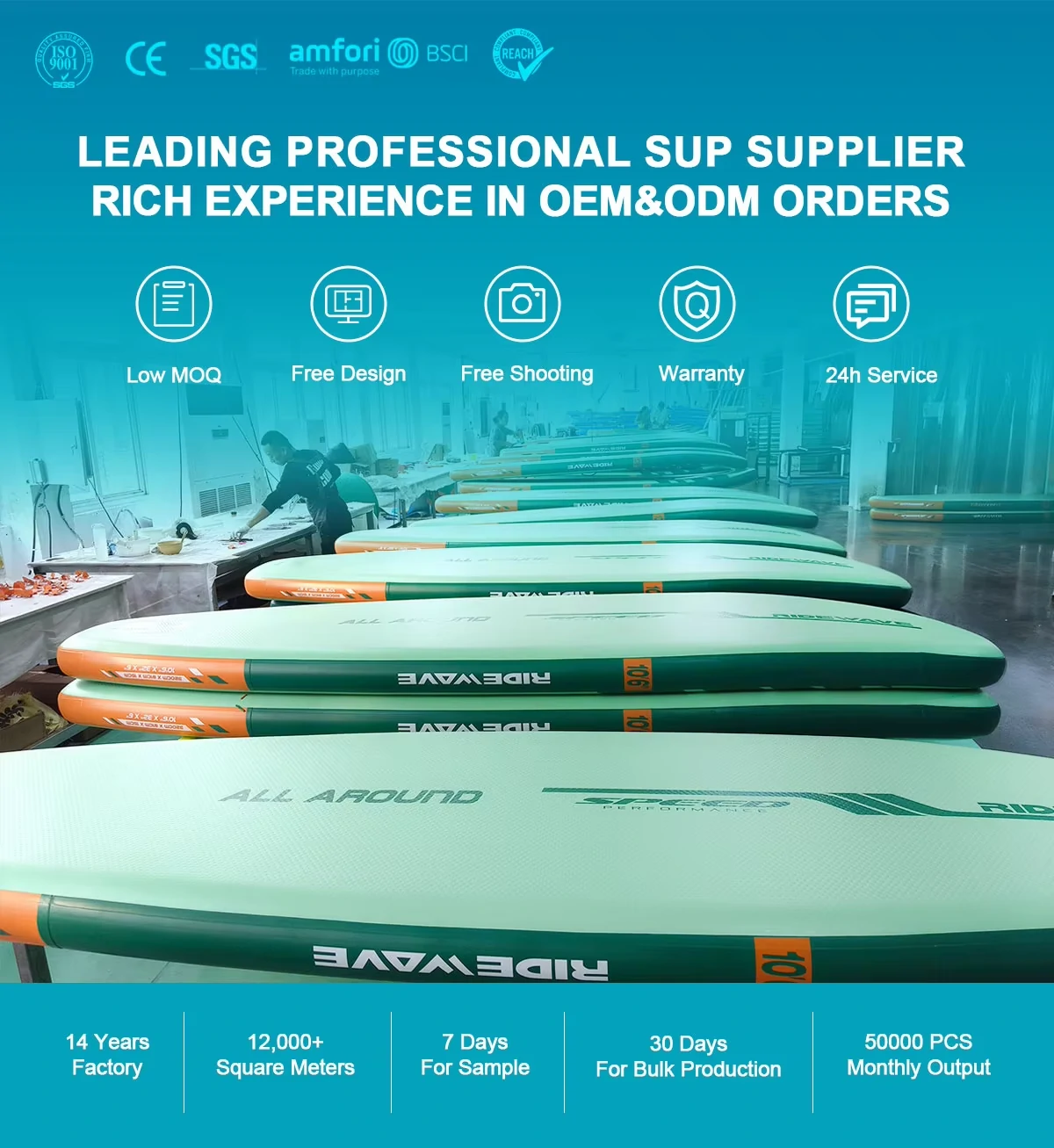
- Strict quality control at every stage with CE, SGS, and BSCI certification.
For ODM partners:
- Ready-to-market paddle board collections with proven designs.
- Flexible customization of logo, colors, and accessories.
- Low MOQ options for testing new markets.
- End-to-end support: sampling, production, inspection, and global delivery.
With over 15 years of manufacturing experience and a commitment to innovation, Ridewave ensures that whether you choose OEM or ODM, your products meet world-class standards and reflect your brand's unique vision.

Case Study: From ODM to OEM - A Brand's Growth Story
A North American startup began working with Ridewave through an ODM partnership. They selected an existing all-around SUP model, added their branding, and launched in their local market. Within a year, their sales doubled, and they gathered valuable customer feedback on design preferences.
With this insight, they transitioned to an OEM project, developing a unique touring board shape with reinforced rails, dual bungee storage, and custom packaging. Today, their boards are sold across multiple countries, and they've become one of the leading independent SUP brands in their region.
This story reflects a common growth path: starting simple with ODM, then evolving into OEM as your market position strengthens.
Conclusion: Building Your Brand with the Right Manufacturing Partner
Choosing between OEM and ODM is not just a production choice-it's a business strategy that determines how your brand will evolve.
If you value creativity, exclusivity, and complete design control, OEM is your path.
If you prioritize efficiency, lower risk, and fast entry, ODM provides a strong foundation.
No matter which model you choose, the most important factor is finding a trusted manufacturing partner who understands your goals, communicates transparently, and supports your growth every step of the way.
At Ridewave, we take pride in being that partner-combining technical expertise, global quality standards, and a deep understanding of the SUP industry.
Whether you're building a new paddle board brand or expanding your existing product line, Ridewave offers the flexibility, craftsmanship, and experience to bring your ideas to life.
Contact Ridewave today to discuss your OEM or ODM inflatable paddle board project - and let's create products that carry your brand confidently across the water.